Synonyms for Singing: 25 Better Words for Different Contexts
Looking for synonyms for singing can be surprisingly tricky because not every word associated with singing means exactly the same thing. Singing generally refers to making musical sounds with the voice, usually following a tune and often using words.
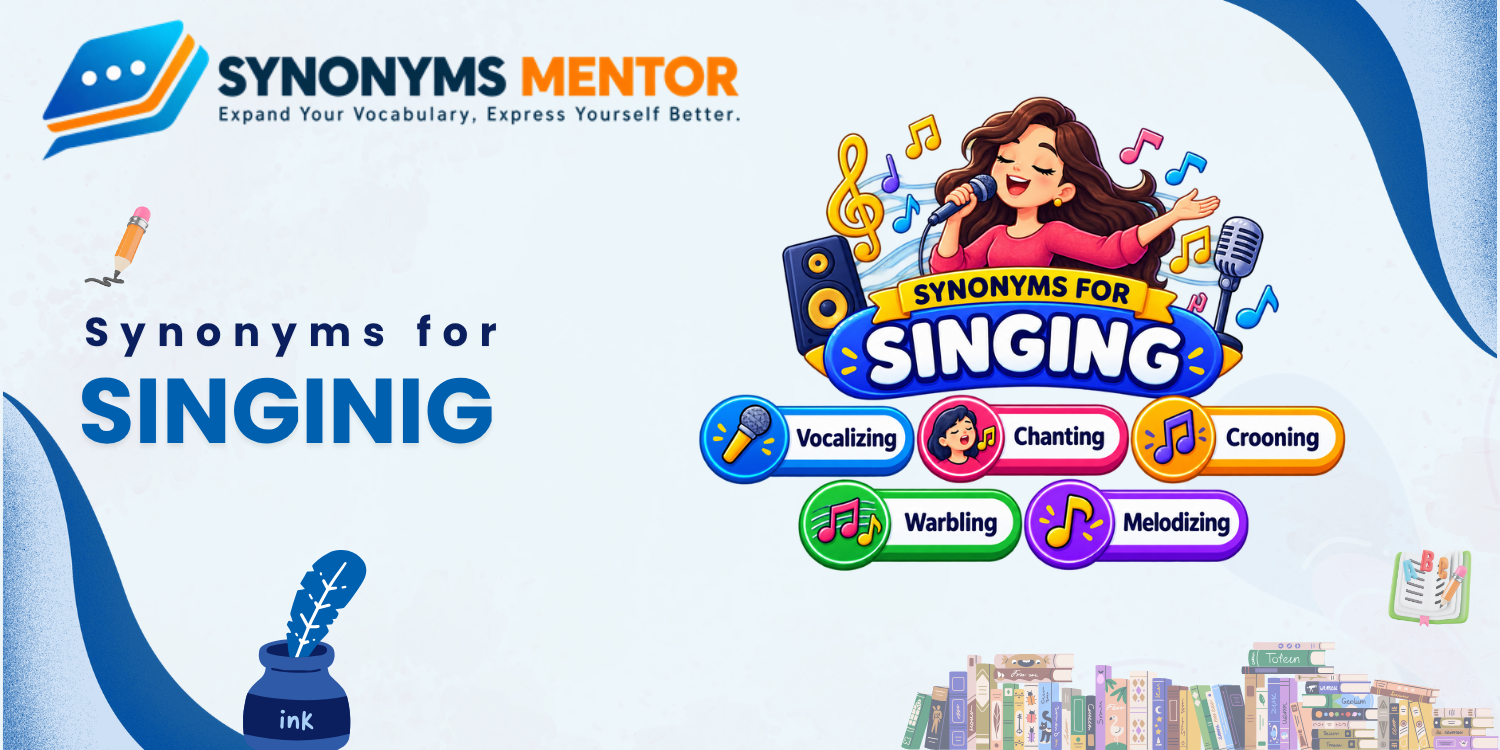
Depending on the context, however, you might want a word that emphasizes a particular vocal style, such as crooning, a repeated or rhythmic vocal delivery such as chanting, or the production of vocal sounds more generally, such as vocalizing.
Other words, including warbling, trilling, yodeling, and caroling, describe more specific forms of vocal performance.
The best synonym therefore depends on what kind of singing you are describing.
Quick Answer
The closest alternatives to singing include vocalizing, chanting, crooning, caroling, warbling, humming, and intoning. However, these are not interchangeable in every sentence.
Vocalizing is broad and technical, chanting suggests rhythmic or repeated vocal delivery, crooning describes a soft or intimate style, and warbling often emphasizes a wavering or ornamental voice.
The Best Synonyms for Singing at a Glance
| Word | Relationship | Meaning | Strength | Formality | Best Context |
|---|---|---|---|---|---|
| Vocalizing | Near synonym | Producing sounds with the voice | Similar | Neutral/Formal | Vocal practice, technical writing |
| Chanting | Near synonym | Singing or reciting rhythmically | Similar | Neutral | Religious, ceremonial, group settings |
| Crooning | Contextual alternative | Singing softly and smoothly | Similar | Neutral | Ballads, intimate performances |
| Caroling | Contextual alternative | Singing traditional songs, especially seasonal ones | Similar | Neutral | Christmas or group singing |
| Warbling | Contextual alternative | Singing with a wavering or ornamented voice | Similar | Literary/Neutral | Describing vocal style or birds |
| Humming | Near synonym | Making a tune with closed or partly closed lips | Weaker | Neutral | Casual or quiet singing |
| Intoning | Contextual alternative | Delivering words in a particular musical pitch | Similar | Formal | Religious, ceremonial speech |
| Trilling | Contextual alternative | Producing rapid, repeated musical notes | More specific | Literary/Technical | Vocal technique, birds |
| Yodeling | Contextual alternative | Singing with rapid changes between vocal registers | More specific | Neutral | Folk and Alpine-style singing |
| Belting | Contextual alternative | Singing loudly and powerfully | More specific | Informal/Professional | Musical theater, pop |
| Harmonizing | Contextual alternative | Singing complementary notes with another voice | More specific | Neutral | Duets, choirs, groups |
| Scatting | Contextual alternative | Improvising vocal sounds in jazz | More specific | Musical/Informal | Jazz |
| Descanting | Contextual alternative | Singing an additional or higher melody | More specific | Formal/Musical | Choral music |
| Piping | Contextual alternative | Singing or producing a high, clear sound | More specific | Literary | Descriptive writing |
| Carol singing | Contextual alternative | Singing traditional carols | More specific | Neutral | Seasonal or religious contexts |
What Does “Singing” Mean?
Singing is the activity of producing musical sounds with the voice, normally following a tune and often using words. Cambridge classifies singing as a noun and gives examples such as singing voice, singing lesson, and choral singing.
The related verb sing means to make musical sounds with the voice. It can be used both transitively and intransitively:
- She sings beautifully.
- The choir sang a traditional hymn.
- They were singing together.
Because singing has several possible contexts, its alternatives should be chosen according to the precise action or vocal quality being described.
Direct and Near Synonyms for Singing
1. Vocalizing
Meaning: Producing sounds with the voice.
How it differs: Vocalizing is broader than singing. It can refer to making vocal sounds without necessarily performing a song or melody.
Best contexts: Vocal exercises, music education, speech and voice training, technical writing.
Example:
The singers spent several minutes vocalizing before the performance.
Best choice when: You want a neutral or technical term for producing vocal sounds.
2. Chanting
Meaning: Repeating or delivering words or sounds rhythmically, often on a limited range of notes.
How it differs: Chanting can overlap with singing, but it usually emphasizes repetition, rhythm, or a ceremonial/group setting.
Example:
The choir was chanting a traditional prayer.
Best contexts: Religious ceremonies, protests, sports crowds, rituals, and repeated vocal phrases.
Collins lists chant among the alternatives associated with singing and gives religious examples involving monks chanting and praying.
3. Crooning
Meaning: Singing in a soft, smooth, often intimate style.
How it differs: Unlike the neutral singing, crooning describes how someone sings.
Example:
The performer was crooning a slow jazz ballad.
Best contexts: Jazz, romantic songs, ballads, and descriptions of soft vocal performances.
4. Humming
Meaning: Making a musical sound without clearly singing the words.
How it differs: Humming is related to singing but is not always singing in the ordinary sense because the melody is produced without fully voiced lyrics.
Example:
She was humming a familiar melody while she worked.
Best contexts: Quiet, casual, absent-minded, or wordless music-making.
5. Intoning
Meaning: Saying or singing words with a particular musical pitch or vocal pattern.
How it differs: Intoning often emphasizes the delivery of words rather than a complete musical performance.
Example:
The priest was intoning the final lines of the prayer.
Best contexts: Religious ceremonies, formal readings, and ritual language.
Contextual Alternatives for Singing
Some words are useful only when you want to describe a particular kind of singing.
6. Warbling
Meaning: Singing with a rapidly changing, wavering, or ornamented voice.
Example:
She heard a bird warbling in the garden.
The word can also describe human singing, especially when the voice has noticeable movement between notes.
Best for: Descriptive or literary writing.
7. Trilling
Meaning: Producing a rapid series of musical notes.
Example:
The vocalist added a short trill to the final note.
Best for: Vocal technique, ornamental singing, and descriptions of birds.
Trill is therefore more specific than the general word singing.
8. Yodeling
Meaning: A style of singing involving rapid changes between different vocal registers.
Example:
The performer entertained the crowd with traditional yodeling.
Best for: Folk music and specific vocal techniques.
It should not normally replace singing when you mean ordinary vocal performance.
9. Caroling
Meaning: Singing carols, especially traditional songs associated with Christmas.
Example:
The children went caroling around the neighborhood.
Best for: Christmas and seasonal singing.
10. Belting
Meaning: Singing with a strong, powerful voice, often at a high volume.
Example:
The singer was belting out the final chorus.
Best for: Musical theater, pop, rock, and powerful vocal performances.
It is more precise than singing because it describes a particular vocal technique or delivery.
11. Harmonizing
Meaning: Singing notes that complement another melody or vocal part.
Example:
The two singers were harmonizing beautifully.
Best for: Duets, choirs, backing vocals, and group performances.
12. Scatting
Meaning: Improvising with non-lexical vocal sounds, especially in jazz.
Example:
The jazz vocalist began scatting during the instrumental section.
Best for: Jazz and improvisational vocal music.
13. Descanting
Meaning: Singing an additional melody, traditionally one that accompanies a main melody.
Example:
The soprano was descanting above the main choral melody.
Best for: Choral and formal musical contexts.
14. Piping
Meaning: Producing or singing with a high, clear sound.
Example:
The children were piping cheerful songs across the courtyard.
Best for: Literary or descriptive writing.
Which Word Should I Use?
The easiest way to choose is to focus on what you want the reader to notice.
Choose “vocalizing” when:
You mean producing sounds with the voice generally, especially in a technical or training context.
The singer was vocalizing before the concert.
Choose “chanting” when:
The singing is rhythmic, repetitive, ceremonial, or group-based.
The crowd was chanting the team’s name.
Choose “crooning” when:
The voice is soft, smooth, and intimate.
He was crooning an old jazz standard.
Choose “humming” when:
Someone is producing a melody without clearly singing the words.
She was humming while preparing dinner.
Choose “warbling” when:
You want to emphasize a wavering, ornamented, or highly expressive vocal quality.
The singer was warbling through the difficult passage.
Choose “belting” when:
The singer is using a powerful, forceful vocal style.
She was belting out the chorus.
Choose “harmonizing” when:
Two or more singers are combining different notes that work together musically.
The brothers were harmonizing on the chorus.
Choose “caroling” when:
The singing consists of traditional carols, particularly during Christmas.
Neighbors gathered for caroling.
Synonyms for Singing by Context
For quiet singing
Use:
- humming
- crooning
- softly singing
Humming is especially appropriate when there are no clearly articulated lyrics.
For loud or powerful singing
Use:
- belting
- bellowing — only when the voice is extremely loud or forceful
- singing out
These are not equal in tone. Belting can be a positive description of vocal technique, while bellowing may suggest excessive loudness.
For group singing
Use:
- chanting
- caroling
- chorusing
- harmonizing
The right choice depends on what the group is doing. Harmonizing specifically means combining complementary vocal parts.
For religious singing
Use:
- chanting
- intoning
- caroling
- singing hymns
Chanting and intoning can be more appropriate than singing when the delivery is ceremonial or closely tied to spoken text.
For beautiful or expressive singing
Use descriptive phrases such as:
- melodious singing
- melodic singing
- beautiful vocalizing
- graceful warbling
- expressive singing
Here, words such as melodious describe the quality of the singing rather than serving as direct substitutes for the activity itself. Cambridge’s thesaurus groups words such as melodious, musical, tuneful, melodic, and mellifluous under an adjective sense related to singing.
Singing vs. Chanting
Singing is the broader term. It can involve melodies, lyrics, complex vocal techniques, solo performances, or group performances.
Chanting usually has a stronger association with repetition, rhythm, recitation, or ceremonial/group vocalization.
Compare:
The singer was singing a beautiful melody.
The crowd was chanting the same phrase repeatedly.
Both involve the voice, but chanting highlights repetition or rhythmic delivery.
Singing vs. Vocalizing
Singing normally implies musical performance, often involving a recognizable melody.
Vocalizing is broader. It can describe exercises or the production of vocal sounds without lyrics or a complete song.
Compare:
She was singing a song.
She was vocalizing to warm up her voice.
Calling the second activity singing would not necessarily be wrong, but vocalizing is more precise.
Singing vs. Humming
Humming involves producing a tune with the mouth generally closed, so words are not clearly articulated.
He was humming a familiar tune.
You would usually not use humming to describe a full vocal performance in which the singer clearly sings lyrics.
Singing vs. Crooning
Crooning is a type of singing rather than a complete synonym for all singing.
It typically suggests a soft, smooth, intimate vocal style.
She was singing a ballad.
is neutral, while:
She was crooning a ballad.
gives the reader information about the vocal style.
Common Mistakes When Choosing a Synonym for Singing
Treating every related musical word as a synonym
Words such as melody, tune, song, voice, harmony, and singer are related to singing but do not mean the same thing.
For example, harmony is a musical concept, while singer is a person who sings.
Using “chanting” for every type of singing
Chanting has specific associations with repetition, rhythm, ceremony, or group vocalization. It is not always a natural replacement for ordinary singing.
Using “vocalizing” when you mean performing a song
Vocalizing can be much broader than singing. It works especially well for vocal exercises and technical descriptions.
Using “warbling” as a neutral replacement
Warbling carries a stylistic meaning. It can suggest a wavering, ornamented, or sometimes overly affected vocal quality.
Confusing “singing” with “humming”
Humming generally does not involve clearly articulated lyrics, so it is a narrower form of musical vocalization.
Words Related to Singing but Not True Synonyms
These words are useful for building vocabulary around the topic, but they should not be presented as direct synonyms:
- song — a piece of music intended to be sung
- singer — a person who sings
- voice — the sound produced by a person’s vocal organs
- melody — a sequence of musical notes forming a recognizable musical line
- harmony — the combination or relationship of musical notes
- chorus — a group of singers or a repeated section of a song
- vocalist — a singer, especially in a professional or musical context
- performance — the act of presenting music or another form of entertainment
This distinction matters because a high-quality synonym resource should not turn every word associated with singing into a replacement for singing.
Antonyms of Singing
There is no single perfect antonym for singing, because the opposite depends on what aspect you mean.
Possible contrasts include:
- silence — no sound
- speaking — using ordinary spoken language rather than singing
- quietness — a lack of noticeable sound
For example, the contrast between singing and speaking concerns vocal mode, while silence represents the absence of vocal sound altogether.
FAQ
What is another word for singing?
Common alternatives include vocalizing, chanting, crooning, humming, caroling, warbling, and intoning. The best choice depends on context. Vocalizing is broad, chanting emphasizes rhythmic or repetitive delivery, crooning suggests soft singing, and humming usually means producing a tune without clearly singing the words.
What is a synonym for singing beautifully?
There is no single exact synonym for singing beautifully. Depending on the intended meaning, you could say singing melodiously, singing tunefully, or singing harmoniously. Melodious and tuneful describe pleasing musical quality rather than replacing singing itself.
What is a formal word for singing?
Vocalizing can work in technical or formal discussions of voice production. Intoning is also appropriate in formal, ceremonial, or religious contexts when the emphasis is on delivering words with a particular musical pitch.
Is chanting the same as singing?
Not exactly. Chanting is a form of vocal musical or rhythmic delivery, but it often involves repetition, a limited melodic range, ceremony, or group participation. Singing is the broader term and covers many styles of vocal performance.
What is another word for singing softly?
Crooning can describe soft, smooth singing, particularly in an intimate or expressive style. Humming is another possibility when the person is producing a melody without clearly articulating the lyrics.
What is another word for singing loudly?
Belting is appropriate when describing a powerful singing technique. Bellowing can describe very loud singing but often carries a rough or excessive connotation, so it is not always complimentary.
What is another word for singing in a group?
The best word depends on the activity. Chanting works for rhythmic group vocalization, caroling works for groups singing carols, and harmonizing specifically describes singers combining complementary vocal parts.
What is the difference between singing and vocalizing?
Singing generally involves making musical sounds with the voice, often following a tune and using words. Vocalizing is broader and can simply mean producing vocal sounds, including exercises used to warm up or develop the voice.
Conclusion
The best synonym for singing depends on the exact vocal activity you want to describe. Vocalizing is a broad and useful alternative in technical contexts, while chanting emphasizes rhythmic or repetitive delivery. Crooning suggests soft, smooth singing; humming usually means producing a melody without clearly singing lyrics; and belting describes powerful vocal performance.

David Wilson is a content strategist and SEO expert who focuses on creating structured vocabulary content. He combines keyword research with simple explanations to make learning English both effective and search-friendly.