Synonyms of Reasoning: 15 Better Alternatives With Examples
Finding the right synonym for reasoning can be surprisingly difficult because the word covers more than simply “thinking.” It can refer to the process of using facts and evidence to reach a conclusion, the logic behind a decision, or the arguments supporting a position.
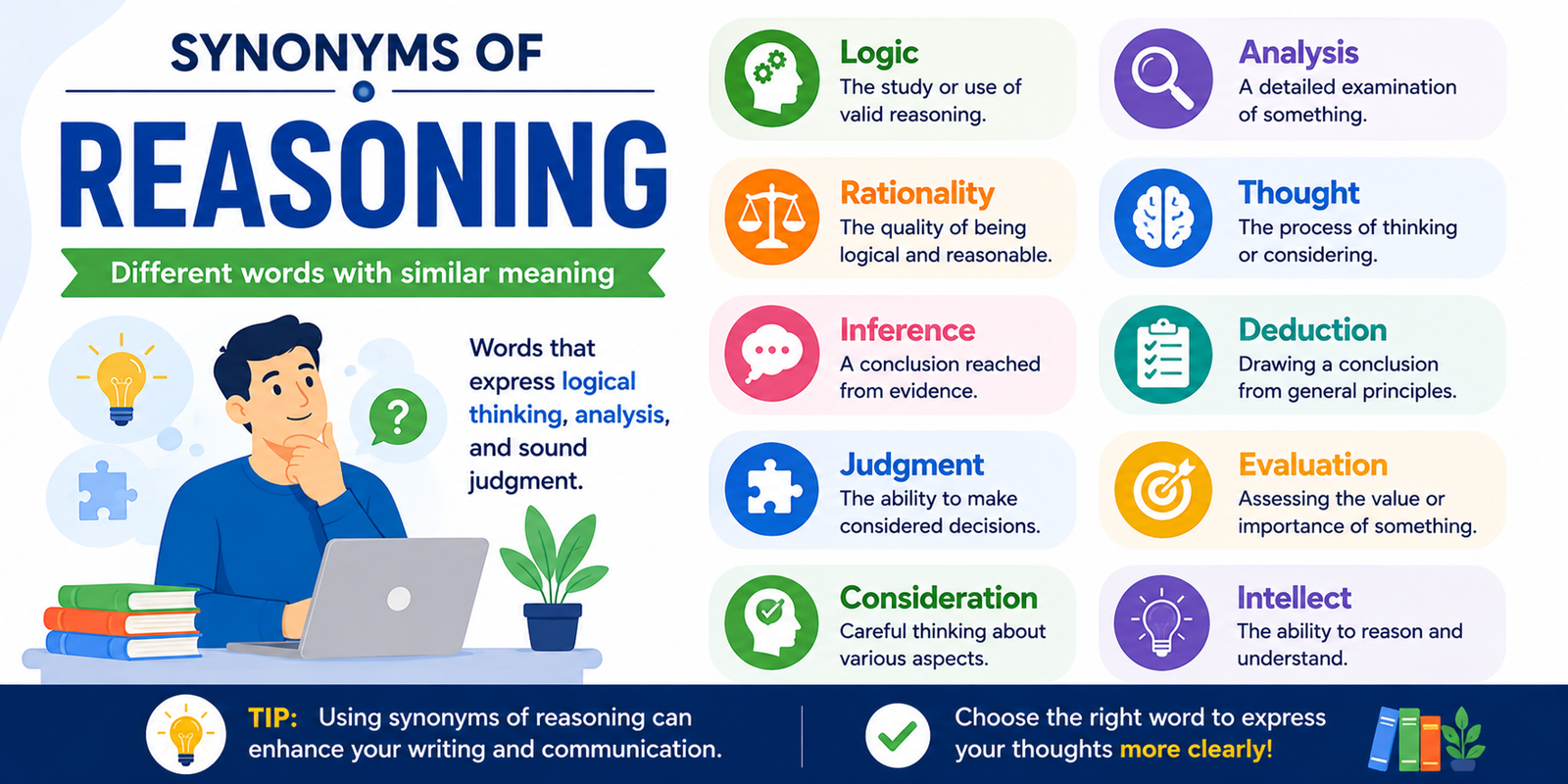
That means words such as logic, analysis, inference, deduction, rationale, argument, and thinking overlap with reasoning, but they are not interchangeable in every sentence. Choosing the right alternative depends on what aspect of reasoning you want to emphasize.
Quick Answer
Some of the closest synonyms of reasoning are logic, thinking, analysis, inference, deduction, rationale, argument, and thought. However, each has a slightly different use. Logic emphasizes sound relationships between ideas, analysis emphasizes examining information, inference emphasizes a conclusion drawn from evidence, and rationale emphasizes the reasons behind a decision.
Core Synonyms of Reasoning
| Word | Relationship | Meaning | Formality | Best Context |
|---|---|---|---|---|
| Logic | Direct/near synonym | Sound principles connecting ideas or conclusions | Neutral–formal | Arguments, decisions, problem-solving |
| Thinking | Near synonym | The general process of using the mind | Neutral | Everyday and general contexts |
| Analysis | Near synonym | Detailed examination of information | Neutral–formal | Research, data, problems |
| Thought | Near synonym | Mental consideration or reflection | Neutral | Decisions, opinions, personal reflection |
| Inference | Contextual alternative | A conclusion drawn from evidence | Formal | Evidence, research, interpretation |
| Deduction | Contextual alternative | Reaching a conclusion from established premises | Formal | Logic, mathematics, investigation |
| Rationale | Contextual alternative | The reasons supporting a decision or action | Formal | Business, policy, decisions |
| Argument | Contextual alternative | A set of reasons supporting a position | Neutral–formal | Essays, debates, discussions |
| Deliberation | Contextual alternative | Careful consideration before deciding | Formal | Decisions, policy, judgment |
| Reflection | Contextual alternative | Careful consideration of an experience or idea | Neutral–formal | Personal or academic writing |
| Judgment | Related/near synonym | An opinion or decision reached through consideration | Neutral–formal | Decisions, assessments |
| Interpretation | Contextual alternative | An explanation of the meaning of information | Neutral–formal | Texts, evidence, events |
| Consideration | Near synonym | Careful thought about something | Neutral | Choices and decisions |
| Cogitation | Rare synonym | Deep or prolonged thinking | Formal/literary | Formal or literary writing |
| Ratiocination | Rare synonym | Formal, systematic reasoning | Very formal | Academic or philosophical writing |
Major dictionaries group several of these terms with reasoning, while also distinguishing different senses such as thinking, argument, deduction, and logic.
What Does “Reasoning” Mean?
Reasoning is the process of using thought, facts, evidence, or principles to reach a conclusion, make a judgment, or support an idea. It can describe both the mental process and the reasons or argument produced by that process.
Examples
- Her reasoning was based on reliable evidence.
- I understand your reasoning, but I disagree with your conclusion.
- The lawyer explained the reasoning behind the argument.
This distinction is important because different synonyms emphasize different parts of the process.
The Most Useful Synonyms of Reasoning
1. Logic
Meaning: A structured way of connecting ideas, evidence, and conclusions.
How it differs: Logic focuses more on whether the relationships between ideas make sense, whereas reasoning can describe the broader process of arriving at a conclusion.
Best context: Arguments, problem-solving, mathematics, business decisions.
Example:
The proposal is supported by sound logic.
Use logic when you want to emphasize that an argument or decision makes sense.
2. Thinking
Meaning: The general mental process of considering ideas or information.
How it differs: Thinking is broader and less specific than reasoning. Not all thinking is necessarily logical or aimed at reaching a conclusion.
Example:
Her thinking changed after she reviewed the new evidence.
Best for: Everyday English and general descriptions of mental processes.
3. Analysis
Meaning: Detailed examination of information, ideas, or a problem.
How it differs: Analysis focuses on breaking something down and examining its parts. Reasoning can include analysis but also covers the process of drawing conclusions.
Example:
His analysis of the problem revealed several weaknesses.
Use analysis for research, reports, data, literature, business, and complex problems.
4. Thought
Meaning: The act or process of considering something mentally.
How it differs: Thought can be broader and more reflective than reasoning.
Example:
After careful thought, she accepted the proposal.
Best for: Decisions, reflection, and general mental consideration.
5. Inference
Meaning: A conclusion reached from evidence or information rather than directly stated facts.
How it differs: An inference is usually the conclusion produced by reasoning, rather than the entire reasoning process.
Example:
The researchers made an inference from the available data.
Use inference when the emphasis is on what someone concludes from evidence.
6. Deduction
Meaning: A conclusion reached through logical reasoning from premises or established information.
How it differs: Deduction is more specific than reasoning. It describes a particular type of logical conclusion.
Example:
Her deduction was based on two independently verified facts.
Use deduction in logic, mathematics, science, and analytical contexts.
7. Rationale
Meaning: The underlying reasons or explanation supporting a decision, action, or policy.
How it differs: Rationale usually refers to the reasoning behind something, rather than the thinking process itself.
Example:
The manager explained the rationale behind the new policy.
This is especially useful when replacing the phrase “reasoning behind a decision.”
8. Argument
Meaning: A set of reasons and evidence used to support a position or conclusion.
How it differs: An argument is an expressed product of reasoning. Reasoning is the process used to develop it.
Example:
The essay presents a convincing argument for reform.
Use argument for essays, debates, persuasive writing, and discussions.
9. Deliberation
Meaning: Careful consideration of different possibilities before making a decision.
How it differs: Deliberation emphasizes the careful decision-making process, rather than logical reasoning generally.
Example:
After considerable deliberation, the committee approved the proposal.
It is particularly useful in formal and professional contexts.
10. Reflection
Meaning: Careful consideration of an idea, experience, or situation.
How it differs: Reflection can be more personal and introspective than reasoning.
Example:
Her reflection on the experience changed her perspective.
Use it when the emphasis is thoughtful consideration rather than formal logic.
Which Word Should You Use?
The easiest way to choose is to identify what you want to emphasize:
- Use “logic” when emphasizing sound connections between ideas.
- Use “thinking” when referring broadly to mental activity.
- Use “analysis” when information is being examined in detail.
- Use “inference” when emphasizing a conclusion drawn from evidence.
- Use “deduction” when describing a specific logical method of reaching a conclusion.
- Use “rationale” when explaining the reasons behind a decision.
- Use “argument” when reasoning has been expressed as a case supporting a position.
- Use “deliberation” when emphasizing careful decision-making.
- Use “reflection” when emphasizing thoughtful or personal consideration.
This contextual distinction is more useful than simply choosing the word that appears highest on a thesaurus page.
Reasoning vs. Logic
Reasoning is the broader concept. Logic concerns the principles or structure that make reasoning coherent and valid.
Compare:
Her reasoning led her to reject the proposal.
This describes her overall process of reaching the conclusion.
Her argument followed a clear logic.
This emphasizes the structure connecting the ideas.
So, logic can be part of reasoning, but the two words are not always interchangeable.
Reasoning vs. Analysis
Analysis involves examining something carefully, often by breaking it into components. Reasoning can use that analysis to reach a conclusion.
The analysis identified a significant pattern.
The reasoning behind the conclusion depended on that pattern.
A useful rule is:
Analysis examines; reasoning connects and concludes.
Reasoning vs. Inference
An inference is a conclusion drawn from available evidence. Reasoning is the broader process that can lead to that inference.
For example:
Evidence: The roads are wet.
Inference: It probably rained.
Reasoning: The process of connecting the wet roads with the possibility of recent rain.
Therefore, inference is usually better when you mean the conclusion itself.
Reasoning vs. Rationale
These words are especially easy to confuse.
Reasoning can describe the process of thinking through an issue.
Rationale describes the reasons supporting a decision or action.
Compare:
I don’t understand your reasoning.
I don’t understand the rationale behind the decision.
The first focuses on someone’s thought process. The second focuses on the justification for the decision.
Reasoning vs. Argument
An argument is an expressed set of reasons supporting a position. Reasoning is the process used to arrive at or construct those reasons.
For example:
Her reasoning was based on several assumptions.
Her argument was supported by three pieces of evidence.
An argument can therefore be the result or expression of reasoning.
Common Collocations With “Reasoning”
Some common phrases help reveal exactly what reasoning means in context:
Reasoning behind
Used when explaining why someone made a decision.
The report explains the reasoning behind the recommendation.
Sound reasoning
Used for reasoning that is logically strong or sensible.
The conclusion was based on sound reasoning.
Logical reasoning
Used for systematic thought based on logical principles.
The test measures logical reasoning skills.
Faulty reasoning
Used when the reasoning contains a logical error or unsupported conclusion.
The argument depends on faulty reasoning.
Line of reasoning
Used for a sequence or progression of ideas leading toward a conclusion.
I followed her line of reasoning, even though I disagreed with the final conclusion.
Reasoning process
Used when focusing on how someone thinks through a problem.
The teacher asked students to explain their reasoning process.
Common Mistakes
Mistake 1: Treating every related word as an exact synonym
Words such as thinking, analysis, deduction, inference, and argument overlap with reasoning, but they emphasize different things.
Mistake 2: Using “rationale” to mean any kind of thinking
Rationale normally refers to the reasons or justification behind an action, decision, or policy.
Mistake 3: Using “deduction” for every conclusion
Deduction is a specific form of reasoning. A conclusion reached through observation or evidence is not automatically a deduction.
Mistake 4: Assuming “logic” and “reasoning” always mean the same thing
Logic emphasizes valid or coherent relationships between ideas. Reasoning is the broader process of reaching conclusions.
Mistake 5: Using rare words when a common word is clearer
Words such as cogitation and ratiocination are legitimate vocabulary, but they are uncommon. In most modern writing, reasoning, thinking, analysis, or logic will sound more natural.
Antonyms of Reasoning
There is no single perfect antonym for every sense of reasoning. Depending on context, useful contrasts include:
- irrationality
- unreason
- impulsiveness
- guesswork
- confusion
These are not all direct grammatical opposites. They represent different ways of contrasting deliberate, rational thought with unsupported or non-rational decision-making.
FAQ
What is the best synonym for reasoning?
There is no single best synonym for every context. Logic is a strong choice when emphasizing sound thought, analysis when examining information, inference when focusing on a conclusion from evidence, and rationale when referring to the reasons behind a decision.
What is another word for reasoning in an essay?
Depending on the sentence, argument, logic, analysis, rationale, or line of reasoning may work. For example, an essay may present an argument, examine evidence through analysis, or explain the rationale behind a conclusion.
Is “logic” a synonym for reasoning?
Yes, logic can overlap with reasoning, and major thesauruses list it as a synonym. However, logic emphasizes the principles and relationships that make an argument coherent, while reasoning is broader.
What is a formal synonym for reasoning?
Ratiocination and cogitation are formal or literary alternatives, while analysis, inference, deduction, rationale, and deliberation are more practical formal choices depending on context.
What is a synonym for “reasoning behind a decision”?
The most natural alternatives are rationale, justification, or basis, depending on the sentence. Rationale is especially useful when referring to the reasons supporting a decision or policy.
What is the difference between reasoning and thinking?
Thinking is broader and can include imagination, memory, reflection, and other mental activity. Reasoning specifically involves using thought to reach conclusions, make judgments, or connect facts and ideas.
Is “argument” a synonym for reasoning?
It can be a contextual synonym, particularly when reasoning means the reasons or conclusions presented in support of a position. However, an argument is generally an expression or product of reasoning, not the entire mental process.
Conclusion
The best synonym for reasoning depends on which part of the concept you want to emphasize. Choose logic for sound connections between ideas, analysis for detailed examination, inference for conclusions drawn from evidence, deduction for a specific logical method, rationale for the reasons behind a decision, and argument for an expressed case supporting a position.

James Anderson is an English teacher and language researcher who creates easy synonym guides and vocabulary lessons. His goal is to help students and writers improve their language skills through simple and clear explanations.