I Am Synonyms: 25 Natural Alternatives for Writing and Speaking
If you are searching for “I am synonyms,” there is one important distinction to understand first: “I am” does not have one universal synonym. Instead, it is the first-person singular form of the verb be, and its meaning changes depending on what follows it. For example, “I am a designer,” “I am tired,” and “I am working” express different ideas, so each sentence may require a different alternative.
Therefore, rather than replacing “I am” mechanically, choose a phrase that preserves the original meaning while fitting the context naturally. This guide explains natural alternatives for essays, resumes, professional communication, and everyday English.
Quick Answer: What Are Synonyms for “I Am”?
The closest grammatical alternative to “I am” is its contraction, “I’m.” However, if you want to avoid the phrase entirely, the best alternative depends on the sentence. For example, “I work as” can replace “I am” when describing a profession, “I feel” can sometimes replace it when describing an emotion or physical state, and “I consider myself” can work when describing how you view yourself. These are contextual alternatives, not universal synonyms.
Is “I Am” a Word or a Phrase?
“I am” is a two-word verb phrase.
- I is the first-person singular subject pronoun.
- am is the first-person singular present form of the verb be.
The verb be can describe qualities, states, identity, professions, age, relationships, location, and other situations.
For example:
I am a student, tired, confident, a designer, at home, & working
Because these sentences have different meanings, you cannot replace “I am” with one alternative in all of them.
This is the most important point to understand when looking for I am synonyms.
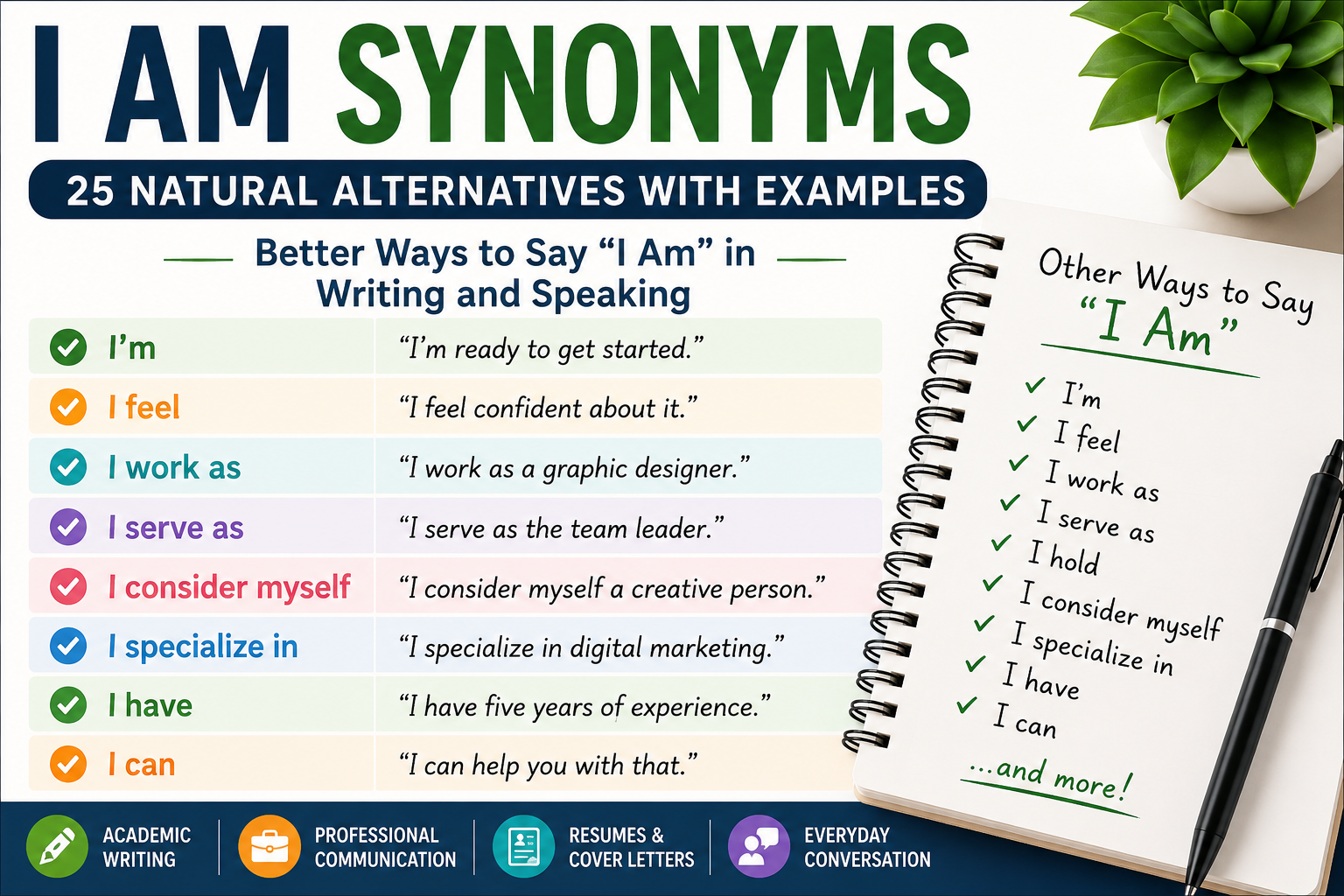
Alternatives to “I Am”
These alternatives are grouped by meaning rather than presented as a random thesaurus list. They cannot all replace “I am” in the same sentence.
| Alternative | Best Use | Example |
|---|---|---|
| I’m | Direct contraction | I’m ready. |
| I feel | Feelings or sensations | I feel confident. |
| I work as | Profession | I work as a designer. |
| I serve as | Role or position | I serve as team leader. |
| I hold | Position or qualification | I hold a senior position. |
| I consider myself | Self-description | I consider myself reliable. |
| I see myself as | Self-perception | I see myself as a problem-solver. |
| I describe myself as | Personal description | I describe myself as creative. |
| I identify as | Identity | I identify as a writer. |
| I specialize in | Professional expertise | I specialize in UI design. |
| My role is | Job or responsibility | My role is project coordinator. |
| I have | Skills or experience | I have five years of experience. |
| I possess | Skills or qualities | I possess strong analytical skills. |
| I bring | Experience or value | I bring extensive design experience. |
| I offer | Skills or services | I offer branding expertise. |
| I can | Ability | I can manage complex projects. |
| I demonstrate | Evidence of a quality | I demonstrate strong leadership. |
| I remain | Continuing state | I remain committed to the project. |
| I appear | Appearance or impression | I appear confident. |
| I seem | Impression or uncertainty | I seem ready. |
| I have become | Change over time | I have become more confident. |
The best alternative depends on what you want to express: identity, profession, ability, experience, feelings, or a continuing state.
1. “I’m” — The Direct Alternative
I’m is simply the contraction of I am.
I am ready.
I’m ready.
The meaning is the same.
It is extremely common in everyday speech and writing. You do not need to avoid I’m simply because you are writing professionally.
However, using the full I am can be useful when you want to place emphasis on am or when a more deliberate style is appropriate.
Best use
Use I’m when you simply want the normal contracted form of I am.
2. “I Feel” — For Feelings and States
When I am is followed by an adjective describing an emotion or sensation, I feel can sometimes provide a natural alternative.
I am confident about the decision.
Feeling confident, I believe the decision is the right one.
I am nervous about the interview.
The upcoming interview makes me feel nervous.
The meanings overlap, but they are not identical.
I am confident presents confidence as your current state.
I feel confident emphasizes your subjective experience of that state.
Best use
Use I feel when you specifically want to emphasize an emotion, sensation, or personal perception.
3. “I Work As” — For Your Profession
Instead of:
I am a graphic designer.
you can write:
I work as a graphic designer.
This is particularly useful in professional profiles and introductions.
However, I work as emphasizes employment or professional activity, while I am simply identifies your profession.
Best use
Use I work as when talking about what you do professionally.
4. “I Serve As” — For Roles and Positions
For example, instead of saying, “I am the project manager,” you can write:
I serve as the project manager.
I serve as the project manager.
The second sentence emphasizes the role being performed.
It is particularly natural in professional, organizational, institutional, and formal contexts.
Best use
Use I serve as for official or defined responsibilities.
5. “I Hold” — For Positions and Qualifications
I hold works especially well with nouns such as:
- position
- degree
- certification
- qualification
- title
Examples:
I hold a senior management position.
I hold a bachelor’s degree in computer science.
You generally cannot replace every use of I am with I hold. It works when the sentence involves something you possess or occupy.
6. “I Consider Myself” — For Self-Description
If you want to describe your own qualities, I consider myself can be useful.
I am a creative problem-solver.
I consider myself a creative problem-solver.
The second version expresses a degree of personal judgment or self-assessment.
It can sound slightly more cautious than directly saying I am.
Best use
Use it when you are describing how you view yourself rather than stating an objective fact.
7. “I See Myself As” — For Self-Perception
“I see myself as” is similar to “I consider myself,” but it can emphasize personal perspective, identity, or future direction.
For example:
I see myself as a lifelong learner.
When describing a personal strength, you could say:
As someone who enjoys solving difficult problems, I see myself as a creative thinker.
This expression works naturally in interviews, personal statements, essays, and reflective writing.
8. “I Describe Myself As” — For Personal Descriptions
This phrase explicitly introduces a description of yourself.
I am detail-oriented and reliable.
I describe myself as detail-oriented and reliable.
The second version can be useful when answering an interview question such as:
How would you describe yourself?
It is less direct than simply saying I am, but sometimes that is exactly what you want.
9. “I Identify As” — For Identity
I identify as has a specific meaning and should not be treated as a universal synonym for I am.
It is appropriate when discussing how someone identifies themselves within a particular identity or category.
I identify as a writer.
This does not necessarily mean exactly the same thing as:
I am a writer.
The first focuses on identity or self-identification; the second makes a straightforward statement.
Best use
Use I identify as only when the concept of identity or self-identification is relevant.
10. “I Regard Myself As” — Formal Self-Assessment
I regard myself as is a formal alternative to I consider myself and works particularly well in professional or academic writing.
With years of experience in the field, I regard myself as a knowledgeable specialist.
It is more formal and can sound somewhat traditional compared with I consider myself.
Best use
Formal writing, professional statements, and analytical contexts.
11. “I Specialize In” — For Expertise
If your original sentence is:
I am a specialist in user experience design.
you might write:
I specialize in user experience design.
This is often stronger in professional writing because it focuses directly on your area of expertise.
However, it changes the structure and emphasis of the original sentence.
12. “My Role Is” — For Professional Responsibilities
Instead of:
I am the marketing coordinator.
you can sometimes write:
My role is marketing coordinator.
More naturally, depending on context:
My role is to coordinate marketing activities.
The second construction is particularly useful when explaining what you are responsible for, rather than merely stating your job title.
13. “I Have” — For Skills and Experience
A common way to make professional writing more specific is to replace a vague I am construction with a statement about what you actually possess.
Instead of:
I am an experienced web developer.
you could write:
I have extensive experience in web development.
This does not mean I have is a synonym for I am. It is a restructuring technique that changes the sentence while preserving much of the intended information.
This distinction is important for resumes and professional profiles.
14. “I Bring” — For Professional Value
I bring is especially useful when describing what you contribute to an organization or project.
Instead of:
I am an experienced designer.
you might write:
I bring extensive design experience to every project.
This shifts the emphasis from who you are to what you contribute.
That can make professional writing more specific and useful.
15. “I Offer” — For Skills and Services
For freelancers and service professionals, I offer can sometimes replace an I am statement.
Instead of:
I am a professional graphic designer.
you could write:
I offer professional graphic design services.
The meaning changes slightly: the first describes the person, while the second describes the service being provided.
16. “I Can” — For Abilities
If I am is followed by a description of what you are capable of, I can may produce a stronger sentence.
Instead of:
I am capable of creating responsive websites.
you could write:
I can create responsive websites.
This is more direct and focuses on ability.
Best use
Resumes, portfolios, proposals, professional profiles, and applications where demonstrating capability matters.
17. “I Demonstrate” — For Evidence of a Quality
Instead of:
I am a strong leader.
you could sometimes write:
I demonstrate strong leadership skills.
This changes the statement from a personal claim to a statement about observable ability or behavior.
It is particularly useful in formal and professional writing.
18. “I Remain” — For a Continuing State
I remain works when the state described by I am continues over time.
Instead of simply writing:
I am committed to the project.
You can emphasize that the commitment continues:
I remain committed to the project.
The second sentence emphasizes that the commitment continues despite circumstances or changes.
Best use
Formal statements, professional communication, and situations involving continuity.
19. “I Appear” — When Something Seems True
I appear can sometimes replace an I am construction when you want to communicate appearance rather than certainty.
For example:
I am confident.
can become:
I appear confident.
These are not equivalent.
The first describes the speaker’s state.
The second describes how the speaker seems to others.
Therefore, appear is a near-alternative rather than a direct synonym.
20. “I Seem” — When You Are Describing an Impression
Similarly:
I am confused.
and:
I seem confused.
have different meanings.
I am confused states the speaker’s condition.
I seem confused describes the impression the speaker gives.
Use seem when uncertainty or appearance is part of the intended meaning.
21. “I Have Become” — When Describing Change
Sometimes I am describes a state that developed over time.
I am more confident now.
A useful alternative may be:
I have become more confident.
This emphasizes the change that produced the current state.
Which Alternative Should You Use?
The best alternative depends on what your original sentence communicates.
If you are stating your profession:
Use I work as, I specialize in, or I serve as.
I am a UX designer.
I work as a UX designer.
If you are describing a feeling:
Use I feel when appropriate.
I am optimistic about the project.
I feel optimistic about the project.
If you are describing yourself:
Use I consider myself, I see myself as, or I describe myself as.
I am a creative person.
I consider myself a creative person.
If you are describing skills:
Use I have, I can, I bring, or I demonstrate.
I am experienced in Figma.
I have experience with Figma.
If you are describing an official role:
Use I serve as or I currently serve as.
I am the department coordinator.
I serve as the department coordinator.
If you are describing identity:
I identify as may work when self-identification is the actual meaning.
Do not use it simply to make an ordinary sentence sound more sophisticated.
“I Am” Alternatives for Resumes
One of the most useful applications of this topic is professional writing.
Repeatedly writing:
I am…
can make a resume profile or cover letter feel repetitive.
Instead of changing every I am mechanically, restructure sentences around skills, experience, achievements, and responsibilities.
Example 1
Repetitive:
I am a graphic designer, experienced in branding, & skilled in Photoshop.
Stronger:
Graphic designer with experience in branding and advanced skills in Photoshop.
Example 2
Repetitive:
I am a web developer. I am experienced in WordPress.
Stronger:
I specialize in WordPress development and responsive website creation.
Example 3
Repetitive:
I am organized and detail-oriented.
Alternative:
I bring strong organizational and attention-to-detail skills to every project.
The goal is not to eliminate I am completely. It is to avoid unnecessary repetition while making the information more specific.
“I Am” Alternatives for Essays
Academic writing requires a slightly different approach.
Suppose you repeatedly write:
I am convinced that…, certain that…, and of the opinion that…
You may be able to remove the personal construction entirely.
Instead of:
I am convinced that the policy is ineffective.
write:
The evidence suggests that the policy is ineffective.
Instead of:
I am of the opinion that this approach is better.
write:
This approach appears to be more effective.
This can make academic writing more objective when the context calls for an evidence-focused style.
However, there is no rule that says academic writers must never use I am. Personal statements, reflective essays, research discussions, and other contexts may appropriately use first-person language.
“I Am” vs. “I’m”
I’m is not a different synonym with a different meaning. It is simply the contracted form of I am.
| Form | Meaning | Example |
| I am | Full form | I am ready. |
| I’m | Contracted form | I’m ready. |
Both are standard English.
The choice depends partly on sentence structure, emphasis, style, and context. Contractions are extremely common in natural English, including speech and many forms of writing.
Common Mistakes With “I Am Synonyms”
Mistake 1: Treating “I have” as a direct synonym
I am experienced.
I have experience.
These sentences overlap in meaning, but I have is not a synonym for I am. It changes the grammatical structure.
Mistake 2: Using “I identify as” everywhere
I am a student.
does not normally need to become:
I identify as a student.
The second sentence introduces a different emphasis on identity.
Mistake 3: Using “I feel” for every adjective
I am a teacher.
does not naturally become:
I feel a teacher.
Feel works with certain states and emotions, not with every complement that follows I am.
Mistake 4: Removing “I” and writing “Am”
Am a designer.
This is not standard English in normal formal writing.
The correct forms are:
I am a designer.
or:
I’m a designer.
Mistake 5: Replacing “I am” just to sound sophisticated
If:
I am a graphic designer.
is the clearest sentence, there is no reason to replace it with a complicated construction.
Good writing is not about avoiding common words. It is about choosing the clearest and most accurate expression.
Are These Really Synonyms?
Strictly speaking, most alternatives listed in articles about “I am synonyms” are not true synonyms.
A true synonym should have substantially the same meaning and grammatical function in the relevant context.
I’m is the closest direct equivalent because it is simply the contracted form of I am.
Expressions such as:
- I work as
- I feel
- I have
- I can
- I consider myself
- I serve as
- I specialize in
are better described as contextual alternatives or sentence-restructuring options.
That distinction matters because replacing words mechanically can produce unnatural or incorrect English.
Frequently Asked Questions
What is another word for “I am”?
There is no single word that universally replaces “I am.” The closest direct alternative is “I’m,” which is simply its contraction. Other alternatives depend on the meaning of the complete sentence, such as “I work as,” “I feel,” “I consider myself,” or “I serve as.”
What is a formal synonym for “I am”?
There is no universal formal synonym. In professional writing, you may restructure the sentence with phrases such as “I serve as,” “I hold,” “I specialize in,” “I possess,” or “I regard myself as,” depending on the intended meaning.
How can I avoid saying “I am” in a resume?
Instead of replacing every occurrence, focus on the information you are communicating. Use constructions such as “I have,” “I bring,” “I specialize in,” “I offer,” or concise noun phrases. For example, change “I am experienced in branding” to “Experienced in branding” or “I have extensive branding experience.”
Is “I’m” a synonym for “I am”?
Yes, in the grammatical sense that I’m is the contracted form of I am. It does not change the basic meaning. The choice between the full and contracted forms depends on context, style, emphasis, and sentence structure.
Can I replace “I am” with “I feel”?
Sometimes. I feel works particularly well when the adjective describes an emotion, sensation, or subjective state. “I am confident” and “I feel confident” are both natural, but the second emphasizes the speaker’s subjective experience.
What can I say instead of “I am a professional”?
Depending on the intended meaning, you could say “I work as a professional,” “I specialize in,” “I have professional experience in,” or simply state your profession directly. The best option depends on what information you want to emphasize.
What is a good alternative to “I am” in an essay?
Often, the best solution is not another first-person phrase. You can restructure the sentence to focus on evidence or the argument. For example, “I am convinced that the evidence supports this view” can become “The evidence supports this view.”
Is “I identify as” the same as “I am”?
Not always. I identify as specifically emphasizes self-identification, while I am can simply state a fact, characteristic, role, or condition. They overlap in some identity-related contexts but should not be treated as interchangeable in every sentence.
Conclusion
The most important thing to remember about I am synonyms is that “I am” does not have one universal replacement. The correct alternative depends on what you are trying to communicate. I’m is the direct contracted form, while phrases such as I work as, I feel, I serve as, I consider myself, I specialize in, I have, and I can are contextual alternatives that change the sentence structure or emphasis.

David Wilson is a content strategist and SEO expert who focuses on creating structured vocabulary content. He combines keyword research with simple explanations to make learning English both effective and search-friendly.