Synonyms of Condole: Accurate Alternatives for Every Context
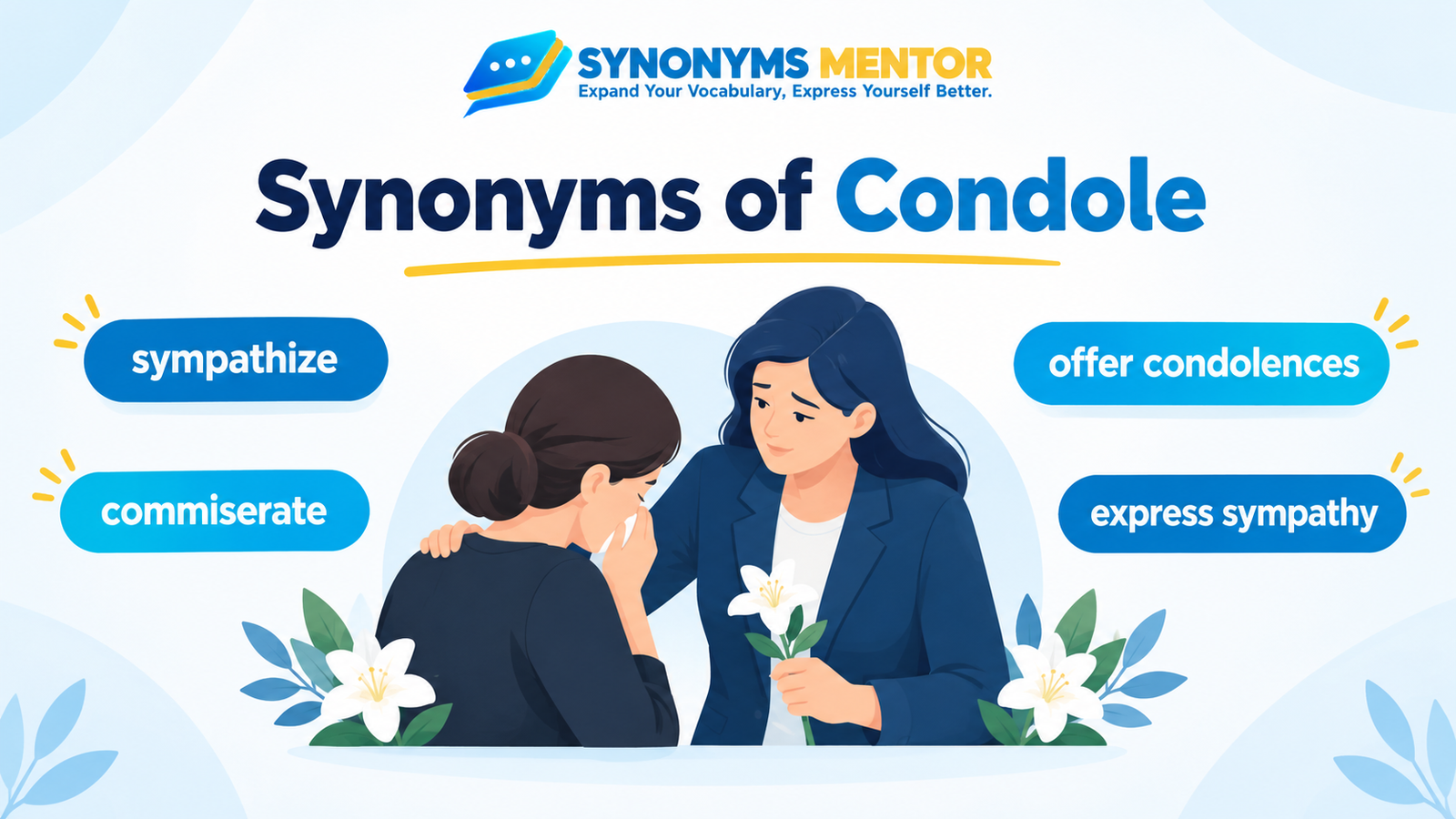
If you are looking for synonyms of condole, the closest choices are sympathize, commiserate, and feel for. However, these words are not interchangeable in every situation.
Condole is a formal verb used especially when expressing sympathy to someone who is grieving, while sympathize is much more common in modern English and works in a wider range of situations.
This guide explains the closest synonyms, contextual alternatives, natural collocations, and the differences that matter when choosing the right word.
Quick Answer
The closest synonyms of condole are sympathize, commiserate, and feel for. In modern everyday English, sympathize with is usually the most natural replacement. Commiserate with emphasizes sharing someone’s distress, while feel for is warmer and more conversational. Offer condolences is often the best modern phrase when responding to a death.
What Does “Condole” Mean?
Condole is a formal verb meaning to express sympathy or sorrow toward someone who is experiencing grief, especially following a death. Cambridge identifies it as formal and specifically associates it with expressing sympathy and sadness for the family or friends of someone who has died.
The word is commonly used in the construction:
condole with + person
For example:
The president condoled with the bereaved families.
The verb is grammatically correct but relatively formal and uncommon in ordinary conversation. Oxford likewise labels it formal and gives the construction condole with somebody.
Part of speech
Condole is a verb.
- Present: condole
- Past: condoled
- -ing form: condoling
- Third-person singular: condoles
Pronunciation
- US: /kənˈdoʊl/
- UK: /kənˈdəʊl/
Etymology
Condole entered English in the late sixteenth century from Late Church Latin condolēre, meaning roughly “to suffer with.” Its components are related to Latin com- (“with”) and dolēre (“to grieve” or “feel pain”).
The Best Synonyms of Condole
Not every word associated with sympathy is a true synonym. The table below separates close equivalents from words that work only in particular contexts.
| Word or Phrase | Relationship | Formality | Best Context |
|---|---|---|---|
| sympathize with | Direct/near synonym | Neutral | General sympathy and grief |
| commiserate with | Near synonym | Formal/neutral | Sharing someone’s distress |
| feel for | Near synonym | Casual/neutral | Warm, personal sympathy |
| offer condolences | Contextual alternative | Formal/neutral | Death and bereavement |
| express sympathy | Contextual alternative | Neutral/formal | General expressions of support |
| comfort | Contextual alternative | Neutral | Helping someone cope with grief |
| console | Contextual alternative | Neutral/formal | Providing emotional comfort |
| empathize with | Contextual alternative | Neutral | Understanding another person’s feelings |
| grieve with | Contextual alternative | Literary/formal | Sharing someone’s grief |
| mourn with | Contextual alternative | Formal/literary | Participating in grief or mourning |
1. Sympathize with
Sympathize with is generally the best modern substitute for condole with.
It means to express or feel sympathy for someone experiencing suffering, difficulty, or grief. Unlike condole, it is not restricted to bereavement.
Example:
We sympathized with the family after their loss.
Best choice when: You want a natural, widely understood alternative to the formal condole.
2. Commiserate with
Commiserate with is a close synonym, especially when the emphasis is on sharing someone’s sorrow, disappointment, or difficult experience.
Collins defines commiserate with as showing pity or sympathy when something unpleasant has happened to someone.
Example:
Her colleagues commiserated with her after the sudden loss.
Best choice when: You want to emphasize shared distress or sympathy.
Important nuance: Unlike condole, commiserate can describe sympathy over relatively ordinary setbacks, not just death or bereavement.
3. Feel for
Feel for is a more conversational alternative.
Example:
I really feel for her after everything she has been through.
It sounds warmer and less formal than condole.
Best choice when: You are speaking naturally in everyday conversation.
4. Offer condolences
Offer condolences is not a single-word synonym, but it is one of the most natural modern alternatives when someone has died.
Example:
We would like to offer our condolences to his family.
The noun condolence refers to an expression of sympathy, particularly following someone’s death, and condolences is commonly used in phrases such as “offer your condolences.”
Best choice when: Writing a sympathy message, formal statement, email, announcement, or public response after a death.
5. Express sympathy
Express sympathy describes the communicative action behind condole.
Example:
The organization expressed sympathy to the victims’ families.
Best choice when: You want clear, neutral wording rather than the relatively uncommon verb condole.
6. Comfort
Comfort overlaps with condole, but the meaning is not identical.
To condole is to express sympathy with someone who is suffering. To comfort someone is to help ease their sadness, distress, or emotional pain.
Example:
Her friends stayed with her to comfort her after the funeral.
Best choice when: The emphasis is on providing emotional support rather than simply expressing sympathy.
7. Console
Console is another contextual alternative.
Example:
He tried to console his friend after the death of her father.
Like comfort, it emphasizes helping someone deal with sadness rather than merely expressing one’s own sympathy.
Best choice when: Someone is actively trying to ease another person’s grief.
8. Empathize with
Empathize with means to understand or share another person’s feelings. It is broader than condole.
Example:
I can empathize with the family during this difficult time.
Best choice when: You want to emphasize emotional understanding.
Important: Do not treat empathize with as a perfect synonym. You can empathize with someone’s fear, frustration, embarrassment, or excitement without expressing condolences.
9. Grieve with
Grieve with can express the idea of sharing another person’s grief.
Example:
The community gathered to grieve with the family.
It is more literary and emotionally direct than ordinary sympathize with.
Best choice when: The context explicitly concerns shared grief.
10. Mourn with
Mourn with is another context-specific alternative.
Example:
The nation mourned with the victims’ families.
It emphasizes participation in mourning rather than simply communicating sympathy.
Best choice when: A person, community, or nation is collectively sharing in a period of mourning.
Closest Synonyms vs. Contextual Alternatives
The most important distinction is that condole has relatively few true everyday substitutes.
Closest synonyms
- sympathize with
- commiserate with
- feel for
Strong contextual alternatives
- offer condolences
- express sympathy
- comfort
- console
- empathize with
- grieve with
- mourn with
This distinction matters because a thesaurus may list many words associated with sympathy, but association does not automatically make a word a direct synonym.
Which Word Should I Use?
Use “sympathize with” when:
You want the most natural general replacement.
I sympathize with you during this difficult time.
Use “commiserate with” when:
You want to emphasize shared distress or hardship.
Her colleagues commiserated with her after the setback.
Use “feel for” when:
You want a warmer, more conversational expression.
I really feel for the family.
Use “offer condolences” when:
Someone has died and you are expressing formal sympathy.
We offer our condolences to the family.
Use “comfort” when:
You are helping someone emotionally.
She stayed behind to comfort her grieving friend.
Use “console” when:
You want a slightly more formal alternative to comfort.
He consoled his sister after the loss.
Use “empathize with” when:
You want to emphasize understanding someone’s feelings.
I empathize with everyone affected by the tragedy.
Condole vs. Sympathize
Condole is narrower and more formal than sympathize.
| Word | Main Meaning | Typical Context |
| condole | Express sympathy, especially for grief | Bereavement; formal contexts |
| sympathize | Feel or express sympathy | Grief, hardship, problems, setbacks |
| commiserate | Share or express sympathy over distress | Losses, disappointments, difficulties |
| feel for | Feel sympathy for someone | Everyday conversation |
Compare:
The ambassador condoled with the bereaved family.
with:
The ambassador sympathized with the bereaved family.
Both communicate sympathy, but sympathized with is generally more natural for contemporary general English.
Condole vs. Console
These verbs are easy to confuse.
Condole means to express sympathy with someone who is suffering.
Console means to comfort someone and help ease their distress.
The minister condoled with the family.
The minister consoled the grieving child.
The first focuses on expressing sympathy. The second focuses on providing comfort.
Condole vs. Commiserate
These words overlap strongly, but their usual contexts differ.
Condole is strongly associated with grief and bereavement and is formal. Commiserate can be used for many kinds of unpleasant experiences.
We condoled with the family after the death.
We commiserated with him after he lost his job.
The second sentence is natural because commiserate can cover disappointment and hardship that do not involve death.
Common Collocations
The verb condole is most naturally used in formal constructions.
Common patterns
- condole with someone
- condole with the family
- condole with the bereaved
- condole with the relatives
- condole with someone on a loss
- condole with someone over a tragedy
Examples:
The delegation came to condole with the family.
Community leaders visited to condole with the bereaved.
She wrote to condole with him on his loss.
The construction condole with is particularly important because condole normally takes with when referring to the person receiving the sympathy. Cambridge and Oxford both illustrate this pattern.
Common Mistakes
Mistake 1: Treating “condole” as an everyday conversational verb
Less natural:
I condoled with my friend yesterday.
More natural:
I sympathized with my friend.
Condole is correct, but it has a formal or literary tone.
Mistake 2: Using “condole” without “with”
Less natural:
I condoled him after his father’s death.
Better:
I condoled with him after his father’s death.
For modern usage, condole with someone is the standard construction.
Mistake 3: Treating “console” as an exact synonym
Condole expresses sympathy; console provides comfort.
They overlap in situations involving grief, but they describe different aspects of the response.
Mistake 4: Assuming “empathize” always means “condole”
You can empathize with someone experiencing almost any emotion or difficulty. Condole is much more specifically associated with sympathy for grief or loss.
Real-World Examples
Workplace
The company expressed its sympathy to the employee’s family following his death.
Formal statement
The organization offered its condolences to everyone affected by the tragedy.
Everyday conversation
I really feel for you after everything that happened.
Community response
Local residents gathered to grieve with the family.
Formal literary style
The delegation came to condole with the bereaved relatives.
Antonyms of Condole
There is no single perfect antonym for condole, because the word describes an act of sympathy rather than a simple opposite quality.
Depending on context, contrasting actions may include:
- ignore
- dismiss
- disregard
- show indifference
- remain unsympathetic
These are contextual opposites rather than exact lexical antonyms.
FAQ
What is the closest synonym of condole?
Sympathize with is usually the closest and most useful modern synonym. Commiserate with is also close, while feel for is a more conversational alternative.
What is another word for “condole with someone”?
You can say sympathize with someone, commiserate with someone, or feel for someone. In bereavement contexts, offer condolences to someone is often more natural.
Is “condole” a formal word?
Yes. Cambridge and Oxford both identify condole as formal. It is particularly associated with expressing sympathy after someone’s death.
Is “sympathize” better than “condole”?
For most modern everyday situations, sympathize sounds more natural. Condole is appropriate when you deliberately want a formal or literary tone.
What is the difference between condole and console?
Condole means to express sympathy with someone who is suffering. Console means to comfort someone and help relieve their sadness.
What is the difference between condole and commiserate?
Condole is especially associated with grief and bereavement and is formal. Commiserate means to share or express sympathy over someone’s distress and can apply to ordinary setbacks as well as serious losses.
Can I say “condole with” after a death?
Yes. Condole with is the standard construction when identifying the person receiving sympathy.
We condoled with the family after the death.
What is the most natural modern alternative to “condole”?
In most situations, sympathize with is the simplest replacement. When someone has died, offer condolences is often even more natural.
Conclusion
The best synonyms of condole depend on the situation. Sympathize with is the most versatile modern alternative, commiserate with emphasizes shared distress, and feel for sounds warmer and more conversational.
For bereavement, offer condolences is often the most natural formal phrase. Comfort and console are related but focus on easing someone’s grief rather than simply expressing sympathy.

Sophia Martinez is an ESL educator who specializes in teaching vocabulary and word meanings. She writes beginner-friendly content that helps learners understand synonyms and improve their English fluency step by step.