Synonyms for Irate: 15 Better Alternatives With Examples
Finding the right synonym for irate is not simply a matter of replacing it with another word meaning “angry.” Irate describes someone who is very angry, but different alternatives can emphasize different aspects of anger. Some words indicate greater intensity, while others suggest frustration, unfair treatment, or an outward display of anger.
For example, furious is a strong general alternative, while incensed often suggests anger caused by something considered wrong or offensive. Indignant adds a sense of perceived unfairness, whereas livid emphasizes extremely strong anger. Choosing the right word therefore depends on what caused the anger, how intense it is, and the tone you want.
This guide separates close synonyms from related alternatives so you can choose the most natural word for each situation.
Quick Answer: What Are the Best Synonyms for Irate?
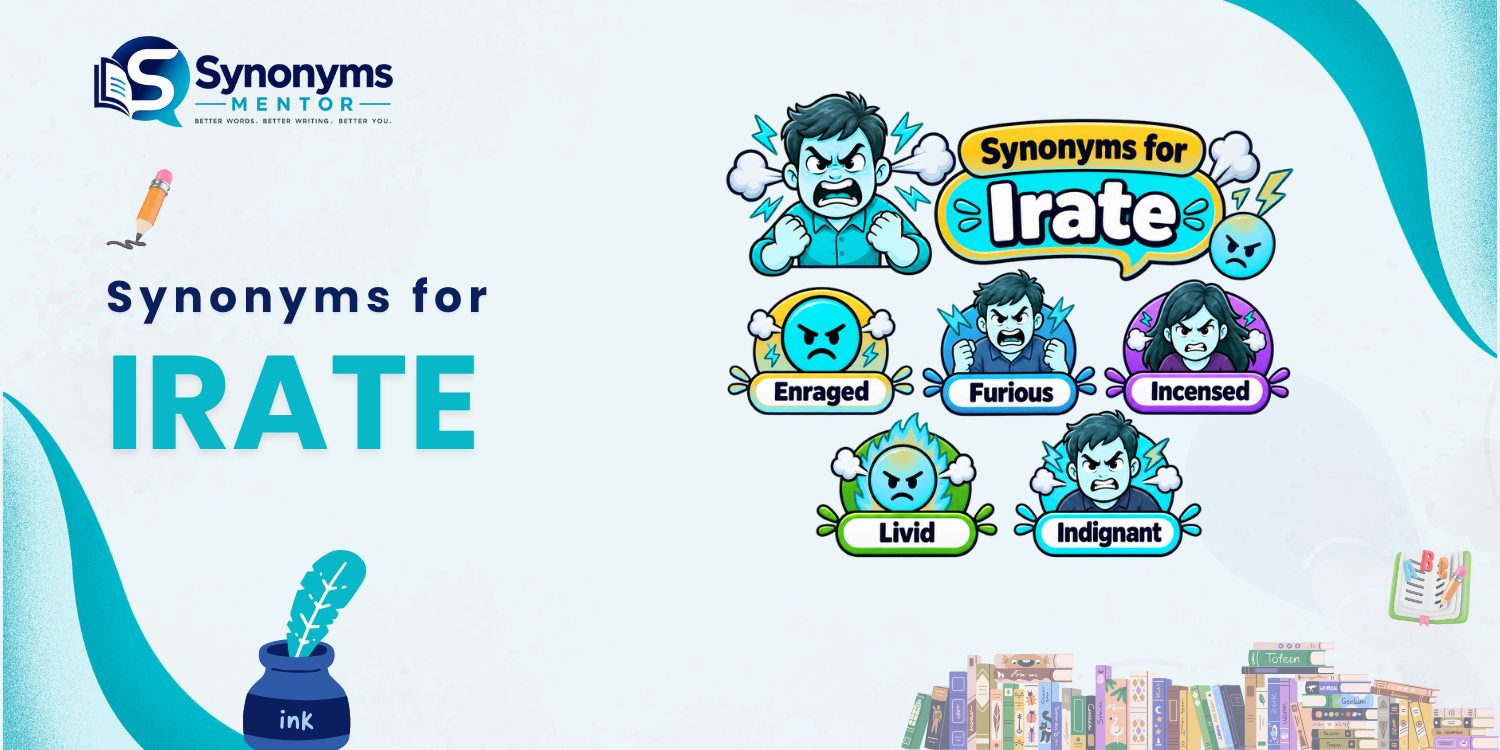
The closest alternatives to irate include angry, furious, incensed, enraged, livid, infuriated, and mad. Irate itself means “very angry,” according to Cambridge and Oxford. Furious is one of the most natural substitutes for strong anger, while incensed emphasizes anger caused by something offensive or unacceptable. Indignant is better when unfair treatment is central to the emotion.
Core Synonyms for Irate
| Word | Relationship | Meaning | Intensity | Formality | Best Context |
|---|---|---|---|---|---|
| Angry | Direct/general | Feeling or showing anger | Strong but broad | Neutral | General situations |
| Furious | Very close | Extremely angry | Very strong | Neutral | People, reactions, conflicts |
| Incensed | Close | Extremely angry, often because something is offensive or wrong | Very strong | Neutral–formal | Unfair or offensive situations |
| Enraged | Close | Extremely angry or filled with rage | Very strong | Neutral | Intense emotional reactions |
| Livid | Close | Extremely angry | Very strong | Neutral | Personal reactions |
| Infuriated | Close | Made extremely angry | Very strong | Neutral | Situations that cause anger |
| Mad | Contextual | Very angry | Strong | Informal | Casual American English |
| Indignant | Near synonym | Angry because something seems unfair or unjust | Strong | Neutral–formal | Injustice or unfair treatment |
| Outraged | Contextual | Extremely angry because something is shocking or unacceptable | Very strong | Neutral | Public or moral criticism |
| Exasperated | Near synonym | Very annoyed or frustrated after repeated problems | Moderate–strong | Neutral | Recurring frustrations |
| Irritated | Near synonym | Annoyed or mildly angry | Mild–moderate | Neutral | Everyday annoyances |
| Annoyed | Near synonym | Slightly angry or bothered | Mild | Neutral | Minor problems |
| Apoplectic | Contextual | Extremely angry, often in an exaggerated or dramatic expression | Extreme | Formal/literary | Dramatic descriptions |
| Seething | Contextual | Suppressing or visibly containing intense anger | Very strong | Neutral | Hidden or controlled anger |
| Wrathful | Contextual | Full of or expressing intense anger | Very strong | Literary/formal | Religious, literary, dramatic contexts |
Cambridge lists angry, furious, incensed, livid, seething, wrathful, and other expressions among words related to irate. Oxford similarly distinguishes irate from mad, furious, upset, and indignant.
What Does “Irate” Mean?
Irate is an adjective meaning very angry. It commonly describes people, reactions, communications, or things associated with strong anger.
For example:
- an irate customer
- an irate caller
- an irate parent
- an irate email
- an irate letter
Cambridge gives irate the pronunciation /aɪˈreɪt/ in both British and American English and defines it as “very angry.” Oxford likewise defines it as “very angry” and gives examples such as irate customers and an irate phone call.
Part of speech: adjective
US IPA: /aɪˈreɪt/
UK IPA: /aɪˈreɪt/
The Most Useful Synonyms for Irate
1. Angry
Angry is the broadest and most natural alternative to irate. It describes feeling or showing anger without specifying exactly why the person is angry or how extreme the emotion is.
Example:
The customer was angry about the unexpected charge.
Choose “angry” when: you want a simple, neutral word that works in almost any everyday situation.
2. Furious
Furious is one of the closest alternatives to irate. It generally communicates extremely strong anger.
Example:
The manager was furious when he discovered the mistake.
Oxford defines furious as extremely angry, while Cambridge also places it among the words associated with irate.
Choose “furious” when: you want stronger emphasis than ordinary angry.
3. Incensed
Incensed describes intense anger, particularly when someone believes something is offensive, unacceptable, or seriously wrong.
Example:
Residents were incensed by the sudden cancellation.
Choose “incensed” when: the cause of the anger matters and involves perceived wrongdoing or unacceptable behavior.
This is especially useful in journalism, professional writing, and formal descriptions.
4. Enraged
Enraged describes extremely intense anger and can sound stronger and more dramatic than irate.
Example:
The player was enraged by the unfair decision.
Choose “enraged” when: you want to emphasize the intensity of the anger rather than simply describe an angry person.
5. Livid
Livid is a strong informal-to-neutral word meaning extremely angry.
Example:
She was livid when she realized her reservation had been canceled.
It works particularly naturally when describing someone’s emotional reaction.
Choose “livid” when: you want a vivid, emphatic alternative to irate.
6. Infuriated
Infuriated means made extremely angry. Unlike irate, which describes a person’s state, infuriated often highlights what caused the anger.
Example:
The delay infuriated the passengers.
Compare:
The passengers were irate.
The delay infuriated the passengers.
Choose “infuriated” when: you want to emphasize the thing that caused the anger.
7. Mad
In American English, mad can mean very angry and is informal.
Example:
My brother was mad about what happened.
Choose “mad” when: writing casual American English.
Avoid it when a formal or professional tone is required. Cambridge specifically labels mad as informal in its anger thesaurus.
Context-Specific Alternatives
Not every anger-related word is interchangeable with irate. Some become better choices when the context changes.
Indignant
Indignant means angry because you believe you or someone else has been treated unfairly.
She was indignant about the accusation.
This is not simply another word for being very angry. The sense of injustice is important. Oxford specifically distinguishes indignant as anger and surprise arising from perceived unfair treatment.
Outraged
Outraged is appropriate when something is considered shocking, offensive, or completely unacceptable.
Parents were outraged by the decision.
Use outraged when the anger carries a strong sense of moral or social disapproval.
Exasperated
Exasperated describes frustration and annoyance that have built up, often because a problem keeps happening.
After explaining the same issue five times, she sounded exasperated.
It is therefore not a perfect replacement for irate. Someone can be exasperated without being intensely angry.
Irritated
Irritated is considerably milder than irate.
I was irritated by the constant interruptions.
Use it for ordinary annoyance rather than extreme anger.
Annoyed
Annoyed is also weaker than irate.
He was annoyed by the delay.
If the person is extremely angry, irate, furious, or enraged is usually more appropriate.
Seething
Seething focuses on intense anger that is being contained or simmering beneath the surface.
He was seething after hearing the decision.
This is especially useful when the person is angry but not openly expressing the emotion.
Apoplectic
Apoplectic is a dramatic word for someone extremely angry.
The coach was apoplectic after the referee’s decision.
It is much more expressive than ordinary irate and may sound exaggerated in everyday writing.
Wrathful
Wrathful means full of or expressing strong anger. It has a formal, literary, or sometimes religious tone.
The story describes the king as a wrathful ruler.
It is not usually the best everyday replacement for irate.
Which Word Should I Use?
The easiest way to choose is to identify what kind of anger you want to communicate.
Choose “angry” when:
You need the simplest general word.
Choose “furious” when:
The person is extremely angry.
Choose “incensed” when:
The anger comes from something offensive, unacceptable, or wrong.
Choose “enraged” when:
You want to emphasize very intense anger.
Choose “livid” when:
You want a vivid description of someone’s extreme anger.
Choose “indignant” when:
The person believes they have been treated unfairly.
Choose “outraged” when:
The situation causes strong moral or social anger.
Choose “exasperated” when:
Repeated problems have created frustration and annoyance.
Choose “irritated” or “annoyed” when:
The anger is relatively mild.
Irate vs. Angry
Irate and angry overlap, but they are not identical in strength.
| Word | Main idea | Typical strength |
|---|---|---|
| Angry | Feeling or showing anger | Broad range |
| Irate | Very angry | Strong |
| Furious | Extremely angry | Very strong |
Angry is the everyday default. Irate is more specific and generally indicates strong anger. Oxford and Cambridge both define irate in terms of very strong anger.
The customer was angry about the bill.
The customer was irate about the bill.
The second sentence suggests a more intense reaction.
Irate vs. Furious
Both words describe strong anger, and furious is often a very natural substitute for irate.
The customer was irate about the delay.
The customer was furious about the delay.
The difference is mainly one of emphasis and style. Furious strongly emphasizes extreme anger, while irate is especially common in descriptions such as irate customers, irate callers, and irate letters.
Irate vs. Incensed
These words overlap strongly, but incensed more clearly suggests that something has provoked serious anger.
The residents were irate about the decision.
The residents were incensed by the decision.
Use incensed when the cause of the anger is especially important.
Irate vs. Indignant
This distinction is important for precise writing.
Irate = very angry.
Indignant = angry because something seems unfair or unjust.
The customer was irate about the delay.
The customer was indignant about being blamed for the delay.
The second sentence adds the idea of perceived unfairness.
Natural Collocations With “Irate”
Some combinations sound especially natural:
- irate customer
- irate customers
- irate caller
- irate callers
- irate parent
- irate passenger
- irate consumer
- irate email
- irate letter
- irate complaint
- irate response
- irate phone call
For these contexts, alternatives can change the tone:
an irate customer — professional and descriptive
a furious customer — stronger and more emotional
an angry customer — simpler and more neutral
an incensed customer — emphasizes serious provocation
This is one reason a synonym should not be selected from a list alone. The surrounding noun matters.
Common Mistakes When Choosing a Synonym for Irate
Mistake 1: Treating “annoyed” as equally strong
Annoyed usually describes a much milder emotional reaction.
Mistake 2: Using “indignant” for every angry person
Indignation normally involves a sense of unfairness or injustice.
Mistake 3: Using “furious” when you want a mild tone
Furious is much stronger than irritated or annoyed. Cambridge defines it as extremely angry.
Mistake 4: Using “mad” in formal writing
In American English, mad meaning angry is common, but it is informal.
Mistake 5: Assuming every thesaurus entry is interchangeable
Words such as exasperated, indignant, and seething describe particular shades of anger. They should not automatically replace irate in every sentence.
Antonyms of Irate
The clearest opposite of irate is calm.
Depending on context, other useful opposites include:
- peaceful
- placid
- composed
- patient
- content
- untroubled
For example:
The customer was irate after the billing error.
The customer remained calm after the issue was explained.
The best antonym depends on whether you want to emphasize the absence of anger, emotional control, or a positive emotional state.
FAQ About Synonyms for Irate
What is the closest synonym for irate?
Angry is the broadest synonym, while furious is one of the closest alternatives when you want to preserve the strong intensity of irate. Incensed, enraged, and livid can also work, but each adds a slightly different emphasis or tone.
Is furious stronger than irate?
Both describe strong anger, and there is no universally fixed intensity scale between them. However, furious explicitly means extremely angry, while irate means very angry. In many contexts, furious sounds more emphatic.
Is angry a synonym for irate?
Yes. Angry is a genuine synonym, but it is broader. Someone can be angry without being extremely angry, whereas irate specifically describes a high degree of anger.
What is a professional synonym for irate?
For professional writing, angry, furious, incensed, or dissatisfied may work depending on the situation. Incensed is useful for serious complaints, while angry is more neutral. In customer-service writing, irate customer itself is also natural and professional.
What is a softer synonym for irate?
Annoyed and irritated are softer alternatives. Frustrated can also work when the person’s emotion comes mainly from difficulty or repeated problems rather than intense anger.
What is a stronger word than irate?
Words such as furious, enraged, livid, and infuriated can communicate extremely strong anger. Apoplectic is even more dramatic, but it is often used for effect rather than as an ordinary everyday replacement.
Is indignant the same as irate?
No. They overlap, but indignant specifically involves anger connected with perceived unfairness or unjust treatment. Someone can be irate without feeling that an injustice has occurred.
What is the best synonym for an irate customer?
Angry customer is the most straightforward alternative. Furious customer emphasizes stronger emotion, while incensed customer suggests that the customer considers something especially offensive or unacceptable.
Conclusion
The best synonym for irate depends on the shade of anger you want to express. Angry is the broadest choice, furious emphasizes extreme anger, incensed highlights serious provocation, enraged emphasizes intensity, and livid gives the description a vivid emotional quality. Words such as indignant, exasperated, irritated, and seething are useful when you need to communicate a more specific type of anger rather than simply replace irate.

Our editorial team is dedicated to making English vocabulary easier to understand and use correctly. We research and review synonyms, antonyms, definitions, word usage, and example sentences to ensure our content is clear, accurate, practical, and useful for students, writers, professionals, and English learners.