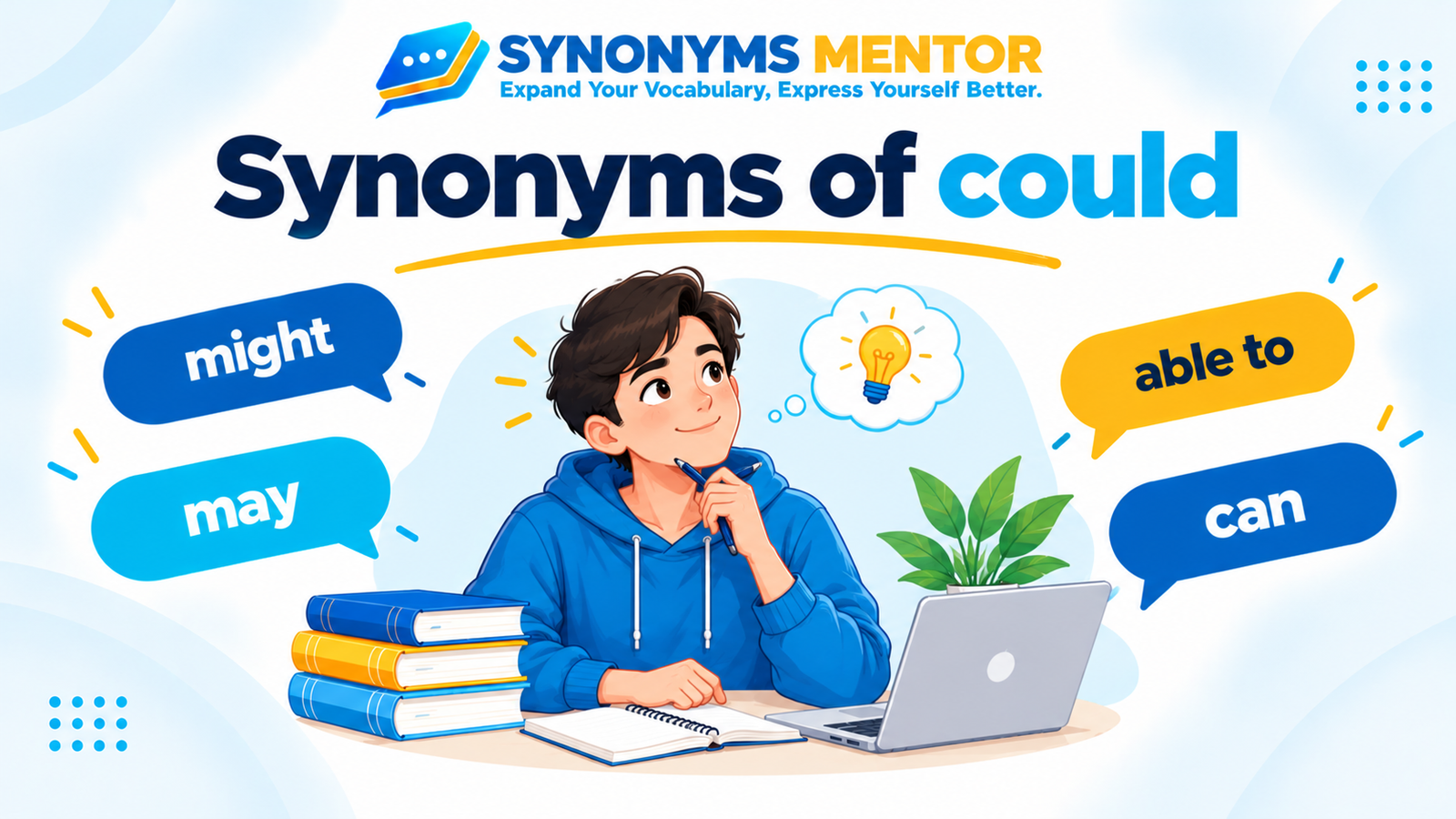
Synonyms of Could: Better Alternatives for Every Context
Finding a synonym for could is more complicated than replacing one word with another. Could is a modal verb that can express past ability, possibility, conditional ability, polite requests, permission, and suggestions. The best alternative therefore depends on what could means in the sentence.
For example, was able to can replace could when describing a successful action in the past, while might can work when could expresses possibility. In a polite request, would or a more direct construction may sometimes work, but the meaning can change.
Understanding these differences helps you choose a natural alternative instead of using a thesaurus replacement that does not quite fit.
Quick Answer: What Are the Synonyms of Could?
Common alternatives to could include was able to, managed to, might, may, would, be capable of, be permitted to, and be possible to, depending on the meaning. There is no single synonym that works in every sentence.
Use was able to for specific past ability, might for possibility, may for some possibilities or formal permission, and would when the intended meaning involves willingness or a conditional result.
What Does “Could” Mean?
Could is a modal auxiliary verb and is traditionally the past form of can. However, modern English uses it for several purposes beyond simple past ability. Merriam-Webster identifies it as the past tense of can, a conditional form, and a less forceful or polite alternative to can.
Common uses include:
- Past ability: When I was younger, I could run five miles.
- Possibility: It could rain tonight.
- Conditional ability: I could help if you needed me.
- Polite request: Could you send me the report?
- Permission: Could I leave early?
- Suggestion: We could take the train instead.
Because these meanings differ, replacing could requires attention to context.
Core Synonyms and Alternatives for Could
| Word or Phrase | Relationship | Strength | Formality | Best Context |
|---|---|---|---|---|
| was/were able to | Direct contextual alternative | Neutral | Neutral | Specific past ability |
| managed to | Near synonym | Stronger | Neutral | Successful past action |
| might | Near synonym | More tentative | Neutral | Possibility |
| may | Near synonym | Neutral | Neutral/Formal | Possibility or permission |
| can | Contextual alternative | More direct | Neutral | Present ability or possibility |
| would | Contextual alternative | Meaning-dependent | Neutral | Willingness or conditionals |
| be capable of | Contextual alternative | Neutral | Formal | Ability/capacity |
| be permitted to | Contextual alternative | Precise | Formal | Permission |
| be possible to | Contextual alternative | Neutral | Formal | Possibility |
| have the ability to | Contextual alternative | Explicit | Formal | Ability |
| have permission to | Contextual alternative | Explicit | Neutral/Formal | Permission |
| succeed in | Contextual alternative | Strong | Neutral/Formal | Successful action |
Not every expression in this table is a direct synonym. Several are meaning-specific alternatives because could itself performs different grammatical functions.
Closest Alternatives to “Could”
1. Was/Were Able To
Was able to is one of the clearest alternatives when could refers to someone’s ability in the past.
Could:
She could solve the problem.
Alternative:
She was able to solve the problem.
However, there is an important distinction. Could commonly describes general or repeated ability in the past, while was/were able to is especially useful for a particular successful occasion. Oxford specifically notes this distinction.
After several attempts, she was able to solve the problem.
Here, was able to emphasizes the successful result.
2. Managed To
Managed to is useful when the action was successfully completed, particularly when it required effort or difficulty.
We could finish the project before Friday.
This simply expresses ability or possibility.
We managed to finish the project before Friday.
This suggests that finishing it was difficult but ultimately successful.
So managed to is not a universal replacement for could. It adds a sense of achievement or overcoming difficulty.
3. Might
Use might when could expresses possibility.
It could rain this evening.
It might rain this evening.
Both sentences express possibility, but might often presents the possibility more tentatively. Cambridge notes that could, may, and might can all express possibility, with differences in meaning and certainty.
4. May
May can sometimes replace could when talking about possibility.
The delay could cause problems.
The delay may cause problems.
The two are close, but they are not always interchangeable. May can sound somewhat more formal, especially in writing.
May is also used for permission:
May I come in?
This is more formal than:
Could I come in?
5. Can
Can is related to could but normally refers to present ability, possibility, or permission.
She could speak French when she was ten.
She can speak French now.
Replacing could with can therefore changes the time reference.
Cambridge also notes that can generally expresses present ability, while could is used for past ability and certain hypothetical or less-certain meanings.
6. Be Capable Of
Be capable of is a more explicit and sometimes more formal way to express ability.
The machine could process thousands of records.
The machine was capable of processing thousands of records.
The second sentence emphasizes the machine’s capacity rather than simply stating what it could do.
Be careful with grammar:
capable of processing
not:
capable of to process
7. Be Permitted To
When could asks about or refers to permission, be permitted to can make the meaning explicit.
Could I use your laptop?
Am I permitted to use your laptop?
The second version is grammatically correct but considerably more formal and less conversational.
For everyday English, Could I…? is usually more natural.
8. Would
Would can sometimes appear as an alternative to could, particularly in questions or conditional situations, but the meaning changes.
Compare:
Could you help me?
Would you help me?
Could you help me? focuses on whether the person is able or willing to provide help in the situation.
Would you help me? focuses more strongly on willingness.
Therefore, would should not be treated as a direct synonym.
Synonyms of Could by Meaning
The easiest way to choose the right alternative is to identify what could means in the sentence.
When “Could” Means Past Ability
Use:
- was able to
- were able to
- managed to
- had the ability to
- was capable of
Example:
When he was younger, he could run very fast.
Possible alternatives include:
When he was younger, he was able to run very fast.
When he was younger, he had the ability to run very fast.
For a particular successful event:
She managed to complete the assignment on time.
Oxford recommends was/were able to or managed to for specific past occasions rather than simply relying on could.
When “Could” Means Possibility
Use:
- might
- may
- be possible
- potentially
- have the potential to
Example:
This decision could create problems.
Possible alternatives:
This decision might create problems.
This decision may create problems.
This decision has the potential to create problems.
The final version is more formal and explicit.
When “Could” Makes a Polite Request
There is often no need to replace could.
Could you send me the document?
is already natural and polite.
Possible alternatives include:
Would you send me the document?
Can you send me the document?
But each has a slightly different tone. Cambridge notes that could is more polite than can in requests.
When “Could” Asks for Permission
Possible alternatives include:
- may I
- can I
- am I allowed to
- am I permitted to
For example:
Could I leave early?
More formal:
May I leave early?
More conversational:
Can I leave early?
When “Could” Makes a Suggestion
You can often replace it with:
- might
- should consider
- could consider
- perhaps we can
- one option is to
Could:
We could postpone the meeting.
Alternative:
We might postpone the meeting.
More explicit:
We should consider postponing the meeting.
The last option changes the sentence from a relatively open suggestion to a stronger recommendation.
Formal Alternatives to Could
For professional and academic writing, the best alternative depends on the intended meaning.
| Intended Meaning | Formal Alternative |
|---|---|
| Ability | was able to |
| Capacity | was capable of |
| Possibility | may |
| Possibility | is possible |
| Potential | has the potential to |
| Permission | was permitted to |
| Permission | was authorized to |
| Ability | had the capacity to |
| Successful action | managed to |
| Conditional result | would be able to |
Example
Less explicit:
The policy could reduce costs.
Formal alternatives:
The policy may reduce costs.
The policy has the potential to reduce costs.
The best choice depends on whether you want to emphasize possibility or potential.
Casual Alternatives to Could
In everyday conversation, alternatives depend heavily on meaning.
Ability
I could do it.
→ I was able to do it.
Possibility
It could happen.
→ It might happen.
Permission
Could I borrow your pen?
→ Can I borrow your pen?
Suggestion
We could get pizza.
→ We might get pizza.
However, could itself is already extremely common in everyday English, so replacing it merely for variety is usually unnecessary.
Could vs. Might
These words are often confused because both can express possibility.
It could snow tonight.
It might snow tonight.
Both indicate that snow is possible.
Might often sounds more tentative, while could can emphasize that something is within the range of possibilities. The difference is not an absolute probability scale; native speakers frequently use them in overlapping ways. Cambridge treats both as possibility modals while distinguishing their broader grammatical uses.
Best rule:
Use might when you want to emphasize uncertainty. Keep could when you are presenting something as one possible outcome or scenario.
Could vs. May
Could and may can both express possibility:
The results could change.
The results may change.
But may can sound more formal in many written contexts.
They also differ in permission:
May I ask a question?
Could I ask a question?
Both are polite, but may is traditionally associated with more formal permission, while could is extremely natural for polite requests and permission questions.
Could vs. Would
These words are not interchangeable in most situations.
Could you help me?
asks about the possibility or ability to help, while also functioning as a polite request.
Would you help me?
focuses more on willingness.
Likewise:
If I had more time, I could finish it.
means I would have the ability or opportunity to finish it.
If I had more time, I would finish it.
means that finishing it is the expected result under that condition.
This distinction is particularly important in conditional sentences.
Could vs. Was Able To
This is one of the most useful distinctions for English learners.
General past ability
When I was a child, I could swim.
Successful action on one occasion
Yesterday, I was able to solve the problem.
The second sentence clearly presents a completed successful action. Oxford specifically distinguishes could for general past ability from was/were able to or managed to for a particular successful event.
Natural Collocations with Could
Because could is a modal verb, it normally comes before the base form of another verb.
Common patterns include:
- could be
- could have
- could help
- could make
- could cause
- could lead
- could mean
- could happen
- could work
- could provide
- could suggest
- could increase
- could reduce
Examples:
This could lead to higher costs.
She could help with the project.
The change could improve efficiency.
It could mean a significant delay.
Modal verbs such as could are followed by the base form of a verb, not to + verb or an -ing form.
Which Alternative Should I Use?
Use “was/were able to” when:
You mean a specific past success or ability.
We were able to complete the work on time.
Use “managed to” when:
The achievement involved difficulty or effort.
She managed to find a solution.
Use “might” when:
You are emphasizing possibility or uncertainty.
The plan might work.
Use “may” when:
You want to express possibility or use a somewhat more formal tone.
The results may vary.
Use “be capable of” when:
You want to emphasize capacity or capability.
The system is capable of handling large files.
Use “be permitted to” when:
You specifically mean official permission.
Employees are permitted to work remotely.
Keep “could” when:
It is already the most natural way to express a polite request, hypothetical possibility, suggestion, or past/general ability.
Could you send me the report?
There is no advantage in replacing a perfectly natural could simply to avoid repetition.
Common Mistakes with Could Synonyms
Mistake 1: Replacing Every “Could” with “Can”
Incorrect:
When I was young, I can swim very well.
Correct:
When I was young, I could swim very well.
Can normally expresses present ability; could commonly expresses past ability.
Mistake 2: Using “Managed To” for General Ability
When I was a child, I managed to swim.
This sounds as though swimming was an individual achievement rather than a general ability.
Better:
When I was a child, I could swim.
Use managed to for a particular successful event:
I managed to swim across the river.
Mistake 3: Treating “Might” and “Could” as Identical
They overlap when expressing possibility, but they are not interchangeable in every use.
You cannot replace:
Could you open the door?
with:
Might you open the door?
without changing the tone and meaning considerably.
Mistake 4: Using “Be Able To” Without the Correct Grammar
Correct:
She was able to finish the task.
Not:
She was able finish the task.
Mistake 5: Using “Could” as a Universal Synonym
The sentence:
I could help.
might mean ability, willingness, possibility, or a conditional offer depending on context.
Always identify the intended meaning before choosing an alternative.
Real-World Examples
Workplace
The new software could reduce administrative work.
Alternative:
The new software may reduce administrative work.
Here, may preserves the idea of possibility.
Academic Writing
The findings could indicate a change in consumer behavior.
Alternative:
The findings may indicate a change in consumer behavior.
May can work well in cautious academic prose.
Everyday Conversation
Could you pass the salt?
Usually, could should simply remain. It is already a natural and polite request.
Past Ability
She could speak three languages as a teenager.
Alternative:
She was able to speak three languages as a teenager.
Difficult Achievement
Despite the technical problems, the team managed to complete the project.
Here, managed to adds the idea of successful completion despite difficulty.
Antonyms of Could
There is no single antonym for could because its meaning changes by context.
Depending on the sentence, possible opposites include:
- couldn’t
- was unable to
- failed to
- was not permitted to
- was impossible
- cannot
- would not
Examples:
Ability:
She could complete the task.
She was unable to complete the task.
Permission:
Could I leave early?
I was not permitted to leave early.
Possibility:
It could happen.
It was impossible.
The appropriate opposite depends on what could means in the original sentence.
FAQ: Synonyms of Could
What is the closest synonym for “could”?
There is no single closest synonym for every use. Was able to is a strong alternative for past ability, while might or may can work when could expresses possibility.
What is another word for “could” in formal writing?
Depending on the meaning, formal alternatives include was able to, may, was capable of, was permitted to, and has the potential to.
What is a synonym for “could” when talking about ability?
Use was/were able to, had the ability to, or was/were capable of. For a difficult successful action, managed to may be more precise.
What is a synonym for “could” when expressing possibility?
Common alternatives include might, may, be possible, and have the potential to.
Can “might” replace “could”?
Sometimes. Might can replace could when both express possibility, but it cannot replace could in every context, such as polite requests or past ability.
Can “would” replace “could”?
Sometimes, but the meaning usually changes. Could often concerns ability or possibility, while would commonly expresses willingness or the expected result of a condition.
Is “can” a synonym for “could”?
Only in certain contexts. Can generally refers to present ability, permission, or possibility, whereas could has additional past, conditional, hypothetical, and polite-request uses.
What is the best alternative to “could” in a sentence?
First identify the meaning. Use was able to for specific past ability, managed to for successful achievement, might/may for possibility, and be permitted to for explicit permission.
Conclusion
The best synonym for could depends on what the modal verb is doing in the sentence. Was able to and managed to are useful for past ability, might and may can express possibility, and be permitted to can clarify permission. For polite requests and suggestions, however, could is often already the most natural choice.

James Anderson is an English teacher and language researcher who creates easy synonym guides and vocabulary lessons. His goal is to help students and writers improve their language skills through simple and clear explanations.