Synonyms of At: Better Alternatives for Every Context
Finding synonyms for at is more complicated than finding alternatives for an ordinary descriptive word. The reason is grammatical: at is primarily a preposition, and its meaning changes according to the relationship it expresses.
For example, at can identify a particular place (at the station), an exact time (at 7:00), a direction (look at the screen), a condition (at work), a rate (at 60 miles per hour), or a point on a scale. Oxford and Cambridge both document these multiple uses.
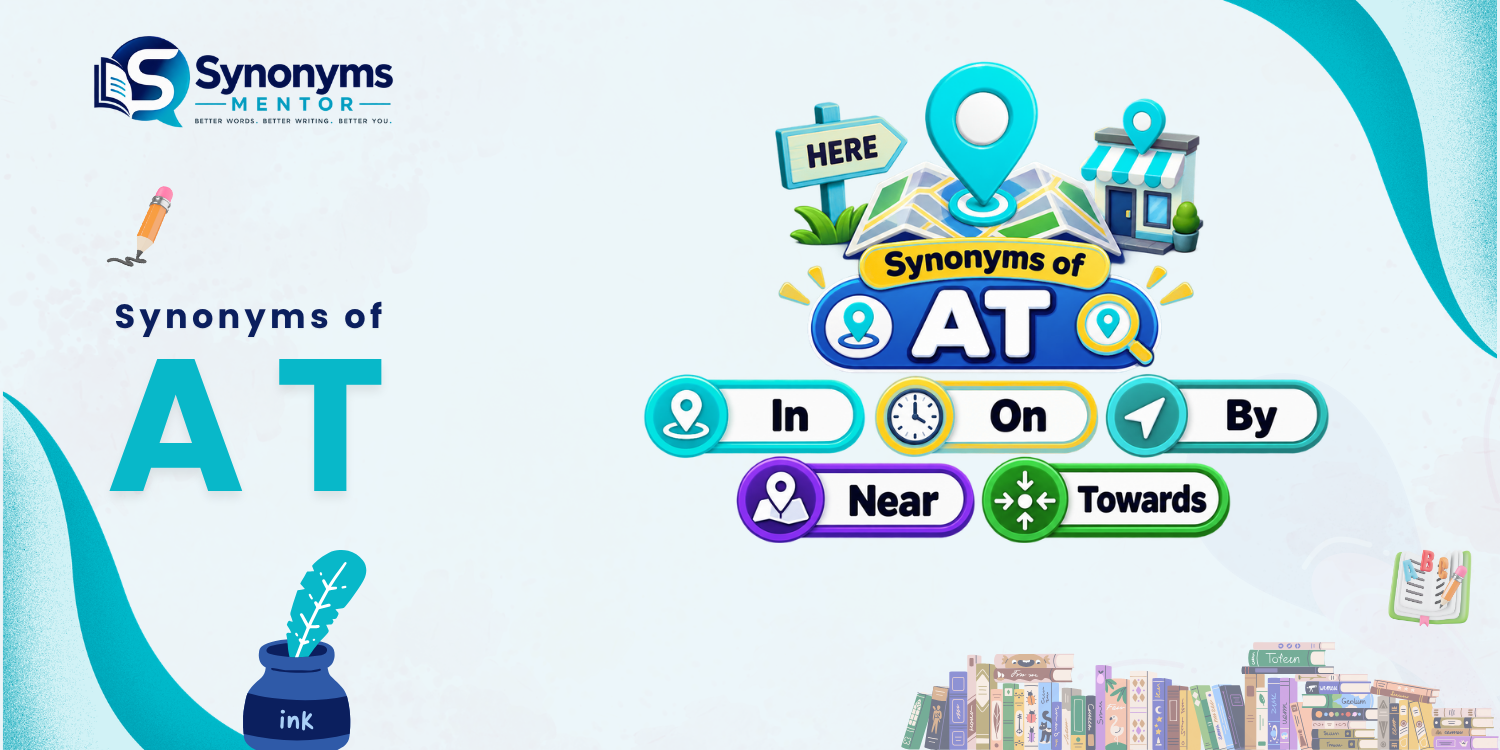
Because of this, there is no universal synonym for “at.” Instead, words such as in, on, by, near, beside, along, toward, around, and across may replace it in particular contexts.
Quick Answer
The closest alternatives to at depend on the sentence. In, on, by, near, beside, along, toward, and around can sometimes replace at, but they are not interchangeable. For example, at the station may become near the station when you mean proximity, while at 5 p.m. generally cannot be replaced by near or beside.
Core Synonym Resource
| Word | Relationship | Meaning | Best Context | Example |
|---|---|---|---|---|
| in | Contextual alternative | Inside a place or area | Enclosed locations | She is in the office. |
| on | Contextual alternative | On a surface, line, or certain locations | Surfaces, streets, transport | The book is on the desk. |
| by | Contextual alternative | Beside or near | Proximity | She stood by the door. |
| near | Contextual alternative | Close to | Approximate location | He lives near the station. |
| beside | Contextual alternative | Next to | Immediate physical position | She sat beside me. |
| along | Contextual alternative | Following the length or course of something | Roads, edges, routes | Shops line the road along the river. |
| toward | Contextual alternative | In the direction of | Direction | He walked toward the entrance. |
| around | Contextual alternative | In the area surrounding something | Approximate location | There were people around the entrance. |
| across | Contextual alternative | From one side to another | Areas, roads, surfaces | A café is across the street. |
Important: These are not universal substitutes. Their grammatical and semantic functions differ from at. Merriam-Webster’s thesaurus itself presents several of these relationships as context-dependent rather than suggesting that they can replace at everywhere.
What Does “At” Mean?
At is primarily a preposition used to identify a particular place, time, direction, condition, rate, or point of reference. Oxford lists uses involving location, work or study, time, age, direction, ability, rate, and states or conditions.
Consider these examples:
- We met at the library. — specific location
- The movie starts at 8 p.m. — exact time
- She looked at the painting. — direction of attention
- He is at work. — state or activity
- The car was traveling at 60 mph. — rate
- She is good at mathematics. — ability
This variety explains why replacing at requires attention to the entire sentence.
Synonyms of “At” by Context
1. “At” for a Specific Location
When at identifies a particular point or place, several alternatives may work depending on the intended meaning.
At:
I’ll meet you at the station.
Possible alternatives:
- near the station
- by the station
- beside the station
- around the station
But each changes the meaning slightly.
Near means close to the station, not necessarily inside or directly at it.
I’ll meet you near the station.
By often means beside or close to something.
I’ll meet you by the station.
Beside is more specific and usually means immediately next to something.
She waited beside the station entrance.
The British Council explains that at is commonly used for places associated with a specific activity and for exact positions.
2. “At” for Time
Time is one of the contexts where at usually should not be replaced with a simple synonym.
We say:
The meeting starts at 9:00.
We generally would not replace at with near, by, or beside.
However, a sentence can sometimes be rephrased, rather than simply replacing at:
The meeting starts at 9:00.
Could become:
The meeting starts at nine o’clock.
Or, if the intended meaning changes:
The meeting starts around 9:00.
Here, around means approximately 9:00, so it is not an exact synonym.
The British Council notes that at is normally used with clock times, mealtimes, and expressions such as at night.
At vs Around
- at 8:00 = exactly 8:00
- around 8:00 = approximately 8:00
Therefore, use around only when you want to express approximation.
3. “At” for Proximity
When at refers to a point or location and the intended meaning is close to, alternatives such as near and by may work.
She was waiting at the entrance.
Possible contextual alternatives:
She was waiting near the entrance.
She was waiting by the entrance.
The meanings are not identical.
- at the entrance → identifies the entrance as the relevant location.
- near the entrance → somewhere close to it.
- by the entrance → beside or close to it.
4. “At” for Direction
At can indicate the target of an action, especially with verbs such as look, point, aim, throw, smile, and wave. Oxford and Cambridge both identify this directional use.
She looked at the painting.
Depending on the verb and intended meaning, alternatives may include:
- toward
- in the direction of
For example:
He walked toward the door.
But:
He walked at the door.
does not mean exactly the same thing. Changing at to toward can change the relationship from a target or point of action to movement in a particular direction.
Choose “toward” when:
You want to emphasize direction or movement toward something.
The child ran toward his mother.
5. “At” for a Surface or Position
Sometimes learners try to replace at with on or in, but the correct choice depends on the type of location.
Compare:
She is at the desk.
The book is on the desk.
She is in the office.
These three prepositions describe different relationships.
The British Council explains that in generally refers to being inside a larger space, on commonly refers to a surface, and at is often used for a specific place or activity.
The Most Useful Contextual Alternatives
In
Use in when the meaning involves being inside an enclosed or larger area.
She is at the office.
This identifies the office as her location or workplace.
She is in the office.
This emphasizes that she is physically inside the office.
Best for: rooms, buildings, cities, countries, enclosed spaces.
On
Use on when something is positioned on a surface or certain lines and routes.
The keys are on the table.
You cannot normally replace:
The keys are at the table.
with on without changing the relationship.
The British Council specifically distinguishes on for surfaces and at for specific positions or activity locations.
Best for: surfaces, streets, floors, some forms of transport, lines and borders.
By
By can sometimes replace at when the intended meaning is beside or near.
She was standing at the door.
She was standing by the door.
The second sentence emphasizes proximity to the door.
Best for: nearby physical locations.
Near
Near is useful when at means a location close to something.
There is a restaurant near the station.
This does not necessarily mean the restaurant is at the station itself.
Best for: approximate location and proximity.
Beside
Beside means next to or immediately alongside something.
He sat beside the window.
It is more specific than near.
Best for: people, objects, and places immediately next to something.
Toward
Toward focuses on direction.
She walked toward the exit.
It is therefore a contextual alternative to certain directional uses of at, not a general replacement.
Best for: movement or orientation.
Along
Along can work in spatial contexts involving the length or course of something.
Merriam-Webster includes along among words related to at in its thesaurus, but the relationship is clearly contextual rather than universal.
There are several cafés along the street.
This is not equivalent to saying that every café is at the same point.
Around
Around can replace certain uses of at when the intended meaning is in the surrounding area or approximately.
There were several people around the entrance.
For time:
I’ll arrive around 6:00.
Here, around means approximately, not exactly.
Which Word Should I Use Instead of “At”?
Use the intended meaning as your guide:
- Choose in for something inside an area.
- Choose on for a surface or certain lines and routes.
- Choose by for something beside or close to another thing.
- Choose near for approximate physical proximity.
- Choose beside for something directly next to another thing.
- Choose toward for movement or orientation in a direction.
- Choose along for something extending beside or following a route.
- Choose around for surrounding areas or approximate times.
If none of these preserves the original meaning, keep “at.”
At vs In
These two prepositions are frequently confused.
| At | In |
|---|---|
| Focuses on a particular point or activity location | Focuses more on being inside an area |
| at the station | in the station |
| at school | in the school |
| at the office | in the office |
For example:
I’ll meet you at the airport.
The airport is the relevant meeting location.
I’m in the airport.
The emphasis is on being physically inside the airport.
The distinction is not absolute in every expression, because English uses fixed collocations, but this general contrast is useful for learners.
At vs On
At often identifies a point or specific location, while on commonly describes a surface.
She is at the door.
The notice is on the door.
The first identifies the door as the person’s location. The second describes the notice’s position on the door.
The same distinction appears with time:
The meeting is at 3:00.
The meeting is on Monday.
The British Council recommends at for exact clock times and on for days and dates.
At vs By
These can be close in meaning when discussing location.
He was standing at the window.
He was standing by the window.
The first presents the window as the relevant location. The second emphasizes that he was beside or near the window.
Use “by” when proximity is the important idea.
At vs Near
These are also related but not identical.
The hotel is at the beach.
The hotel is near the beach.
At can identify a particular location associated with the beach. Near explicitly means close to the beach without necessarily being there.
So near is often useful when you want to make the location less exact.
Common Mistakes With “At” Synonyms
Mistake 1: Assuming every synonym works everywhere
There is no universal replacement for at.
❌ The meeting starts near 9:00.
if you mean exactly 9:00.
✅ The meeting starts at 9:00.
Mistake 2: Using “in” simply because a place is involved
❌ I am in the station.
when the intended meaning is simply the meeting point.
✅ I’ll meet you at the station.
Both can be grammatically correct, but they communicate different spatial relationships.
Mistake 3: Treating “near” and “at” as identical
She is near the door.
means she is close to the door.
She is at the door.
identifies the door as her particular location.
Mistake 4: Replacing “at” with “toward” in every directional expression
Toward emphasizes direction, while at can identify a target of attention or action.
He looked at the painting.
He walked toward the painting.
These are different constructions.
Mistake 5: Forcing a synonym into a fixed expression
English contains many established phrases with at, including:
- at work
- at home
- at school
- at night
- at first
- at least
- at once
- at risk
- at peace
- at the moment
Replacing at mechanically can make the sentence unnatural or change its meaning.
Common Collocations With “At”
Because at is a grammatical word rather than an ordinary descriptive word, learning its common combinations is often more useful than memorizing synonym lists.
Location
- at home
- at school
- at work
- at the office
- at the station
- at the airport
- at the door
- at the entrance
Time
- at 5 p.m.
- at noon
- at midnight
- at night
- at lunchtime
- at the weekend
The British Council specifically identifies clock times, mealtimes, at night, and certain holiday/weekend expressions as common uses of at.
Condition or state
- at risk
- at peace
- at rest
- at war
- at work
- at ease
Skill or ability
- good at
- bad at
- skilled at
- excellent at
These patterns are why a learner should not attempt to replace every occurrence of at with another preposition.
Pronunciation of “At”
In American English, at is commonly pronounced /æt/ in its strong form and /ət/ in its weak form. Oxford gives both pronunciations.
In natural speech, the weak form /ət/ is common when at is unstressed.
A Simple Rule for Choosing an Alternative
Before replacing at, ask:
What relationship does “at” express here?
- Exact point? → You may need to keep at.
- Inside an area? → in may work.
- Surface or line? → on may work.
- Nearby? → near or by may work.
- Immediately next to? → beside may work.
- Direction? → toward may work.
- Surrounding area? → around may work.
- Following a route or edge? → along may work.
- Exact time? → Usually keep at.
This approach is much safer than memorizing a flat list of synonyms.
FAQ
What is the closest synonym for “at”?
There is no single synonym that works in every context. Depending on the sentence, in, on, by, near, beside, along, toward, or around may provide a suitable alternative. However, each expresses a slightly different relationship, so the correct choice depends on what at means in the original sentence.
What can I use instead of “at” for a place?
For location, possible alternatives include in, by, near, beside, and around, depending on the intended meaning. For example, at the station, near the station, and by the station are all possible, but they do not communicate exactly the same spatial relationship.
Can “in” be a synonym for “at”?
Sometimes, but not generally. In emphasizes being inside an area, while at often identifies a particular point, location, or activity. Compare at the office with in the office. The distinction depends on what the speaker wants to emphasize.
Can “on” replace “at”?
Only in certain contexts. On is commonly used for surfaces, days, dates, and some lines or routes, while at is commonly used for exact times and particular points or locations. For example, at 6 p.m. is correct, while on Monday is correct.
What is another word for “at” in formal writing?
There is no universally more formal replacement. In formal writing, the best approach is usually to keep at when it is the natural preposition. If the context allows a different construction, words such as near, beside, toward, or within may work, but they should only be used when they preserve the intended meaning.
What is the difference between “at” and “near”?
At can identify a particular point or location, while near means close to something. Meet me at the library identifies the library as the meeting location; meet me near the library means somewhere close to the library.
What is the difference between “at” and “by”?
By often means beside or near. She waited at the door identifies the door as the relevant location, whereas she waited by the door emphasizes her position beside or close to it.
Should I replace “at” to avoid repetition?
Not necessarily. Because at is a common grammatical preposition, repetition is often completely natural. Replacing it merely to create variation can produce an inaccurate or unnatural sentence. Choose an alternative only when it expresses the intended relationship better.
Conclusion
The best way to understand synonyms of at is to stop thinking of them as a single interchangeable list. At performs several grammatical functions, including expressing location, exact time, direction, condition, rate, and other relationships.
Words such as in, on, by, near, beside, along, toward, and around can sometimes replace at, but only in appropriate contexts. For accurate English, focus first on what relationship the preposition expresses, then choose an alternative if it preserves the intended meaning.

Olivia Brown is a vocabulary expert and content writer who focuses on synonyms, antonyms, and word usage. She helps learners understand English words in a simple and practical way, making communication clearer and more effective