Synonyms of Thematic: 15 Better Alternatives With Examples
Finding synonyms of thematic is slightly more complicated than replacing one adjective with another. The word usually describes something that is related to, organized around, or based on a theme or subject. It is especially common in academic writing, literature, film criticism, research, design, music, and professional communication.
However, not every word associated with theme is a true synonym. For example, topical can work in some contexts, while conceptual emphasizes ideas rather than themes. Similarly, narrative may describe storytelling structure, but it is not a general replacement for thematic. Therefore, the best alternative depends on what you are actually trying to describe.
This guide separates the closest alternatives from near-synonyms and context-specific choices. As a result, you can choose a word that sounds natural rather than simply selecting the longest thesaurus list.
Quick Answer: What Are the Best Synonyms of Thematic?
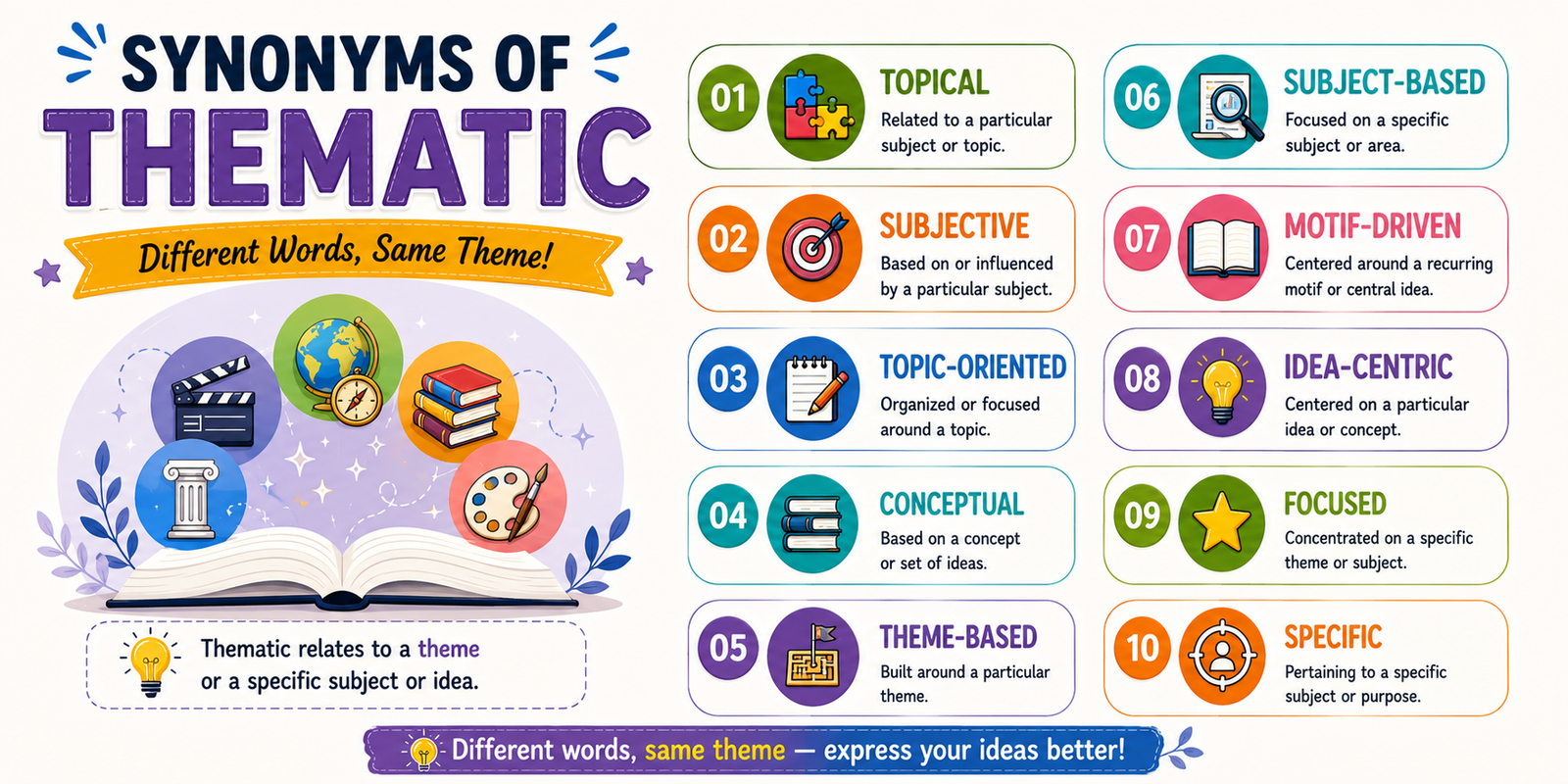
The closest useful synonyms of thematic include topical, theme-based, subject-focused, theme-oriented, motif-based, and subject-related. However, these alternatives are not interchangeable in every sentence.
For example, theme-based is especially clear when describing an organized structure, whereas topical can mean related to a subject or, in other contexts, related to current affairs. Conceptual is related but usually emphasizes ideas rather than themes.
Core Synonym Resource
| Word or phrase | Relationship | Meaning | Strength | Formality | Best context |
|---|---|---|---|---|---|
| Theme-based | Direct/contextual | Organized around a particular theme | Similar | Neutral | Projects, lessons, design |
| Theme-oriented | Direct/contextual | Focused on a particular theme | Similar | Neutral–formal | Research, analysis |
| Subject-focused | Contextual | Concentrating on a particular subject | Similar | Neutral | Academic and professional writing |
| Subject-related | Contextual | Connected with a particular subject | Slightly broader | Neutral | General writing |
| Topical | Near-synonym | Relating to a topic or subject | Similar in some contexts | Neutral–formal | Discussions, issues, research |
| Motif-based | Contextual | Built around recurring motifs | More specific | Formal | Literature, art, music |
| Theme-centered | Contextual | Centered on a particular theme | Similar | Neutral | Education, design, analysis |
| Theme-oriented | Contextual | Directed toward a theme | Similar | Formal | Research and academic writing |
| Conceptual | Near-synonym | Related to ideas or concepts | Different emphasis | Formal | Theory, design, analysis |
| Ideational | Near-synonym | Related to ideas or concepts | Different emphasis | Formal | Academic writing |
| Narrative | Related/contextual | Connected with a story or storytelling | Different meaning | Neutral–formal | Literature, film |
| Subject-matter-based | Contextual | Organized according to subject matter | Similar in limited contexts | Formal | Education, research |
| Topically organized | Contextual | Arranged according to topics | Similar in limited contexts | Formal | Reports, websites, courses |
| Motivic | Specialized | Relating to a recurring motif | More specific | Formal | Music, literature |
| Theme-driven | Contextual | Guided or shaped by a central theme | Similar | Neutral | Creative work, analysis |
The important point is that these are not 15 perfect substitutes. Some are better treated as contextual alternatives. This distinction matters because dictionary and thesaurus results can combine closely related vocabulary with genuine synonyms. For instance, WordHippo separates several meanings of thematic, including theme/topic-related, musical, current-affairs-related, and atmospheric uses.
What Does “Thematic” Mean?
Thematic is an adjective meaning related to a theme, subject, or recurring idea. It can describe something that is organized around a central theme or that examines themes within a work.
For example:
- The novel has several thematic similarities.
- The museum created a thematic exhibition about migration.
- The researchers conducted a thematic analysis of the interviews.
- The film contains several important thematic elements.
The word is particularly common in academic and analytical contexts. Collins lists collocations such as thematic concern, thematic element, and thematic focus, which demonstrate how naturally the adjective works with analytical nouns.
Pronunciation
Thematic: /θiˈmætɪk/
The primary stress falls on the second syllable: the-MAT-ic.
The Best Synonyms of Thematic by Context
The most useful way to choose an alternative is to consider what “thematic” is describing.
For a project, course, or collection: “theme-based”
Theme-based is one of the clearest alternatives when something is deliberately organized around a particular theme.
Example:
The school introduced a theme-based reading program.
This sounds natural when describing educational programs, exhibitions, events, activities, or collections.
Choose “theme-based” when: you want to emphasize the organizing principle.
For research or analysis: “theme-oriented”
Theme-oriented emphasizes a focus on themes.
Example:
The study uses a theme-oriented approach to examine the participants’ responses.
It is particularly useful in formal or academic writing.
Choose “theme-oriented” when: the emphasis is on an analytical approach centered on themes.
For a subject or topic: “subject-focused”
Subject-focused emphasizes concentration on a particular subject rather than necessarily a recurring literary or artistic theme.
Example:
The report provides a subject-focused discussion of renewable energy.
This can be clearer than thematic when your meaning is simply “focused on a subject.”
For recurring patterns in art or literature: “motif-based”
Motif-based is narrower than thematic. A motif is a recurring element, image, idea, or pattern, so this alternative should not be used when you simply mean “related to a theme.”
Example:
The novel uses a motif-based structure built around images of water.
Choose “motif-based” when: recurring motifs are specifically important.
For ideas and theories: “conceptual”
Conceptual overlaps with thematic, but the emphasis is different.
Thematic asks:
What theme or recurring subject does this concern?
Conceptual asks:
What idea, concept, or abstract framework does this concern?
For example:
The exhibition has a strong thematic focus on identity.
But:
The exhibition explores the conceptual relationship between identity and memory.
Therefore, conceptual is a near-synonym, not a universal substitute.
Which Word Should I Use?
Use this quick decision guide:
Choose thematic when:
You are discussing themes, recurring ideas, or the overall thematic content of a work.
The novel has a strong thematic focus on identity.
Choose theme-based when:
Something is explicitly organized around a theme.
The lesson uses a theme-based approach.
Choose subject-focused when:
You mean concentrated on a particular subject.
The article takes a subject-focused approach.
Choose topical when:
You mean related to a topic or subject. Be careful, however, because topical can also mean related to current or contemporary issues.
The discussion addresses topical environmental concerns.
Choose motif-based when:
Recurring motifs are the specific focus.
The artist developed a motif-based visual language.
Choose conceptual when:
The emphasis is on an idea or abstract concept rather than a theme.
The project explores several conceptual questions.
Important Synonym Comparisons
Thematic vs. Topical
These words overlap, but they are not identical.
Thematic usually concerns a theme or recurring idea within a work, subject, or body of material.
Topical usually means related to a topic. In another common sense, it can mean related to current events or matters of present interest.
Compare:
The essay examines the thematic relationship between freedom and responsibility.
versus:
The essay discusses topical issues in modern education.
The first concerns themes within an analytical work. The second concerns subjects or current issues.
Therefore, topical is a useful near-synonym, but not always a safe replacement.
Thematic vs. Conceptual
Both words can describe abstract content, but they focus on different things.
Thematic = connected with a theme.
Conceptual = connected with an idea, concept, or theoretical framework.
For example:
The film has a strong thematic connection to loneliness.
The installation raises several conceptual questions about identity.
So, if you are discussing recurring themes, use thematic. If you are discussing abstract ideas, conceptual may be more accurate.
Thematic vs. Narrative
Narrative relates primarily to storytelling, plot, or the way events are presented as a story.
Thematic relates to themes or underlying ideas.
A novel can therefore have:
- a narrative structure
- a thematic structure
These are related but different concepts.
The film’s narrative follows two families over three decades.
The film’s thematic concerns include memory and belonging.
Using narrative as a general synonym for thematic would therefore be misleading.
Thematic vs. Motif-Based
A theme is a broader idea or subject, while a motif is a recurring element that can help express a theme.
For example, loneliness may be a theme, while repeated images of empty rooms may function as a motif.
Therefore:
Thematic = broader and more general.
Motif-based = more specific to recurring elements.
This distinction is especially useful in literary and artistic analysis.
Common Collocations With “Thematic”
Understanding collocations can help you choose alternatives naturally.
Thematic approach
The researchers adopted a thematic approach to the data.
Possible alternatives:
- theme-based approach
- theme-oriented approach
- subject-focused approach
Thematic analysis
The interviews were examined through thematic analysis.
Here, simply replacing thematic with conceptual or narrative would usually change the meaning.
Thematic elements
The film contains several thematic elements.
Possible contextual alternatives:
- theme-based elements
- recurring themes
- thematic motifs
Thematic focus
The novel has a strong thematic focus on identity.
Possible alternatives:
- central themes
- thematic emphasis
- focus on recurring themes
Thematic structure
The exhibition has a clear thematic structure.
Possible alternatives:
- theme-based structure
- theme-centered structure
- topic-based structure
The best replacement depends on whether the original sentence emphasizes themes, topics, organization, or recurring motifs.
Common Mistakes When Using Synonyms of Thematic
1. Treating “topical” as an exact synonym
Although topical can mean related to a topic, it can also mean related to current events or matters of present interest. Therefore, it does not always carry the same meaning as thematic.
2. Using “conceptual” when you mean “theme-based”
A conceptual approach focuses on concepts or ideas. A thematic approach focuses on themes. The two can overlap, but they are not interchangeable in every context.
3. Using “narrative” as a replacement
Narrative concerns storytelling and story structure. It should not automatically replace thematic.
4. Calling every theme-related word a synonym
Words such as theme, motif, subject, concept, and narrative are closely connected to thematic, but they belong to different grammatical or semantic categories.
For example, theme is normally a noun, while thematic is an adjective.
5. Overusing “theme-based”
Although theme-based is clear, repeating it throughout formal writing can sound mechanical. Sometimes the original thematic is the more natural choice.
Related Words That Are Not Exact Synonyms
Some vocabulary is useful for understanding thematic but should not be presented as a direct replacement.
Theme
The central subject, idea, or concern.
Topic
The subject being discussed or examined.
Motif
A recurring element, image, idea, or pattern.
Subject matter
The material or subject being discussed.
Concept
An abstract idea or general notion.
Narrative
A story or the structure through which a story is presented.
These words form part of the same semantic field, but their grammatical roles and meanings differ.
Antonyms of Thematic
There is no single opposite that works perfectly in every context.
Depending on what you mean, useful contrasts can include:
- non-thematic
- unrelated
- disconnected
- random
- unstructured
- miscellaneous
For example:
The exhibition follows a clear thematic structure.
could contrast with:
The exhibition presents a miscellaneous collection of unrelated works.
The appropriate opposite depends on whether you are contrasting thematic with a lack of organization, a lack of connection, or simply a lack of a central theme.
Etymology of “Thematic”
Thematic ultimately comes from Greek thematikos, related to thema, meaning a subject or theme. The English adjective developed from this idea of something concerning a theme or subject.
The historical connection explains why the modern adjective naturally appears in discussions of literature, art, music, research, and other fields where themes and subjects are analyzed.
FAQ About Synonyms of Thematic
What is the closest synonym for thematic?
Theme-based is one of the clearest alternatives when you mean “organized around a particular theme.” Topical can also overlap with thematic when the intended meaning is “related to a topic,” but it has additional meanings and therefore is not always interchangeable.
What is another word for thematic approach?
Depending on the context, alternatives include theme-based approach, theme-oriented approach, and subject-focused approach. Theme-based approach is usually the clearest choice when the method is explicitly organized around themes.
Is topical a synonym for thematic?
Sometimes, but not always. Topical can mean related to a topic, which overlaps with one meaning of thematic. However, topical can also describe something current or relevant to present-day issues, so replacing thematic with it can change the meaning.
What is a synonym for thematic analysis?
In research writing, it is generally better to retain the established term thematic analysis rather than replace it with a loose synonym. In a general explanation, you could describe it as theme-based analysis or analysis organized around recurring themes, depending on what you need to communicate.
What is a synonym for thematic elements?
Depending on the context, you could use themes, theme-based elements, or recurring motifs. However, motifs are more specific because they refer to recurring elements rather than themes in general.
Is conceptual the same as thematic?
No. Conceptual relates primarily to concepts or ideas, whereas thematic relates to themes or recurring subjects. They may overlap in academic and artistic discussions, but they should not automatically be substituted for one another.
What is the difference between thematic and narrative?
Thematic concerns themes and underlying ideas. Narrative concerns storytelling, plot, or the structure used to tell a story. A work can have both a narrative structure and a thematic focus.
Is theme-based a good synonym for thematic?
Yes, in many contexts. Theme-based is particularly useful when something is deliberately organized around a theme, such as a lesson, exhibition, event, activity, or project. It is more transparent and sometimes more conversational than thematic.
Conclusion
The best synonyms of thematic depend on the exact meaning you want to preserve. Theme-based, theme-oriented, and theme-centered are strong alternatives when something is organized around a theme. Subject-focused works better when the emphasis is simply on a subject, while topical can work when you mean related to a topic. Conceptual, narrative, and motif-based are useful related terms, but each introduces a different emphasis.

David Wilson is a content strategist and SEO expert who focuses on creating structured vocabulary content. He combines keyword research with simple explanations to make learning English both effective and search-friendly.