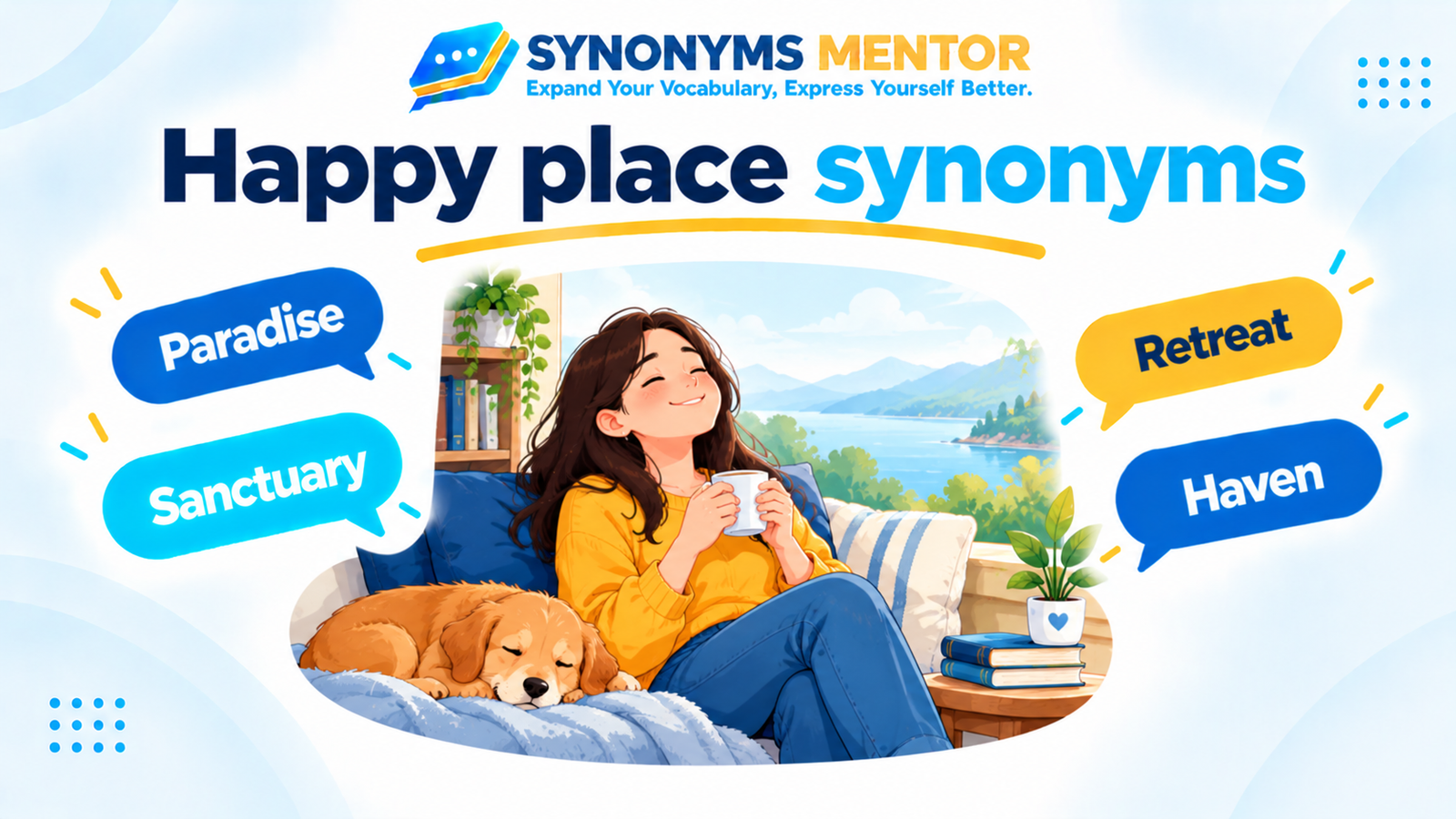
Happy Place Synonyms: 25+ Better Alternatives With Examples
A happy place is something that makes you feel happy, comfortable, peaceful, or relaxed. Although the phrase often refers to a physical location, it can also describe a memory, activity, experience, or situation that creates positive feelings.
Because of this, there is no single perfect synonym for happy place. For example, sanctuary emphasizes safety and peace, whereas paradise emphasizes an ideal or exceptionally pleasant place. Therefore, the best alternative depends on what you want to emphasize.
Below, you will find useful alternatives organized by meaning, context, tone, and natural usage.
Quick Answer: What Are the Best Synonyms for “Happy Place”?
The closest alternatives to happy place include sanctuary, haven, retreat, oasis, comfort zone, peaceful place, place of comfort, favorite place, and personal refuge. However, these expressions are not interchangeable in every situation.
For instance, sanctuary suggests safety and peace, while retreat suggests somewhere you go to escape everyday pressures. Meanwhile, paradise is stronger and more idealized.
Best Happy Place Synonyms at a Glance
| Word or phrase | Relationship | Main idea | Best context | Formality |
|---|---|---|---|---|
| Sanctuary | Close alternative | Safety and peace | Emotional or physical refuge | Neutral/formal |
| Haven | Close alternative | Safe, peaceful place | People, homes, locations | Neutral |
| Retreat | Contextual alternative | Escape and relaxation | Travel, nature, personal space | Neutral |
| Oasis | Contextual alternative | Relief in difficult surroundings | Figurative writing | Literary |
| Comfort zone | Near synonym | Familiarity and ease | Personal situations | Neutral |
| Peaceful place | Direct paraphrase | Calm and tranquility | General writing | Neutral |
| Place of comfort | Direct paraphrase | Emotional comfort | Personal writing | Neutral |
| Favorite place | Contextual alternative | A personally preferred location | Everyday speech | Neutral |
| Personal refuge | Contextual alternative | Emotional escape or safety | Reflective writing | Formal |
| Safe haven | Close alternative | Security and protection | Emotional or physical contexts | Neutral |
| Paradise | Stronger alternative | Ideal happiness or beauty | Descriptive writing | Neutral |
| Happy retreat | Phrase alternative | Relaxation and enjoyment | Travel/lifestyle | Neutral |
| Place of peace | Contextual alternative | Calm and serenity | Reflective writing | Neutral |
| Joyful place | Contextual alternative | Happiness and positive energy | Descriptive writing | Neutral |
| Escape | Related alternative | Getting away from pressure | Informal/general | Neutral |
| Dreamland | Figurative alternative | An imagined or ideal world | Creative writing | Informal/literary |
| Wonderland | Figurative alternative | Magical, wonderful place | Creative writing | Informal/literary |
| Piece of paradise | Figurative alternative | Exceptionally pleasant place | Descriptive writing | Neutral |
| Piece of heaven | Figurative alternative | Extremely pleasant place | Emotional/descriptive | Informal |
| Home away from home | Contextual alternative | Familiarity and belonging | Travel/community | Neutral |
What Does “Happy Place” Mean?
Happy place is an idiomatic noun phrase describing a place, memory, activity, experience, or situation that produces feelings of happiness, comfort, or relaxation.
The expression can therefore describe both physical and nonphysical experiences.
For example:
- The beach is my happy place.
- Reading is my happy place.
- Thinking about my childhood home takes me to my happy place.
- She goes to her happy place whenever she needs to relax.
Consequently, replacing happy place with another expression requires attention to context.
The Closest Alternatives to “Happy Place”
1. Sanctuary
Sanctuary is one of the strongest alternatives when the emphasis is on peace, safety, and protection.
Her garden became a sanctuary from the noise of everyday life.
Unlike happy place, sanctuary does not necessarily imply happiness. Instead, it suggests somewhere a person can feel protected or peaceful.
Best for: peaceful spaces, homes, nature, emotional refuge.
2. Haven
A haven is a safe or peaceful place. Therefore, it works particularly well when your “happy place” provides security as well as comfort.
The little bookstore became a haven for people who loved quiet afternoons.
Compared with sanctuary, haven often sounds slightly more everyday and can describe both literal and figurative places.
3. Retreat
A retreat is a place or period used for rest, relaxation, or escape from ordinary pressures.
The cabin in the mountains is my favorite retreat.
Use retreat when the idea of getting away and recharging matters more than simple happiness.
4. Oasis
An oasis can describe a place of calm or relief surrounded by something difficult, busy, or unpleasant.
The small garden was an oasis of calm in the middle of the city.
As a result, oasis is especially effective in descriptive and literary writing.
5. Comfort Zone
A comfort zone describes a situation or environment in which someone feels comfortable and familiar.
The studio has always been my comfort zone.
However, this is not an exact synonym for happy place. A comfort zone emphasizes familiarity and ease, whereas a happy place emphasizes happiness and positive emotion.
Contextual Alternatives
For a Physical Location
If you mean an actual location that makes you feel happy, consider:
- favorite place
- peaceful place
- sanctuary
- haven
- retreat
- oasis
- place of peace
- home away from home
For example:
The lake is my favorite place to clear my mind.
Here, favorite place is more natural than sanctuary if you simply mean a location you particularly enjoy.
For Emotional Comfort
If the emphasis is on feeling safe, calm, or emotionally supported, use:
- sanctuary
- haven
- safe haven
- personal refuge
- place of comfort
- source of comfort
For example:
Her grandmother’s house was a safe haven during difficult times.
In this case, safe haven communicates more than happiness; it also communicates security.
For Relaxation
If your “happy place” is somewhere you go to rest, alternatives include:
- retreat
- escape
- peaceful spot
- place of relaxation
- quiet refuge
For example:
The cabin is my favorite retreat after a busy week.
For an Ideal or Beautiful Place
If you want to emphasize beauty, perfection, or an almost dreamlike quality, consider:
- paradise
- piece of paradise
- piece of heaven
- dreamland
- wonderland
For example:
The island felt like a piece of paradise.
These expressions are stronger and more figurative than happy place.
Which Word Should You Use?
The right choice depends on the feeling you want to communicate.
Choose “sanctuary” when you want to emphasize peace, safety, or protection.
Choose “haven” when you want to describe a safe and welcoming place.
Use “retreat” when you want to emphasize getting away from stress or routine.
Use “oasis” when you want to contrast calmness with a busy or difficult environment.
Choose “comfort zone” when familiarity and emotional ease are more important than happiness itself.
Choose “paradise” when the place feels exceptionally beautiful, enjoyable, or ideal.
Use “favorite place” when you simply mean a location you personally enjoy.
Use “home away from home” when the place gives you a strong sense of familiarity and belonging.
Happy Place vs. Comfort Zone
These expressions overlap, but they are not identical.
A happy place is something that makes you feel happy, relaxed, or fulfilled. A comfort zone is a familiar situation or environment where you feel comfortable and generally do not feel challenged.
For example:
The beach is my happy place.
This means the beach gives you positive feelings.
Working from home is my comfort zone.
This emphasizes familiarity and ease.
Therefore, something can be your comfort zone without being your strongest source of happiness.
Happy Place vs. Sanctuary
Both expressions can describe a peaceful environment. However, sanctuary has a stronger association with safety, protection, and refuge.
Compare:
The library is my happy place.
The library makes the speaker happy.
The library is my sanctuary.
The library provides a peaceful escape or refuge.
Consequently, sanctuary is a good alternative when your meaning includes emotional protection.
Happy Place vs. Paradise
Paradise describes an exceptionally beautiful, enjoyable, or ideal place. It is therefore stronger and more dramatic than happy place.
This beach is my happy place.
sounds personal and conversational.
This beach is paradise.
sounds more emphatic and descriptive.
So, use paradise when you want stronger imagery rather than a simple personal expression.
Natural Examples of “Happy Place” Alternatives
Here are several ways to express the idea naturally:
- The garden is my sanctuary.
- The cabin is my personal retreat.
- The café has become my favorite place.
- The beach feels like a piece of paradise.
- My bedroom is my safe haven.
- The forest is my oasis of peace.
- Her grandmother’s home was a place of comfort.
- The little town became her home away from home.
- Reading is her source of comfort.
- The mountains are his peaceful escape.
Notice that the alternatives change the emphasis. Therefore, choosing a synonym is not simply about replacing one phrase with another; it is about choosing the specific emotional meaning you want.
Common Mistakes When Choosing a “Happy Place” Synonym
Mistake 1: Treating every related word as an exact synonym
Words such as paradise, sanctuary, comfort zone, and retreat overlap with happy place, but they emphasize different ideas.
Mistake 2: Using “comfort zone” when you mean happiness
A comfort zone is primarily about familiarity and ease. It does not automatically mean something brings joy.
Mistake 3: Using “paradise” in ordinary situations
Paradise can sound exaggerated if you are simply describing a place you enjoy.
Mistake 4: Using “sanctuary” when safety is irrelevant
If you simply want to say that you love a coffee shop, favorite place may sound much more natural than sanctuary.
Mistake 5: Forgetting that “happy place” can describe activities
A happy place does not have to be a physical location. Merriam-Webster specifically includes activities and experiences in its definition.
For example:
Painting is my happy place.
Here, creative outlet or source of joy may be more appropriate than a location-based word such as haven.
Related Expressions
Some expressions are useful because they capture part of the idea without being strict synonyms:
- source of joy
- source of comfort
- place of peace
- peaceful escape
- personal refuge
- favorite spot
- safe space
- inner sanctuary
- home away from home
- place of belonging
These should be treated as contextual alternatives or related expressions, rather than interchangeable dictionary synonyms.
FAQ
What is another word for “happy place”?
Depending on the context, another word for happy place can be sanctuary, haven, retreat, oasis, favorite place, safe haven, personal refuge, or place of comfort. The best choice depends on whether you want to emphasize happiness, safety, peace, familiarity, or relaxation.
What is a formal word for “happy place”?
There is no single formal replacement that works in every context. Sanctuary, personal refuge, and place of comfort can sound more formal or literary, depending on the sentence. However, happy place itself is perfectly natural in everyday English.
What is a synonym for a peaceful happy place?
Good options include sanctuary, haven, retreat, oasis, place of peace, and peaceful refuge. Among these, sanctuary and haven are especially useful when the location provides both peace and emotional security.
Is “comfort zone” the same as “happy place”?
No. They overlap, but they have different meanings. A happy place is something that produces happiness, comfort, or positive feelings, whereas a comfort zone is a familiar situation in which someone feels comfortable. Therefore, they cannot always replace each other.
Is “paradise” a synonym for “happy place”?
Sometimes, especially when the happy place is exceptionally beautiful or enjoyable. However, paradise is stronger and more idealized. It describes an almost perfect place, while happy place can refer to something much more ordinary and personal.
Can an activity be a “happy place”?
Yes. A happy place does not have to be a physical location. Reading, painting, exercising, listening to music, cooking, or another enjoyable activity can function as someone’s “happy place.” Merriam-Webster explicitly includes activities and experiences in the meaning of the expression.
What is the best synonym for “my happy place”?
For everyday writing, favorite place is often the simplest choice. However, if you mean a place that gives you peace and emotional safety, sanctuary, haven, or safe haven may communicate the idea better. If you mean relaxation and escape, retreat is often more appropriate.
Conclusion
The best happy place synonym depends on the exact feeling you want to express. Sanctuary emphasizes safety and peace, haven suggests protection and comfort, retreat emphasizes relaxation, oasis suggests relief, and paradise creates a stronger sense of beauty and perfection. Meanwhile, favorite place is the simplest everyday alternative.

James Anderson is an English teacher and language researcher who creates easy synonym guides and vocabulary lessons. His goal is to help students and writers improve their language skills through simple and clear explanations.