To Conclude Synonyms: 20 Better Alternatives for Essays & Writing
If you are looking for to conclude synonyms, the best alternative depends on what you mean by “conclude.” In an essay, to summarize, in summary, or to sum up can introduce a final overview. In a formal presentation, in closing or as a final point may sound more natural. If conclude means “bring something to an end,” words such as finish, end, and complete are closer synonyms.
The key is not simply to find a different phrase. It is to choose one that matches your meaning, tone, and context.
Quick Answer: What Are the Best Synonyms for “To Conclude”?
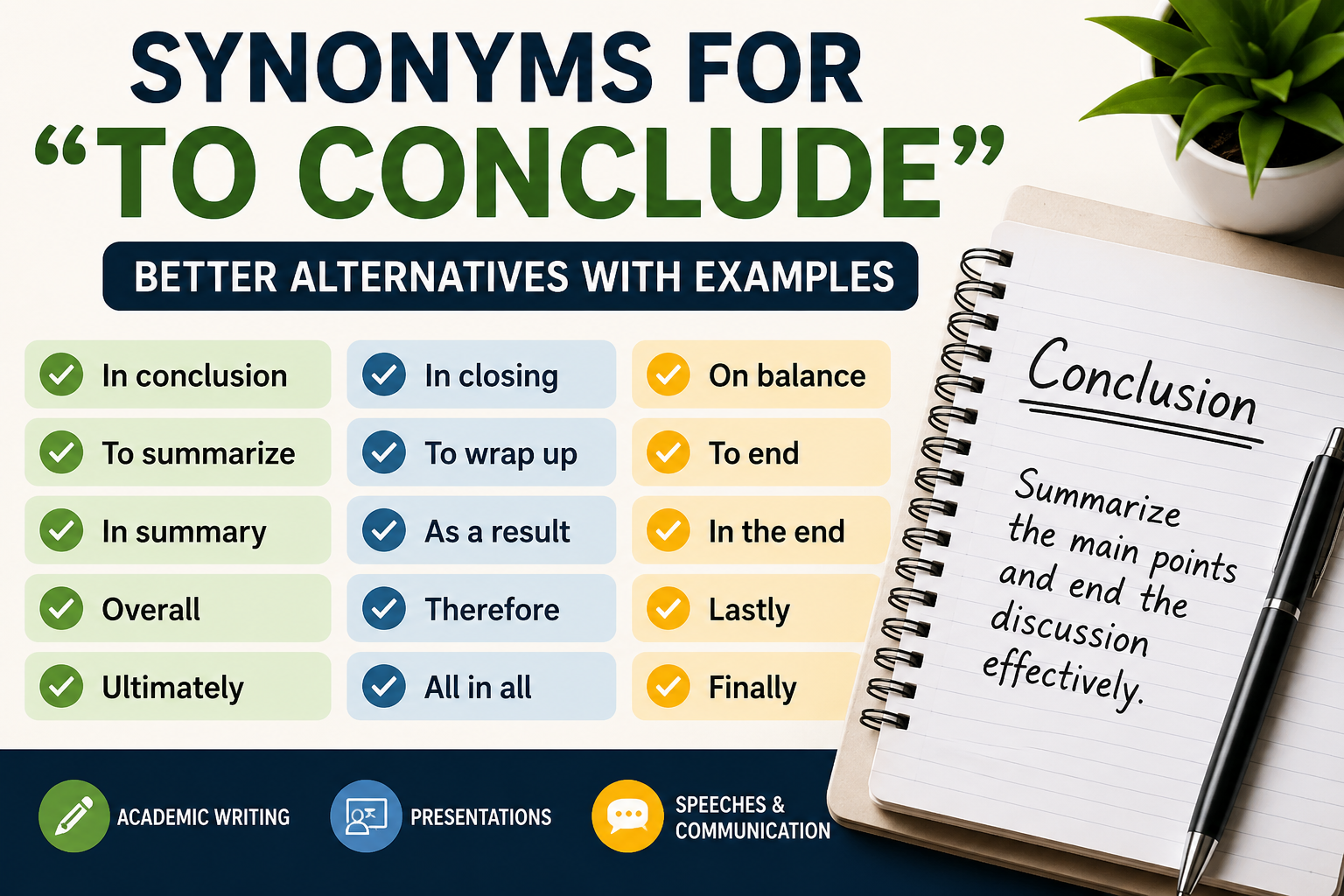
Some useful alternatives to to conclude include:
- To summarize — emphasizes a brief review of the main points.
- In summary — formal and clear; introduces a summary.
- To sum up — natural and slightly less formal.
- In conclusion — directly signals the final section or thought.
- In closing — useful for speeches, presentations, and professional communication.
- Overall — gives a broad final assessment.
- Ultimately — emphasizes the final result or judgment.
- All in all — natural for general or less formal writing.
- In short — reduces the discussion to its essential point.
- On balance — useful when weighing advantages and disadvantages.
- All things considered — signals a judgment after considering several factors.
- In brief — introduces a concise summary.
- As a final point — introduces one last argument or observation.
- To wrap up — informal and conversational.
- In the end — emphasizes the final result or outcome.
- Finally — signals the last point, but does not necessarily summarize everything.
- On the whole — gives an overall assessment.
- Taking everything into account — emphasizes a conclusion based on several considerations.
- To bring this discussion to a close — formal and explicit.
- As a final observation — useful when ending an analytical discussion.
However, these are not all exact synonyms. Some are functional alternatives used to signal a conclusion rather than replacements for the verb conclude.
What Does “Conclude” Mean?
Conclude is a verb with several meanings.
It can mean to bring something to an end, as in:
The conference concluded at 5 p.m.
It can also mean to reach a judgment or belief based on information or evidence:
The researchers concluded that the treatment was effective.
A third use involves formally settling or arranging something, especially an agreement:
The two countries concluded a trade agreement.
Oxford lists these major senses of conclude, while Merriam-Webster similarly distinguishes ending something, reaching a judgment, and reaching an agreement.
This matters because the best synonym changes with the meaning.
The Best “To Conclude” Alternatives for Essays
If you are writing an essay and want an alternative to “To conclude,” do not automatically replace it with another word meaning “finish.” You usually need a phrase that introduces your final synthesis or judgment.
1. To Summarize
Best for: academic and formal writing
To summarize, the evidence suggests that early intervention produces better outcomes.
Why use it: It tells the reader that you are briefly reviewing the main ideas.
Important distinction: To summarize focuses specifically on condensing information. It does not necessarily mean that you are presenting a final judgment.
2. In Summary
Best for: academic, professional, and formal writing
In summary, the study found significant differences between the two groups.
It is a straightforward alternative to to conclude when your final paragraph mainly summarizes the preceding discussion.
3. To Sum Up
Best for: general, professional, and moderately formal writing
To sum up, the proposal offers several benefits but also presents some practical challenges.
This is natural English, but it is generally less formal than in summary.
4. In Conclusion
Best for: essays, reports, academic writing
In conclusion, the evidence supports the proposed approach.
This is not really a synonym for to conclude; it is a closely related conclusion marker. Both phrases explicitly tell the reader that the discussion is ending.
5. Overall
Best for: final evaluation or broad judgment
Overall, the results indicate that the new system performed better.
Overall is especially useful when you want to give an assessment rather than simply announce that you are finishing.
6. Ultimately
Best for: emphasizing the final result or judgment
Ultimately, the success of the project depends on how effectively the team responds to these challenges.
Ultimately focuses on what matters in the final analysis or result. It is not simply a replacement for to conclude.
7. In Closing
Best for: speeches, presentations, letters, and professional communication
In closing, I would like to thank everyone who contributed to the project.
It sounds natural when you are literally bringing a communication event to an end.
8. In Short
Best for: concise summaries
In short, the plan is affordable, practical, and relatively easy to implement.
This works when you want to reduce a longer explanation to its essential message.
9. In Brief
Best for: concise formal summaries
In brief, the evidence does not support the original assumption.
It has a similar function to in short, although it tends to sound somewhat more formal.
10. All in All
Best for: general or moderately informal writing
All in all, the event was a success.
This gives an overall assessment and is less formal than in conclusion.
Quick Comparison of the Best Alternatives
| Alternative | Relationship to “to conclude” | Formality | Best use |
| To summarize | Contextual alternative | Formal | Summarizing key points |
| In summary | Contextual alternative | Formal | Academic and professional writing |
| To sum up | Contextual alternative | Neutral | General writing |
| In conclusion | Conclusion marker | Formal | Essays and reports |
| Overall | Contextual alternative | Neutral | Final assessment |
| Ultimately | Near-synonym | Neutral/Formal | Final result or judgment |
| In closing | Contextual alternative | Formal | Speeches and presentations |
| In short | Contextual alternative | Neutral | Concise final point |
| In brief | Contextual alternative | Formal | Brief summary |
| All in all | Contextual alternative | Informal/Neutral | Overall assessment |
| As a final point | Contextual alternative | Formal | Last argument |
| To wrap up | Contextual alternative | Informal | Conversation and casual communication |
| On balance | Contextual alternative | Formal | Weighing competing factors |
| All things considered | Contextual alternative | Neutral/Formal | Final judgment |
| Finally | Conclusion signal | Neutral | Last point or stage |
| In the end | Contextual alternative | Neutral | Final outcome |
| On the whole | Contextual alternative | Formal/Neutral | Overall assessment |
| Taking everything into account | Contextual alternative | Formal | Evidence-based judgment |
| To bring this discussion to a close | Functional alternative | Formal | Meetings and formal discussion |
| As a final observation | Functional alternative | Formal | Analytical writing |
The important point is that not every entry in this table can replace “to conclude” in the same sentence. The phrases perform overlapping rhetorical functions, but their meanings and collocations differ.
Synonyms for “Conclude” When It Means “Finish”
If you mean conclude = bring something to an end, the closest alternatives are different.
Finish
She finished the report before the deadline.
Finish is one of the most common everyday alternatives. It often emphasizes completing the final part of something.
End
The meeting ended at noon.
End is broad and natural. It emphasizes the point at which something stops.
Complete
The team completed the investigation.
Complete emphasizes that something has been fully done, rather than merely brought to an endpoint.
Close
The chair closed the meeting with a brief statement.
Close is particularly natural for meetings, discussions, sessions, and events that are treated as something being brought to a formal close.
Terminate
The company terminated the contract.
Terminate is more formal and often emphasizes an official or definite ending. It can sound too strong for ordinary situations.
Merriam-Webster notes that conclude, close, end, finish, and complete overlap but differ in emphasis: close can suggest bringing something that was open to an end, complete emphasizes successful completion, end stresses finality, and finish can emphasize the final step in a process.
Synonyms for “Conclude” When It Means “Reach a Judgment”
This is a completely different meaning.
The researchers concluded that the results were reliable.
Here, finish would not work.
Better alternatives include:
Determine
The investigation determined that the equipment had failed.
Determine emphasizes establishing an answer or fact.
Decide
The committee decided that the proposal should be revised.
Decide emphasizes making a judgment or choice.
Infer
From the available evidence, the researchers inferred that the system had malfunctioned.
Infer emphasizes reaching a conclusion from evidence, clues, or information that may not state the answer directly.
Deduce
From the pattern of errors, the engineer deduced that the software contained a configuration problem.
Deduce usually carries a stronger sense of logical reasoning.
Judge
The panel judged the proposal to be impractical.
Judge emphasizes forming an assessment or evaluation.
Cambridge groups decide, determine, judge, deduce, reason, surmise, and infer with the reasoning-related sense of conclude.
These words overlap, but they should not be treated as interchangeable in every context.
“To Conclude” vs. “To Summarize”
These phrases are often confused.
To conclude
Signals that you are bringing an argument, discussion, or piece of communication to its final point.
To conclude, the evidence supports the proposed policy.
To summarize
Signals that you are briefly restating the important information.
To summarize, the study examined three possible explanations.
A conclusion can contain a summary, but the two concepts are not identical.
Choose “to conclude” when: you are presenting your final thought or judgment.
Choose “to summarize” when: your primary purpose is to recap the main points.
“To Conclude” vs. “Finally”
Finally generally means last in sequence.
Finally, we examined the financial consequences.
This tells the reader that this is the last item in a series. It does not necessarily mean that you are summarizing the entire argument.
Compare:
Finally, the researchers examined the financial consequences.
with:
To conclude, the evidence supports the proposed solution.
The first signals a last point. The second signals a final conclusion.
“To Conclude” vs. “Ultimately”
Ultimately focuses on the final result, outcome, or judgment.
Ultimately, the project failed because the budget was insufficient.
It can appear near the end of an article, but it does not simply mean “I am now ending my article.”
Use ultimately when the idea of a final result matters.
“To Conclude” vs. “To Sum Up”
These are often interchangeable when introducing a summary.
To conclude, the evidence supports the proposal.
To sum up, the evidence supports the proposal.
However, to sum up emphasizes summarization more strongly and generally sounds less formal.
For academic writing, to summarize or in summary may be preferable when you specifically want to recap evidence.
Natural Alternatives by Context
For Academic Essays
Best choices:
- In conclusion
- To conclude
- In summary
- To summarize
- Overall
- Ultimately
- On balance
Example:
Overall, the evidence suggests that the policy produced mixed results.
Avoid forcing casual expressions such as to wrap up into a highly formal academic argument.
For Presentations and Speeches
Best choices:
- In closing
- To conclude
- As a final point
- To summarize
- Finally
Example:
In closing, I would like to highlight three practical recommendations.
For Business Writing
Best choices:
- In summary
- Overall
- On balance
- Ultimately
- Taking everything into account
- To conclude
Example:
Taking everything into account, the second option represents the lower-risk investment.
For Casual Conversation
Best choices:
- To sum up
- All in all
- In short
- To wrap up
- In the end
Example:
All in all, it was a pretty good experience.
Common Mistakes
Mistake 1: Treating every alternative as an exact synonym
Words such as overall, finally, and ultimately can introduce a final thought, but they do not have exactly the same meaning as to conclude.
Mistake 2: Using “finish” for a conclusion marker
You normally would not write:
Finish, the evidence supports the argument.
Instead:
To conclude, the evidence supports the argument.
Finish is a verb meaning to complete or bring something to an end; it does not function as the same discourse marker.
Mistake 3: Using “infer” when you mean “finish”
The meeting inferred at 5 p.m. ❌
The meeting concluded at 5 p.m. ✓
Infer relates to reaching a conclusion from evidence, not bringing an event to an end.
Mistake 4: Assuming “summarize” and “conclude” mean exactly the same thing
A summary tells readers what the main points were. A conclusion can summarize those points and state their final significance.
Mistake 5: Overusing “in conclusion”
The phrase is perfectly acceptable, but repeatedly announcing conclusions can make writing feel mechanical. Sometimes the strongest conclusion simply states the final insight without a transition phrase.
Do You Need a Synonym for “To Conclude” in an Essay?
Not necessarily.
“To conclude” is grammatically correct and appropriate for formal writing. You do not need to replace it simply to make your vocabulary appear more sophisticated.
If the sentence is a genuine conclusion marker, these are reliable choices:
- To conclude
- In conclusion
- In summary
- To summarize
- Overall
If you are making a final judgment, consider:
- Ultimately
- On balance
- All things considered
- Taking everything into account
If you are simply introducing the last point, use:
- Finally
- As a final point
The best choice is the one that accurately describes what follows.
Frequently Asked Questions
What is the best synonym for “to conclude”?
There is no single best synonym for every context. To summarize, in summary, in conclusion, to sum up, and overall are useful when ending an essay or discussion. If conclude means “finish,” then end, finish, complete, and close are closer synonyms.
What is a formal synonym for “to conclude”?
For formal writing, in conclusion, in summary, to summarize, on balance, and ultimately can work depending on meaning. In closing is particularly suitable for formal speeches and presentations.
What can I say instead of “to conclude” in an essay?
You can use in conclusion, in summary, to summarize, to sum up, overall, or ultimately. However, choose based on the function of the sentence. To summarize emphasizes a recap, while ultimately emphasizes a final judgment.
Is “finally” a synonym for “to conclude”?
Sometimes, but not always. Finally primarily signals the last item or stage in a sequence. To conclude more directly signals a final conclusion or closing statement.
Is “to summarize” the same as “to conclude”?
No. They overlap, but they emphasize different things. To summarize means to give the main points briefly. To conclude signals a final point, judgment, or ending.
What is the difference between “conclude” and “complete”?
Conclude can mean bringing something to an end, while complete emphasizes that all required parts have been successfully finished. For example, you can complete a form, while a meeting typically concludes.
What is another word for “conclude” when it means “decide”?
Depending on the context, alternatives include decide, determine, judge, infer, and deduce. These are not interchangeable in every sentence because they describe different ways of reaching a judgment.
Is “in closing” formal?
Yes. In closing is a natural formal expression, particularly in speeches, presentations, letters, and professional communication. It signals that the speaker or writer is moving to the final remarks.
Conclusion
The best synonym for “to conclude” depends on what you mean and where you are using it. For essays and academic writing, “in conclusion,” “to summarize,” and “in summary” are reliable choices. For a final judgment, “overall,” “ultimately,” or “on balance” may be more precise. In speeches and presentations, “in closing” works naturally, while “finally” is better when introducing the last point rather than summarizing the entire discussion.

Sophia Martinez is an ESL educator who specializes in teaching vocabulary and word meanings. She writes beginner-friendly content that helps learners understand synonyms and improve their English fluency step by step.