Synonyms for Turn: 40+ Alternatives for Every Context
The word turn has many meanings, so its synonyms depend heavily on context. You might turn a wheel, turn left at an intersection, turn red, turn an idea into a business, or wait for your turn. These uses cannot all be replaced by the same word.
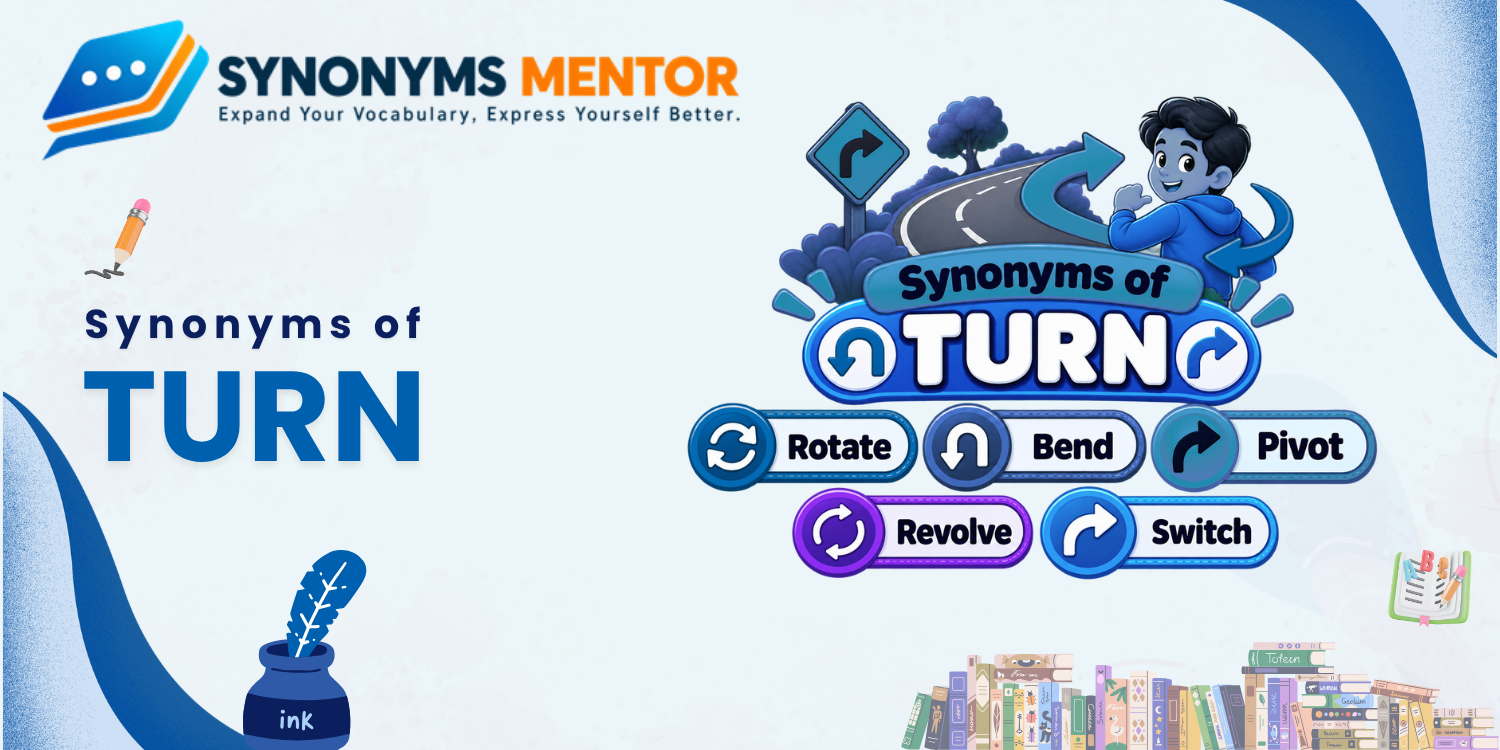
Common synonyms for turn include rotate, spin, pivot, swivel, twist, change, become, transform, shift, redirect, reverse, veer, depend, hinge, opportunity, and chance. The right choice depends on whether turn describes movement, direction, change, transformation, dependence, or an opportunity.
This guide organizes the alternatives by meaning so you can choose a word that sounds natural rather than simply picking a word from a thesaurus.
Quick Answer: What Are the Best Synonyms for Turn?
The best synonym for turn depends on the context. For physical rotation, suitable alternatives include rotate, spin, revolve, pivot, and swivel. A change in direction can be described with words such as swerve, veer, redirect, reverse, or change direction. In the sense of becoming something, become, grow, change, and transform are useful alternatives. If turn refers to an opportunity to act, consider chance, opportunity, go, or attempt.
Core Synonyms for Turn
| Word | Relationship | Meaning | Strength | Best Context |
|---|---|---|---|---|
| rotate | Direct/near synonym | Move around an axis or center | Similar | Objects, machinery, movement |
| spin | Near synonym | Rotate rapidly or freely | Often stronger | Wheels, bodies, objects |
| revolve | Near synonym | Move continuously around a central point | Similar | Planets, mechanisms |
| pivot | Contextual | Turn around a fixed point | Specific | Bodies, objects, strategy |
| swivel | Contextual | Turn smoothly from side to side | Specific | Chairs, heads, screens |
| twist | Near synonym | Turn with a rotating or bending motion | Different | Handles, bodies, materials |
| change | Direct in some senses | Become different | Broader | Conditions, situations |
| become | Direct in some senses | Begin to be something | Similar | States, qualities |
| transform | Near synonym | Change substantially | Stronger | People, systems, ideas |
| shift | Near synonym | Move or change from one position/state | Similar | Direction, focus, conditions |
| veer | Contextual | Move suddenly away from a direction | More specific | Vehicles, paths, movement |
| swerve | Contextual | Change direction sharply | More specific | Vehicles, people, objects |
| reverse | Contextual | Change to the opposite direction | Stronger | Movement, decisions |
| redirect | Contextual | Send toward a different direction | Specific | Traffic, attention, resources |
| convert | Contextual | Change into another form or use | Specific | Systems, energy, formats |
| depend | Contextual | Be determined by something | Different | Conditions, outcomes |
| hinge | Contextual | Depend entirely or largely on | More formal | Decisions, outcomes |
| opportunity | Contextual noun | A chance to act | Similar | “My turn” |
| chance | Contextual noun | An opportunity or possibility | Similar | “Your turn” |
| go | Contextual noun | A person’s opportunity to act | Informal | Games, conversations |
| attempt | Contextual noun | An effort to do something | Different | Trying something |
The important point is that these words are not interchangeable in every sentence. Rotate can replace turn when something moves around an axis, but it usually cannot replace turn in a sentence such as “It turned cold.”
What Does “Turn” Mean?
Turn can function as both a verb and a noun, and it has numerous meanings.
As a verb, it can describe physical rotation, a change in direction, becoming something, changing something, operating a control, or changing one’s position. For example:
- Turn the handle.
- Turn left at the corner.
- The leaves turned brown.
- She turned the idea into a successful project.
As a noun, turn can mean an opportunity to act, a change in direction, a rotation, a change in circumstances, or a performance. Cambridge’s dictionary entries illustrate these separate senses, while its thesaurus groups alternatives according to individual meanings.
Pronunciation: US /tɝːn/, UK /tɜːn/.
Synonyms for Turn Meaning “Rotate”
When turn means to move around a central point or axis, the strongest alternatives are:
Rotate
Rotate is one of the closest alternatives when something moves around an axis.
Turn the wheel slowly.
Rotate the wheel slowly.
It is especially natural in technical, scientific, and mechanical contexts.
Spin
Spin usually suggests rotation, often rapidly or freely.
The wheel turned quickly.
The wheel spun quickly.
In comparison, spin can sound more dynamic than turn.
Revolve
Revolve describes movement around a central point or object.
The planets revolve around the Sun.
It is more specific than the everyday turn.
Pivot
Pivot means to turn around a fixed point.
She turned toward the door.
She pivoted toward the door.
It is particularly useful when describing a deliberate movement around a central point.
Swivel
Swivel suggests turning smoothly from one side to another.
He turned his chair toward the window.
He swiveled his chair toward the window.
Twist
Twist emphasizes a turning or winding movement.
Turn the cap to open the bottle.
Twist the cap to open the bottle.
Best choices: rotate for neutral/technical writing, spin for rapid rotation, revolve for orbital movement, pivot for turning around a point, and swivel for smooth side-to-side movement.
Cambridge and Merriam-Webster both list rotation-related alternatives such as rotate, spin, revolve, pivot, swivel, twist, and whirl, while noting that their meanings differ by context.
Synonyms for Turn Meaning “Change Direction”
When turn means change the direction in which someone or something is moving or facing, several alternatives become useful.
Change direction
This is the clearest neutral replacement.
The car turned left.
The car changed direction and headed north.
Veer
Veer means to move away from a previous direction, often gradually or unexpectedly.
The cyclist veered toward the sidewalk.
Swerve
Swerve suggests a sudden or sharp change in direction.
The driver swerved to avoid the obstacle.
Redirect
Redirect means to cause something to move or be directed somewhere else.
The police redirected traffic.
It is particularly useful for formal and professional writing.
Reverse
Reverse means to change direction so that movement goes back the opposite way.
The vehicle reversed toward the entrance.
Shift
Shift can describe a change in direction, position, focus, or emphasis.
The discussion shifted toward environmental concerns.
Not every use of shift means physical turning, so it is better treated as a near synonym rather than a universal replacement.
Synonyms for Turn Meaning “Become”
One of the most important meanings of turn is to become a particular condition, color, or state.
The sky turned dark.
Here, the most useful alternatives are:
Become
The most general replacement.
The sky became dark.
Get
A common informal alternative in many constructions.
It’s getting cold.
Grow
Often works when a change develops gradually.
The child grew restless.
Go
Used in certain established expressions, particularly for changes in condition or color.
The milk went sour.
Change
A broad alternative when the emphasis is on becoming different.
The situation changed dramatically.
Cambridge specifically groups become, get, grow, and go with turn in the sense of becoming something.
Choose “become” when:
You want a neutral, general expression.
Choose “grow” when:
The change develops progressively.
Choose “go” when:
The expression naturally uses go, such as certain changes in condition.
Choose “transform” when:
The change is substantial rather than simply a change of state.
Synonyms for Turn Meaning “Transform or Change Something”
Sometimes turn means to change something into another form, state, or use.
They turned the old building into a restaurant.
Possible alternatives include:
- transform
- convert
- change
- alter
- adapt
- reshape
- remake
Transform
Transform emphasizes a substantial change.
They transformed the old building into a modern restaurant.
Convert
Convert is especially appropriate when something changes from one use, system, or form into another.
The company converted the warehouse into offices.
Alter
Alter usually suggests making changes without necessarily creating something completely different.
They altered the design.
Adapt
Adapt emphasizes modifying something so it works for a new purpose or situation.
They adapted the building for office use.
These are contextual alternatives, not universal replacements for turn.
Synonyms for Turn Meaning “Depend On”
Consider:
The decision turns on whether the evidence is reliable.
Here, turn on does not mean physically rotate. It means that something depends on another factor.
The best alternatives include:
- depend on
- hinge on
- be determined by
- rest on
- be contingent on
Depend on
The most natural general alternative.
The outcome depends on the evidence.
Hinge on
A stronger and somewhat more formal expression.
The decision hinges on the evidence.
Be determined by
Useful in formal or analytical writing.
The outcome will be determined by several factors.
Cambridge’s thesaurus identifies depend, hinge, pivot, rest, and related expressions for this particular sense of turn.
Synonyms for Turn Meaning “An Opportunity”
As a noun, turn can mean a person’s opportunity or responsibility to do something.
It’s your turn to answer.
Possible alternatives include:
- opportunity
- chance
- go
- shot
- attempt
- try
But these are not exact equivalents in every situation.
Opportunity
It was my turn to speak.
I had an opportunity to speak.
Opportunity emphasizes the possibility of doing something, whereas turn often emphasizes sequence or fairness.
Chance
Is it your turn?
Do you have a chance?
Chance is broader and does not necessarily imply an established order.
Go
Go is informal and common in games and activities.
It’s your turn.
It’s your go.
Shot
Shot can mean an opportunity to attempt something.
Give me a shot.
It does not mean exactly the same thing as turn.
Synonyms for Turn Meaning “A Change”
In expressions such as:
The situation took a surprising turn.
The noun turn can mean a change or development in circumstances.
Useful alternatives include:
- change
- shift
- development
- alteration
- transition
- change of direction
For example:
The negotiations took an unexpected turn.
The negotiations underwent an unexpected change.
The best choice depends on the type of change being described.
Cambridge also recognizes turn as a noun referring to the development of a situation, including expressions such as “take a turn for the better/worse.”
Which Synonym for “Turn” Should You Use?
| If you mean… | Best choice | Example |
|---|---|---|
| Move around an axis | rotate | Rotate the wheel. |
| Move rapidly around | spin | The wheel spun. |
| Move around a central object | revolve | The Earth revolves around the Sun. |
| Turn around a fixed point | pivot | She pivoted toward him. |
| Turn smoothly sideways | swivel | He swiveled the chair. |
| Change direction suddenly | swerve | The car swerved. |
| Change direction generally | redirect / change direction | They redirected traffic. |
| Become something | become | The sky became dark. |
| Change substantially | transform | The experience transformed her. |
| Change into another form | convert | They converted the file. |
| Depend on | depend on / hinge on | The result depends on timing. |
| Get an opportunity | chance / opportunity | I had a chance to respond. |
| Take one’s place in sequence | go | It’s your go. |
| Change in circumstances | shift / change | Events took a different turn. |
Important Comparisons
Turn vs. Rotate
Turn is broader and more common in everyday English. Rotate specifically emphasizes movement around an axis or center.
Turn the handle.
Rotate the handle.
Both can work, but rotate sounds more technical and precise.
Turn vs. Spin
Spin usually emphasizes faster or freer rotation.
The wheel turned slowly.
The wheel spun rapidly.
A spinning object is turning, but not every instance of turn implies spinning.
Turn vs. Pivot
Pivot describes turning around a fixed point.
She turned toward the audience.
She pivoted toward the audience.
Pivot often suggests a deliberate or noticeable change of position.
Turn vs. Become
When turn means “become,” become is usually the safest neutral replacement.
The leaves turned yellow.
The leaves became yellow.
However, English often favors turn in descriptions of colors or changes in condition.
Turn vs. Transform
Transform implies a more substantial change.
The experience changed him.
The experience transformed him.
Transform is stronger than the ordinary turn when the resulting state is significantly different.
Turn vs. Change
Change is broader. Turn can describe a particular transition, direction, or development, while change simply indicates that something becomes different.
Common Collocations With “Turn”
Because turn has so many meanings, its surrounding words often determine which synonym is appropriate.
Physical movement
- turn a wheel
- turn a handle
- turn a knob
- turn around
- turn over
Possible alternatives: rotate, spin, twist, swivel
Direction
- turn left
- turn right
- turn around
- turn toward
- turn away
Possible alternatives: change direction, veer, swerve, redirect, reverse
Becoming
- turn red
- turn cold
- turn gray
- turn sour
- turn negative
Possible alternatives: become, grow, go, change
Transformation
- turn something into something
- turn an idea into reality
- turn waste into energy
Possible alternatives: transform, convert, change, adapt
Dependence
- turn on a decision
- turn on the outcome
Possible alternatives: depend on, hinge on, be determined by
Common Mistakes With “Turn” Synonyms
1. Treating every synonym as interchangeable
This is the biggest mistake.
You cannot normally replace:
The leaves turned yellow.
with:
The leaves pivoted yellow.
The two words describe completely different meanings.
2. Using “spin” when you only mean change direction
Spin emphasizes rotation. For a vehicle changing direction, turn, veer, swerve, or reverse may be more appropriate depending on the movement.
3. Using “transform” for a minor change
Transform suggests substantial change.
For a small adjustment, change, alter, or modify may be more natural.
4. Assuming “opportunity” always means “turn”
It’s your turn to clean the room.
Here, turn emphasizes sequence or responsibility. Opportunity does not fully preserve that meaning.
5. Confusing “turn” with “turn into”
Turn into specifically expresses transformation:
The caterpillar turned into a butterfly.
The closest alternatives are become or transform, depending on context.
Antonyms of “Turn”
Because turn has many meanings, its antonyms also vary.
For change direction, possible opposites include:
- continue straight
- proceed
- maintain direction
When turn means become, its opposites can include:
- remain
- stay
- continue to be
In the sense of change, suitable opposites are:
- preserve
- maintain
- retain
There is no single antonym that works for every meaning of turn.
FAQ About Synonyms for Turn
What is the most common synonym for “turn”?
There is no single best synonym because turn has many meanings. Rotate is useful when turn means move around an axis, change direction works for movement, become works for a change of state, and chance or opportunity can work when turn means a person’s opportunity to act.
What is another word for “turn” when talking about direction?
Depending on the situation, you can use change direction, veer, swerve, redirect, reverse, or shift. Veer usually suggests moving away from a direction, while swerve suggests a sharper or more sudden movement.
What is a synonym for “turn” meaning “become”?
The most useful alternatives are become, get, grow, go, and change, although their usage differs. For example, “the sky turned dark” can often become “the sky became dark,” while particular expressions may naturally favor get, grow, or go.
What is a formal synonym for “turn”?
There is no single formal replacement. Depending on meaning, rotate, redirect, transform, convert, hinge on, or become may work better in formal writing. The appropriate word depends on the sense of turn you are using.
Is “rotate” the same as “turn”?
Not always. Rotate specifically describes movement around an axis or center, whereas turn has many additional meanings, including changing direction, becoming something, transforming something, and taking an opportunity.
What is a synonym for “turn into”?
Common alternatives include become, transform into, convert into, change into, and develop into. The best choice depends on whether the sentence describes a natural change, a deliberate transformation, or conversion into a different form or use.
What is a synonym for “take a turn”?
The answer depends on the phrase. Take a turn can mean to receive an opportunity, take a different direction, or experience a change in circumstances. For example, “take a turn for the worse” means become worse, while “take a turn” in a game can mean have a go.
Conclusion
Turn is one of the most versatile words in English, which is why there is no single synonym that works everywhere. Use rotate, spin, revolve, pivot, or swivel for rotational movement; veer, swerve, reverse, or redirect for changes in direction; become, grow, or change for changes of state; and transform or convert when describing a substantial change.

James Anderson is an English teacher and language researcher who creates easy synonym guides and vocabulary lessons. His goal is to help students and writers improve their language skills through simple and clear explanations.