Synonyms for Seemingly: Better Alternatives With Examples
Finding a synonym for seemingly is not simply a matter of replacing it with apparently or ostensibly. These words overlap, but they do not always communicate exactly the same idea.
Seemingly is an adverb used when something appears to be true based on how it looks or the information available, while leaving room for the possibility that the reality is different. The best alternative therefore depends on what you want to emphasize: appearance, available evidence, outward behavior, an apparent motive, or doubt about a claim.
Quick Answer
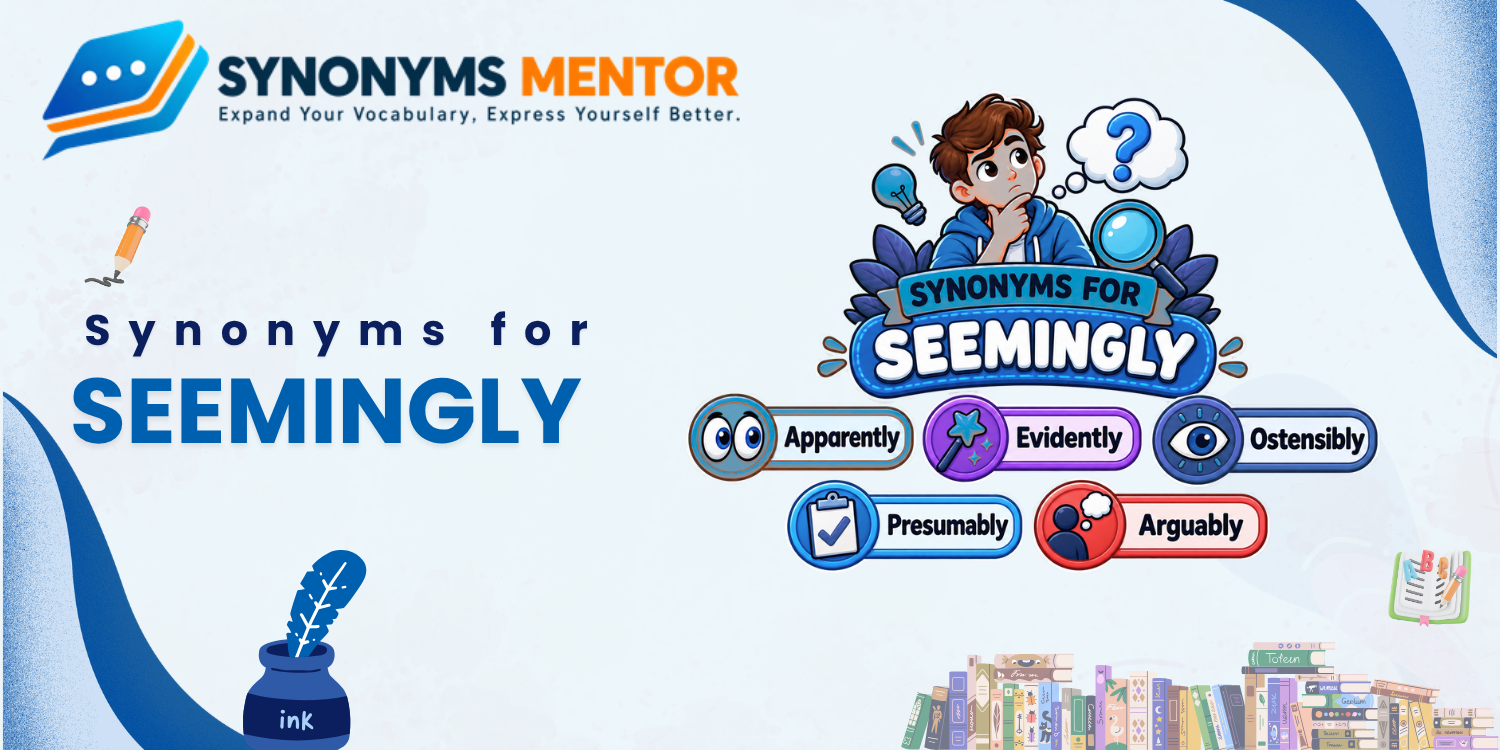
The closest synonyms for seemingly include apparently, ostensibly, outwardly, supposedly, evidently, presumably, superficially, and on the surface. Apparently is usually the safest general replacement. Use ostensibly when an apparent reason or purpose may conceal the real one, outwardly when focusing on external appearance, and supposedly when the truth of a claim is uncertain or viewed skeptically.
Core Synonyms for Seemingly
| Word or Phrase | Relationship | Meaning | Strength | Formality | Best Context |
|---|---|---|---|---|---|
| Apparently | Direct synonym | As it appears or seems to be true | Similar | Neutral | General writing and conversation |
| Ostensibly | Near synonym | Apparently true or done for a stated purpose, sometimes with an implied different reality | Similar | Formal | Motives, purposes, explanations |
| Outwardly | Contextual alternative | In terms of external appearance or behavior | Similar | Neutral/Formal | People, emotions, behavior |
| Supposedly | Near synonym | According to what is claimed or believed, with possible doubt | Similar | Neutral | Claims, reports, expectations |
| Evidently | Near synonym | As appears clear from available evidence | Stronger | Neutral/Formal | Evidence and conclusions |
| Presumably | Near synonym | Based on what is reasonably assumed | Similar | Neutral/Formal | Inferences and assumptions |
| Superficially | Contextual alternative | Based only on surface characteristics | Stronger in limitation | Neutral/Formal | Analysis, appearance, evaluation |
| On the surface | Contextual alternative | Judging only from outward appearances | Similar | Neutral | General explanation |
| On the face of it | Contextual alternative | Based on an initial or obvious view | Similar | Neutral | Reasoning and evaluation |
| To all appearances | Contextual alternative | As far as outward evidence suggests | Similar | Formal/Literary | Formal or descriptive writing |
Several of these relationships are reflected in established thesaurus sources, although their contextual meanings are not identical.
What Does “Seemingly” Mean?
Seemingly is an adverb meaning in a way that appears to be true or real, although the actual situation may be different.
For example:
The seemingly simple task took several hours.
Here, the task appeared simple, but the outcome suggests that it was more complicated than it initially looked.
It can also refer to conclusions based on currently available facts:
The project is seemingly impossible to complete on time.
The speaker is indicating that the project appears impossible based on what is currently known, rather than necessarily claiming absolute certainty. Cambridge and Merriam-Webster both describe this appearance-based sense.
Pronunciation
US: /ˈsiː.mɪŋ.li/
UK: /ˈsiː.mɪŋ.li/
Part of speech: Adverb
The Most Useful Synonyms for Seemingly
1. Apparently
Meaning: As it appears or seems to be true.
Why it works: Apparently is generally the closest and most versatile replacement for seemingly. Collins explicitly treats apparently as a synonym of seemingly.
Example:
The company is apparently planning to expand next year.
Best for: General writing, conversation, reports, and explanations.
Choose “apparently” when:
You simply want to say that something appears to be true based on what you know.
2. Ostensibly
Meaning: Apparently or supposedly, especially when referring to an apparent reason, purpose, or explanation.
This word can carry an implication that the stated reason is not necessarily the real reason.
Example:
He left the meeting ostensibly because he had another appointment.
The sentence can suggest that the appointment was the stated reason, while another motive may have existed.
Best for: Formal writing, motives, purposes, explanations, and analysis.
Seemingly vs ostensibly
- Seemingly: focuses broadly on how something appears.
- Ostensibly: often focuses on an apparent or stated reason or purpose.
3. Outwardly
Meaning: In terms of external appearance or observable behavior.
Example:
She remained outwardly calm during the discussion.
Here, outwardly emphasizes what other people could observe. It does not necessarily mean that she was actually calm internally.
Best for: Emotions, behavior, appearance, and personal reactions.
Choose “outwardly” when:
The contrast is between external appearance and internal reality.
4. Supposedly
Meaning: According to what is claimed, believed, or reported.
Example:
The product is supposedly ready for release.
Unlike seemingly, supposedly can introduce skepticism. The speaker may not fully accept the claim.
Seemingly vs supposedly
The machine is seemingly ready.
This focuses on how the machine appears.
The machine is supposedly ready.
This suggests that someone claims or says it is ready.
That distinction matters in professional and journalistic writing.
5. Evidently
Meaning: In a way that appears clear from the available evidence.
Example:
She had evidently forgotten about the appointment.
Evidently generally places more emphasis on evidence or observable signs than seemingly does.
Choose “evidently” when:
You are drawing a conclusion from something that provides evidence.
6. Presumably
Meaning: Based on a reasonable assumption.
Example:
The store is presumably closed because the lights are off.
The speaker is making an inference rather than simply describing an appearance.
Seemingly vs presumably
- Seemingly: “This is how it appears.”
- Presumably: “This is what I reasonably assume.”
They can overlap, but the reasoning behind the statement is different.
7. Superficially
Meaning: Based only on the surface or most obvious characteristics.
Example:
The two proposals are superficially similar.
This word often suggests that a deeper examination would reveal important differences.
Choose “superficially” when:
You want to emphasize that an observation is only true at a surface level.
8. On the Surface
Meaning: Judging from outward appearance without considering deeper details.
Example:
On the surface, the proposal seems reasonable.
This is a natural alternative in explanatory and conversational writing.
It is particularly useful when you want to contrast an initial impression with a deeper analysis.
9. On the Face of It
Meaning: Based on an initial or obvious assessment.
Example:
On the face of it, the decision seems reasonable.
This phrase is useful when discussing an initial judgment that may require further examination.
It is somewhat more idiomatic than seemingly.
10. To All Appearances
Meaning: As far as the available outward evidence suggests.
Example:
To all appearances, the negotiations had failed.
This is a more formal or literary alternative and works especially well in descriptive writing.
Collins lists to all appearances among the contextual alternatives associated with seemingly.
Which Word Should I Use?
A simple decision guide can make the differences easier to remember.
Choose apparently when:
You need the most natural general replacement for seemingly.
The problem is apparently more complicated than expected.
Choose ostensibly when:
You are discussing an apparent or stated reason that may not be the real one.
He resigned ostensibly for personal reasons.
Choose outwardly when:
You are contrasting external behavior with internal feelings.
He remained outwardly confident.
Choose supposedly when:
Something is claimed or reported and you want to leave room for doubt.
The package was supposedly delivered yesterday.
Choose evidently when:
Available evidence makes a conclusion appear clear.
She had evidently misunderstood the instructions.
Choose presumably when:
You are making a reasonable assumption.
They are presumably waiting for the results.
Choose superficially when:
Something appears true only at the surface level.
The solutions are superficially similar.
Seemingly vs Apparently
These are the closest general alternatives.
| Seemingly | Apparently |
|---|---|
| Focuses on appearance or seeming reality | Focuses on what appears to be true |
| Can suggest that reality may differ | Can also suggest incomplete information |
| Common in descriptive writing | Extremely common in general English |
Example:
The seemingly harmless decision caused major problems.
The apparently harmless decision caused major problems.
Both work naturally. In many sentences, the difference is subtle.
Best choice: Use apparently when you want the most straightforward substitute.
Seemingly vs Ostensibly
These words overlap, but ostensibly is more specialized.
She was seemingly upset.
This describes how she appeared.
She left ostensibly because she was tired.
This introduces an apparent reason for her action.
Rule of thumb:
Use seemingly for general appearance; use ostensibly when discussing an apparent purpose, reason, or explanation.
Seemingly vs Supposedly
This distinction is particularly important.
The treatment is seemingly effective.
The treatment appears effective.
The treatment is supposedly effective.
Someone claims or says it is effective, but the speaker may have reservations.
Therefore, supposedly is not always an interchangeable synonym for seemingly.
Seemingly vs Evidently
Both can introduce an apparent conclusion, but they differ in emphasis.
Seemingly focuses on appearance:
The problem was seemingly solved.
Evidently focuses more strongly on evidence:
The problem was evidently solved because the system started working again.
If the sentence involves a clear clue, observation, or piece of evidence, evidently may be the better choice.
Seemingly vs Presumably
These words represent different kinds of uncertainty.
Seemingly = based on how something appears.
Presumably = based on what you reasonably assume.
Compare:
She was seemingly unaware of the change.
She was presumably unaware of the change.
The first describes her apparent state. The second presents the speaker’s assumption about her state.
Common Contexts for “Seemingly”
Seemingly + Adjective
This is one of the most common patterns.
- seemingly simple
- seemingly impossible
- seemingly harmless
- seemingly endless
- seemingly insignificant
- seemingly unrelated
- seemingly inevitable
- seemingly obvious
For example:
It was a seemingly insignificant decision that changed the entire project.
Seemingly + Verb
He seemingly ignored the warning.
Seemingly + Phrase
The two events were seemingly unrelated.
The word works particularly well when an apparent situation later turns out to be more complicated than expected.
Common Mistakes With Seemingly
1. Treating every synonym as interchangeable
Apparently, supposedly, evidently, and presumably overlap with seemingly, but they can express different sources of uncertainty or reasoning.
2. Using “supposedly” when there is no claim
If you simply mean that something appears to be true, apparently or seemingly may be more accurate.
3. Using “outwardly” for every kind of appearance
Outwardly normally emphasizes external appearance or observable behavior. It is especially useful when contrasting appearance with an internal state.
4. Using “superficially” as a neutral synonym
Superficially can imply that an observation is limited to the surface and may not survive deeper examination. It therefore carries a stronger evaluative nuance.
5. Confusing “seemingly” with certainty
Seemingly does not normally establish that something is definitely true. It signals appearance or an inference based on available information.
Antonyms of Seemingly
There is no single perfect opposite in every context because seemingly describes appearance, not a simple positive/negative quality.
Depending on the sentence, useful contrasts can include:
- actually
- truly
- really
- genuinely
- in reality
- in fact
For example:
The task was seemingly easy, but it was actually difficult.
Here, actually directly contrasts the appearance with the underlying reality.
FAQ
What is the closest synonym for seemingly?
Apparently is usually the closest general synonym. Both can describe something that appears to be true based on available information. However, apparently can sometimes emphasize a conclusion based on what has been learned, while seemingly often emphasizes appearance itself.
What is a formal synonym for seemingly?
Ostensibly is a useful formal alternative, especially when discussing an apparent reason, purpose, or explanation. To all appearances can also work in formal or literary writing.
Is apparently the same as seemingly?
They are very close and are interchangeable in many sentences, but not always. Apparently can emphasize what seems to be true based on available information, whereas seemingly often emphasizes how something appears.
Is supposedly a synonym for seemingly?
Sometimes, but it is not a perfect substitute. Supposedly usually means according to a claim, report, or belief and can imply doubt. Seemingly focuses on appearance or apparent reality.
What is another word for seemingly in formal writing?
Depending on context, use apparently, ostensibly, evidently, presumably, or to all appearances. Ostensibly is particularly useful when discussing an apparent purpose or stated reason.
What is the difference between seemingly and ostensibly?
Seemingly broadly describes something that appears to be true. Ostensibly often describes something that is apparently true or done for an apparent reason, sometimes with an implication that the real situation is different.
What is the difference between seemingly and outwardly?
Seemingly can describe general apparent reality. Outwardly specifically emphasizes external appearance or observable behavior, often in contrast with what is happening internally.
Conclusion
The best synonym for seemingly depends on the idea you want to emphasize. Apparently is the safest general replacement, while ostensibly works well for apparent motives or purposes, outwardly emphasizes external appearance, supposedly can signal doubt about a claim, and evidently emphasizes evidence. Presumably is better when the statement is an assumption, while superficially suggests a surface-level assessment.

James Anderson is an English teacher and language researcher who creates easy synonym guides and vocabulary lessons. His goal is to help students and writers improve their language skills through simple and clear explanations.