Synonyms for Scattered: 25 Better Alternatives With Examples
Finding a good synonym for scattered is more complicated than simply replacing it with dispersed or spread out. The best alternative depends on what is scattered and what you want to emphasize.
You might describe books strewn across a floor, villages dispersed across a region, sporadic rainfall, sparse vegetation, or random ideas in a disorganized discussion. These words overlap with scattered, but each carries a slightly different meaning or emphasis.
This guide classifies the most useful alternatives so you can choose a word that sounds natural and communicates exactly what you mean.
Quick Answer: What Are the Best Synonyms for Scattered?
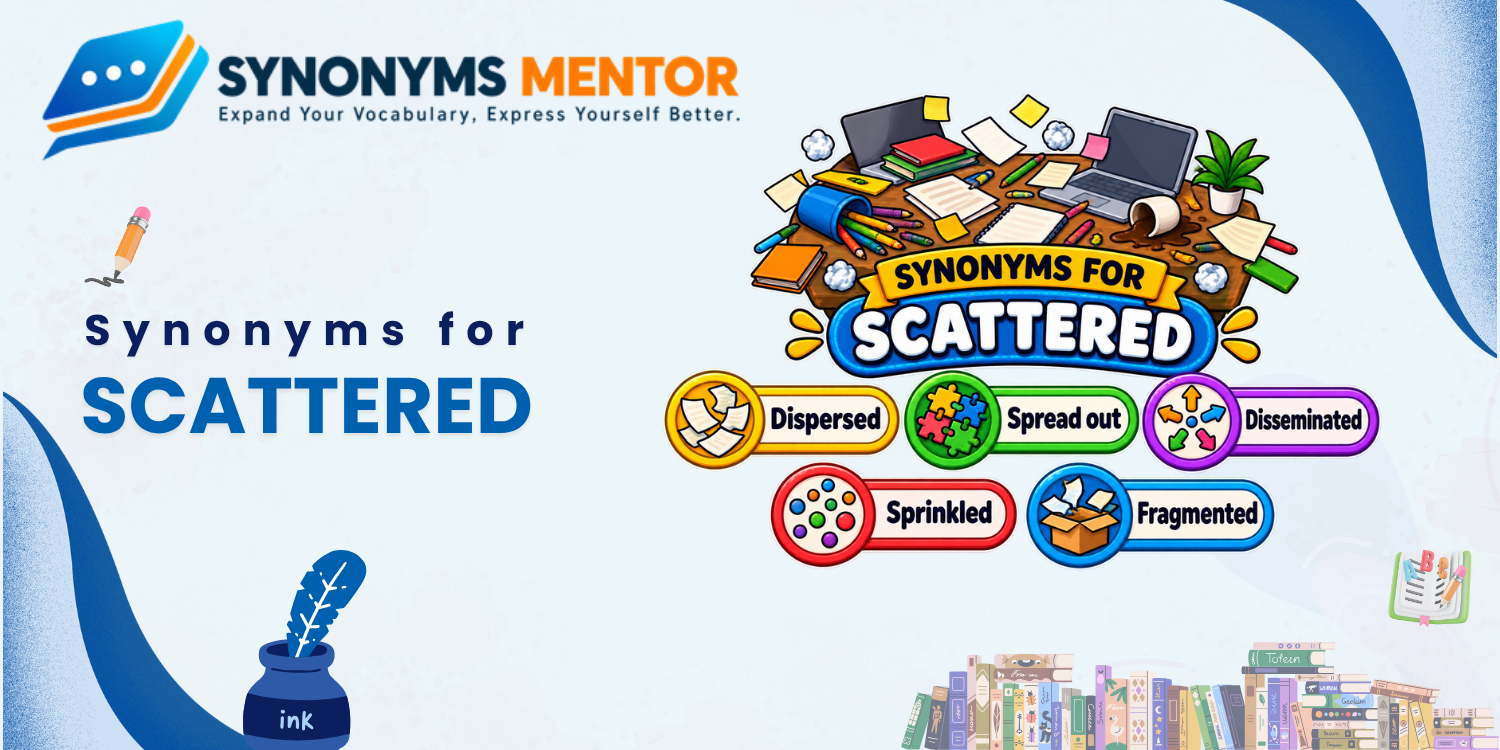
The closest alternatives to scattered include dispersed, spread out, distributed, strewn, dotted, sparse, sporadic, isolated, diffuse, irregular, random, and widely spaced. However, they are not interchangeable in every sentence.
Dispersed is especially useful for things spread across an area, while sporadic emphasizes occasional occurrence and random emphasizes the absence of a pattern.
Core Synonym Resource
Direct Synonyms for Dispersed
The following words are the closest alternatives to dispersed when something is spread across an area or positioned apart from other things.
| Word | Relationship | Meaning | Strength | Formality | Best Context |
|---|---|---|---|---|---|
| Dispersed | Direct/near synonym | Spread over a relatively wide area | Similar | Neutral/Formal | People, populations, settlements, objects |
| Spread out | Direct synonym | Positioned over a larger area rather than close together | Similar | Neutral | People, objects, places |
| Distributed | Contextual synonym | Placed or allocated among different locations | Similar | Neutral/Formal | Resources, information, objects |
| Strewn | Contextual synonym | Spread loosely over a surface or area | Similar | Neutral/Literary | Debris, clothes, papers, objects |
| Dotted | Contextual synonym | Located here and there as separate points | Similar | Neutral | Buildings, trees, islands, lights |
| Widely spaced | Direct/contextual | Separated by considerable distances | Similar | Neutral/Formal | Buildings, settlements, objects |
| Sparse | Near synonym | Present in small numbers or low density | Similar | Neutral/Formal | Vegetation, population, information |
| Isolated | Near synonym | Separated from others | Similar | Neutral | Houses, communities, incidents |
| Diffuse | Near synonym | Spread broadly rather than concentrated | Similar | Formal/Technical | Light, information, influence |
Words for Irregular or Unpredictable Distribution
Some alternatives focus less on physical distance and more on the irregular or unpredictable occurrence of something. These terms work well when events, incidents, or patterns appear at uneven intervals.
| Word | Relationship | Meaning | Strength | Formality | Best Context |
|---|---|---|---|---|---|
| Sporadic | Contextual synonym | Occurring occasionally and irregularly | Similar | Neutral/Formal | Rain, incidents, outbreaks, events |
| Random | Near synonym | Lacking a recognizable pattern | Similar | Neutral | Selection, arrangement, ideas |
| Irregular | Near synonym | Not following a regular pattern or distribution | Similar | Neutral/Formal | Events, shapes, patterns |
| Intermittent | Contextual synonym | Occurring with pauses between instances | Similar | Formal | Rain, signals, activity |
| Occasional | Contextual synonym | Happening from time to time | Weaker | Neutral | Events, problems, appearances |
| Few and far between | Phrase | Occurring or existing only occasionally and at considerable intervals | Similar | Informal/Neutral | Events, opportunities, examples |
| Discontinuous | Contextual/technical | Existing in separate sections rather than continuously | Similar | Formal/Technical | Data, patterns, processes |
Contextual Alternatives for Scattered Distribution
Other words describe something that is scattered, separated, or present in small amounts. The most suitable choice depends on whether you are describing objects, information, surfaces, or physical locations.
| Word | Relationship | Meaning | Strength | Formality | Best Context |
|---|---|---|---|---|---|
| Haphazard | Near synonym | Lacking organization or planning | Stronger | Neutral | Arrangement, decisions, work |
| Fragmentary | Contextual synonym | Existing in incomplete pieces | Similar | Formal | Information, evidence, accounts |
| Stray | Contextual synonym | Separated from the expected group or position | Similar | Neutral | Objects, animals, comments |
| Sprinkled | Contextual synonym | Distributed in small amounts across an area | Similar | Neutral | Decorations, objects, details |
| Speckled | Contextual synonym | Covered with many small spots or marks | More specific | Neutral | Surfaces, patterns, colors |
| Peppered | Contextual synonym | Distributed throughout something in noticeable amounts | More vivid | Neutral/Informal | Comments, details, objects |
| Thinly distributed | Contextual synonym | Spread with relatively low density | Similar | Formal | Population, resources, vegetation |
Related Words That Are Not Exact Synonyms
A few terms are related to dispersed but describe a different quality. Disjointed usually refers to ideas or writing that lack logical connections, while disorganized describes something without proper order or systematic arrangement.
| Word | Relationship | Meaning | Strength | Formality | Best Context |
|---|---|---|---|---|---|
| Disjointed | Related, not exact | Lacking logical connection or coherence | Different | Neutral/Formal | Ideas, writing, arguments |
| Disorganized | Related, not exact | Lacking order or systematic arrangement | Different | Neutral | Work, information, thoughts |
The distinctions above reflect the fact that dictionaries group scattered with several different semantic families, including dispersed, sparse, sporadic, random, and haphazard.
What Does Scattered Mean?
Scattered is an adjective meaning that things are spread apart over an area, separated from one another, or occurring at irregular intervals.
For example:
- Books were scattered around the room.
- Small communities are scattered across the region.
- There were scattered showers throughout the afternoon.
Cambridge defines scattered in terms of covering a wide area, while Oxford describes it as being spread far apart across a wide area or over a period of time.
The word can therefore describe both space and time.
The Best Synonyms for Scattered by Context
1. For Objects Spread Around an Area
When physical objects are lying or positioned in different places, these are usually the strongest choices.
Dispersed
Best when objects or groups are separated across a larger area.
The villages are dispersed throughout the valley.
Spread out
A natural, everyday alternative.
The children were spread out across the field.
Strewn
Best when objects are spread loosely over a surface, often suggesting disorder.
Papers were strewn across the desk.
Dotted
Best when separate things appear as individual points within a larger area.
Small islands are dotted along the coastline.
Sprinkled
Useful when relatively small amounts of something appear at intervals.
Wildflowers were sprinkled across the meadow.
2. For People, Homes, or Settlements
Dispersed, spread out, widely spaced, and isolated are particularly useful.
The population is widely dispersed across the region.
A few isolated homes stood along the mountain road.
Small settlements are scattered throughout the countryside.
Oxford specifically uses scattered for settlements and families spread across wide areas.
3. For Events That Happen Infrequently
Here, sporadic, occasional, and intermittent may be better than dispersed.
The city experienced sporadic power outages.
There were occasional complaints from residents.
Intermittent rain continued throughout the morning.
Sporadic emphasizes irregular occurrence rather than physical distance. Cambridge places sporadic, irregular, sparse, occasional, and infrequent in the relevant semantic group for scattered.
4. For Information or Ideas
The correct choice depends on the problem.
Choose fragmentary when information exists only in incomplete pieces. For example, investigators may have only fragmentary evidence.
Disorganized works better when the information lacks a clear structure. For instance, a report can contain disorganized information that is difficult to arrange or understand.
When ideas or sections fail to connect logically, disjointed is the more precise choice. A person’s explanation may therefore seem disjointed and difficult to follow.
Use random when there is no apparent pattern among the information or observations. An article, for example, may contain several random observations without a clear connection.
These are not exact synonyms of scattered. They describe particular qualities that scattered information may have.
Important Synonyms Explained
Dispersed
Meaning: Spread over a relatively wide area or separated into different locations.
How it differs from scattered:
Dispersed often emphasizes the process or state of being spread apart. It can sound more formal and is common in geographic, scientific, and organizational contexts.
Best contexts: populations, settlements, resources, organizations, particles.
Example:
The company’s offices are dispersed across several states.
Oxford explicitly identifies disperse as a synonym of scatter when something is spread over a wide area.
Spread Out
Meaning: Positioned over a larger area with space between items or people.
How it differs:
This is more conversational than dispersed.
Example:
The chairs were spread out across the room.
Strewn
Meaning: Spread loosely over an area or surface.
How it differs:
Strewn commonly suggests objects lying around rather than simply being geographically separated.
Example:
Clothes were strewn across the bedroom floor.
Sparse
Meaning: Existing in small numbers or with relatively low density.
How it differs:
Sparse emphasizes quantity or density, while scattered emphasizes distribution.
Sparse vegetation covered the dry hillside.
You can have vegetation that is both sparse and scattered, but the two words highlight different properties.
Sporadic
Meaning: Occurring irregularly or only occasionally.
How it differs:
Use sporadic mainly for things that happen over time, rather than objects physically spread around a place.
The region experienced sporadic rainfall.
Random
Meaning: Lacking an obvious pattern, plan, or system.
How it differs:
Something can be scattered without being random.
The trees were scattered evenly across the field.
They are scattered, but their arrangement is not necessarily random.
Haphazard
Meaning: Lacking order, planning, or organization.
How it differs:
Haphazard adds a stronger suggestion of poor organization.
The files were arranged in a haphazard manner.
This is different from simply saying that files were scattered.
Which Word Should I Use?
A quick decision guide makes the differences easier to remember:
- Choose dispersed when things are spread across a broad area.
- Choose spread out for natural, everyday English.
- Choose strewn when objects are lying across a surface.
- Choose dotted when separate features appear as points across a landscape.
- Choose sparse when the main idea is low density.
- Choose sporadic when something happens irregularly over time.
- Choose random when there is no obvious pattern.
- Choose haphazard when the arrangement appears careless or unplanned.
- Choose isolated when individual things are separated from others.
- Choose fragmentary when information exists only in incomplete pieces.
Scattered vs. Dispersed
These words are very close, and both can describe things spread across an area.
| Scattered | Dispersed |
|---|---|
| More general | Often more formal |
| Common in everyday English | Common in academic/professional writing |
| Can imply irregular placement | Strongly emphasizes separation or distribution |
| Works with objects, people, events, etc. | Especially common with populations, settlements, resources, and groups |
Scattered: Small rocks were scattered across the beach.
Dispersed: The population is widely dispersed throughout the region.
Both are valid, but dispersed often sounds more precise in formal geographic or demographic contexts.
Scattered vs. Sparse
These words are related but not identical.
Scattered focuses on where things are located.
Sparse focuses on how few or how widely distributed they are.
Compare:
Scattered trees grew across the hillside.
Sparse trees grew across the hillside.
The first emphasizes their distribution. The second emphasizes their low density.
Cambridge lists sparse among the words associated with scattered, but its thesaurus grouping also shows why the two should not be treated as perfect substitutes.
Scattered vs. Sporadic
This distinction is especially important.
Scattered can describe physical distribution:
Scattered houses lined the road.
Sporadic normally describes events or occurrences:
Sporadic protests continued throughout the week.
So, sporadic is a useful contextual alternative when scattered means occurring occasionally, not when it simply means physically spread out.
Scattered vs. Random
Random means lacking a recognizable pattern or method.
Scattered means separated or spread across different locations.
The photographs were scattered across the table.
This does not necessarily mean the photographs were placed randomly.
Therefore, random is not a universal synonym for scattered.
Natural Collocations With Scattered
Some common combinations include:
- scattered across the country
- scattered around the room
- scattered throughout the region
- scattered across the landscape
- scattered showers
- scattered debris
- scattered settlements
- scattered communities
- scattered information
- scattered thoughts
- scattered documents
- scattered remains
Oxford specifically records patterns such as scattered around, scattered across, and scattered along.
The right replacement depends on the noun:
- scattered settlements → dispersed settlements
- scattered papers → strewn papers
- scattered showers → sporadic showers in contexts where irregular occurrence is the intended meaning
- scattered population → dispersed population
- scattered vegetation → sparse vegetation when low density is the focus
- scattered information → fragmentary or disorganized information, depending on the intended meaning
Common Mistakes When Choosing a Synonym for Scattered
Mistake 1: Treating every related word as an exact synonym
Words such as random, sporadic, and sparse overlap with scattered, but they emphasize different characteristics.
Mistake 2: Using “sporadic” for physical objects
❌ Sporadic books were lying on the floor.
This sounds unnatural because sporadic normally describes occurrence over time.
✓ Books were scattered across the floor.
Mistake 3: Using “random” when you only mean “separated”
❌ Random houses were built along the highway.
If you simply mean that the houses were located at intervals, scattered, isolated, or widely spaced may be better.
Mistake 4: Assuming “sparse” always means “scattered”
Sparse emphasizes small quantity or low density, not merely separation.
Mistake 5: Using “disorganized” for physical distribution
Disorganized means lacking order or structure. Something can be scattered without being disorganized.
Antonyms of Scattered
The best antonym depends on the sense.
When describing physical distribution, suitable opposites include concentrated, clustered, grouped, centralized, and compact. These words suggest that people, objects, or elements are located closely together rather than spread across a wide area.
- Concentrated
- Clustered
- Grouped
- Centralized
- Compact
For irregular occurrence, words such as continuous, regular, constant, steady, and frequent can express the opposite idea. They indicate that something happens consistently, repeatedly, or at relatively predictable intervals.
- Continuous
- Regular
- Constant
- Steady
- Frequent
When the intended meaning involves a lack of organization, possible opposites include organized, ordered, systematic, and structured. Each term suggests that information, objects, activities, or processes have a clear arrangement or logical order.
- Organized
- Ordered
- Systematic
- Structured
Cambridge lists continuous, regular, steady, and constant as antonyms within the relevant sporadic/scattered sense.
Pronunciation of Scattered
Scattered is pronounced:
- US: /ˈskæt̬.ɚd/
- UK: /ˈskæt.əd/
Cambridge gives these US and UK pronunciations for the adjective.
FAQ About Scattered Synonyms
What is the closest synonym for scattered?
Dispersed is one of the closest general alternatives when scattered means spread apart over a wide area. Spread out is also very natural in everyday English. The best choice still depends on context.
What is a formal word for scattered?
Dispersed is a strong formal alternative, particularly for populations, settlements, resources, and organizations. Diffuse can also work in technical contexts when something is spread broadly rather than concentrated.
What is another word for scattered people?
Depending on the meaning, use dispersed, spread out, widely separated, or isolated. For example, “The community is dispersed across the region” sounds natural when referring to people living in different locations.
What is another word for scattered information?
Use fragmentary when the information is incomplete, disorganized when it lacks structure, or disjointed when the pieces fail to connect logically. Scattered information itself is perfectly natural when information is located in many different places.
Is “sporadic” a synonym for scattered?
Sometimes. Sporadic is a contextual synonym when scattered refers to events or occurrences happening irregularly. It is not a good general replacement for physically scattered objects.
Is “random” the same as “scattered”?
No. Random emphasizes the absence of a pattern, while scattered emphasizes separation or distribution. Something can be scattered in a deliberate or regular arrangement.
Is “sparse” the same as “scattered”?
Not exactly. Sparse emphasizes low density or a small quantity, whereas scattered emphasizes distribution. A group of objects can be scattered without being sparse.
What is the opposite of scattered?
For physical objects, useful opposites include clustered, grouped, concentrated, and compact. For events, regular, continuous, or constant may be better opposites.
Conclusion
The best synonym for scattered depends on what aspect of the meaning you want to emphasize. Dispersed works well for things spread across a broad area, spread out is an everyday alternative, strewn suits objects lying across a surface, sparse emphasizes low density, and sporadic is better for irregular events.

David Wilson is a content strategist and SEO expert who focuses on creating structured vocabulary content. He combines keyword research with simple explanations to make learning English both effective and search-friendly.