Synonyms for Concerning: 15+ Alternatives for Every Context
The word concerning has two important uses in modern English. As a preposition, it means “about,” “regarding,” or “in connection with.” As an adjective, it means “worrying” or “causing concern.” Because these meanings are different, the best synonym depends entirely on the sentence.
For example, you can replace concerning the new policy with regarding the new policy, but you cannot replace a concerning development with regarding development. The first use identifies a topic; the second expresses worry.
This guide explains the closest synonyms for concerning, their differences in meaning and tone, and which alternative works best in formal, professional, academic, and everyday English.
Quick Answer: What Are the Best Synonyms for Concerning?
The best synonyms for concerning depend on its meaning. When concerning means “about,” use regarding, about, relating to, with regard to, in connection with, or with respect to.
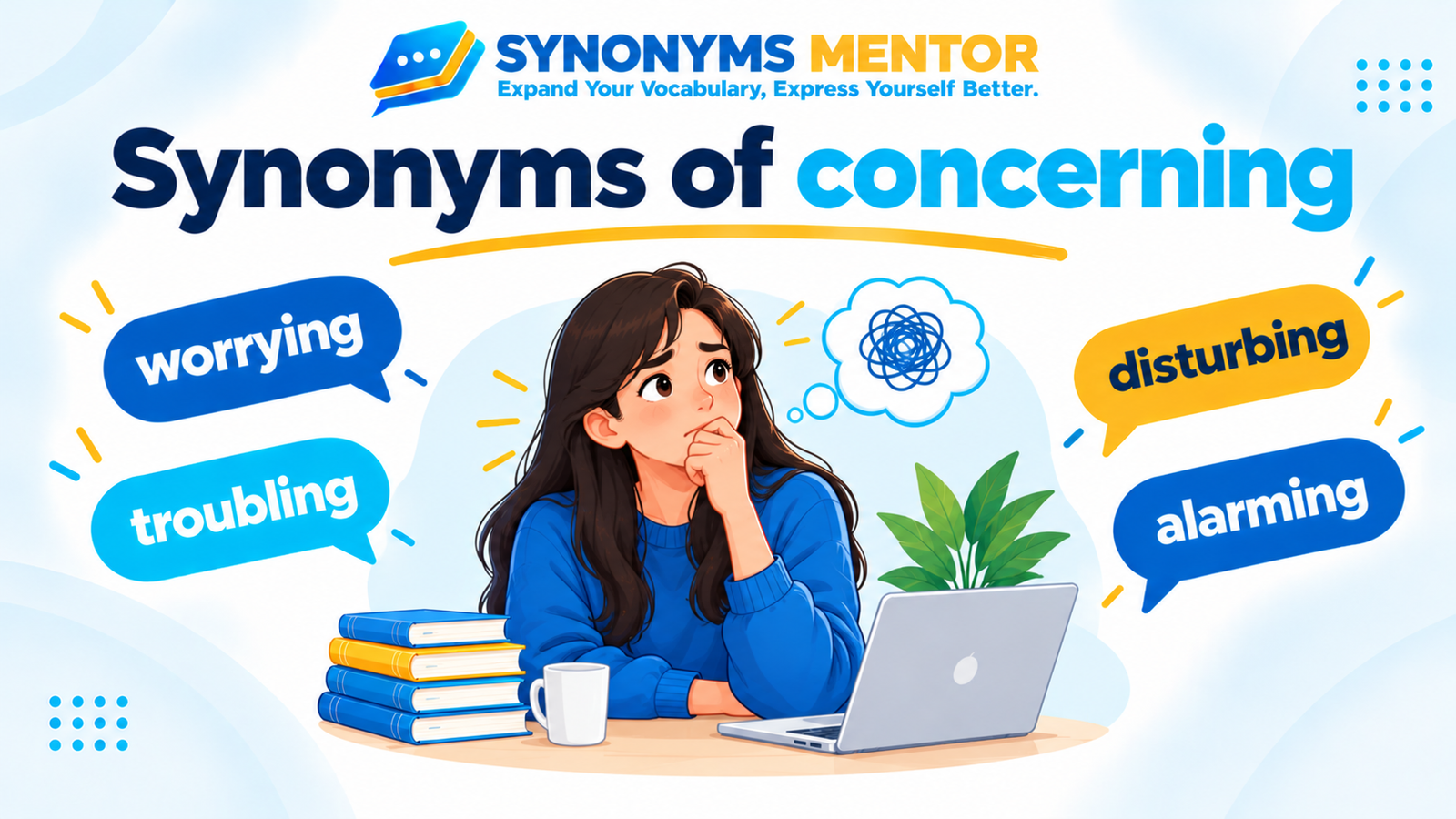
When it means “worrying,” use worrying, troubling, alarming, disturbing, or unsettling. Regarding is especially useful in formal writing, while about is the most natural everyday alternative.
What Does “Concerning” Mean?
Concerning has two main uses.
1. Concerning = About or Regarding
As a preposition, concerning introduces the subject or topic being discussed. It is generally formal in this use. Cambridge defines it as equivalent to “about,” while Collins lists regarding and about among its synonyms.
- We received several emails concerning the new policy.
- The report contains information concerning workplace safety.
- I have a question concerning your application.
Here, concerning does not mean worrying. It simply tells the reader what something is about.
2. Concerning = Worrying
As an adjective, concerning describes something that causes worry or makes people uneasy. Cambridge describes this use as meaning “making you feel slightly worried,” while Collins gives the sense of something worrying or troublesome.
- The rise in crime is concerning.
- The doctor noticed some concerning symptoms.
- There was a concerning decline in attendance.
This second meaning is especially common in expressions such as “it is concerning that…” and “a concerning trend.”
The Best Synonyms for “Concerning” at a Glance
| Word or phrase | Relationship | Strength | Formality | Best context |
|---|---|---|---|---|
| about | Direct synonym | Neutral | Neutral | Everyday speech and writing |
| regarding | Direct synonym | Neutral | Formal | Business, academic, professional |
| relating to | Near synonym | Neutral | Neutral/Formal | Topics, subjects, policies |
| with regard to | Direct synonym | Neutral | Formal | Professional and official writing |
| with respect to | Direct synonym | Neutral | Formal | Legal, academic, technical writing |
| in connection with | Contextual alternative | Neutral | Formal | Events, cases, investigations |
| on | Contextual alternative | Neutral | Neutral | Subjects, books, discussions |
| about | Direct synonym | Neutral | Neutral | General communication |
| worrying | Direct synonym for adjective sense | Moderate | Neutral | Everyday and professional contexts |
| troubling | Near synonym | Moderate–Strong | Neutral | Problems and developments |
| alarming | Near synonym | Strong | Neutral | Serious risks or warnings |
| disturbing | Near synonym | Strong | Neutral | Events or information causing distress |
| unsettling | Near synonym | Moderate | Neutral | Situations creating unease |
| disconcerting | Near synonym | Moderate | Formal | Unexpected or unsettling situations |
| problematic | Contextual alternative | Moderate | Formal | Situations, policies, conditions |
The first group applies when concerning means “about.” The second applies when it means “worrying.” Keeping these two groups separate prevents misleading synonym choices.
Closest Synonyms for “Concerning” Meaning “About”
1. Regarding
Regarding is one of the closest alternatives to concerning when introducing a subject. It is formal and particularly common in business and professional communication. Cambridge treats regarding and concerning as alternatives for about.
Example:
I am writing regarding your recent application.
Best for: emails, business letters, reports, and formal communication.
Concerning:
I am writing concerning your recent application.
Regarding:
I am writing regarding your recent application.
Both are correct, although regarding often sounds slightly more direct in professional correspondence.
2. About
About is the simplest and most natural everyday alternative.
We had a discussion concerning the project.
We had a discussion about the project.
Unlike concerning, about works comfortably in casual conversation as well as ordinary writing.
Best for: everyday English, general writing, conversation, and clear communication.
If there is no reason to sound formal, about is often the best choice.
3. Relating to
Relating to means connected with or concerning a particular subject. It is especially useful when discussing documents, rules, policies, information, or issues.
Please submit all documents relating to the transaction.
It can sometimes suggest a relationship or connection rather than simply identifying a topic.
4. With Regard to
With regard to is a formal phrase meaning “about” or “concerning.”
With regard to your request, we will respond within five business days.
It is useful in professional and official writing, although regarding is usually shorter.
5. With Respect to
With respect to also means “concerning” or “in relation to.”
The company has revised its policy with respect to remote work.
This phrase is particularly common in formal, academic, legal, and technical contexts.
6. In Connection With
In connection with means concerning something because there is a relevant relationship or association.
The police questioned him in connection with the investigation.
It is not always interchangeable with concerning. The phrase often implies an actual connection between two events, people, or circumstances.
7. On
On can replace concerning when introducing the subject of a discussion, book, article, lecture, or similar work.
She wrote an article concerning climate policy.
She wrote an article on climate policy.
This is shorter and often more natural.
Synonyms for “Concerning” Meaning “Worrying”
When concerning describes something that causes worry, words such as worrying, troubling, alarming, disturbing, and unsettling become relevant.
8. Worrying
Worrying is the most straightforward alternative when concerning means causing concern.
The decline in sales is concerning.
The decline in sales is worrying.
It is natural, clear, and widely understood.
Best for: everyday English, journalism, workplace communication, and general writing.
9. Troubling
Troubling suggests that something is problematic, disturbing, or a cause for concern.
The report revealed some troubling statistics.
Compared with worrying, troubling can sound somewhat more serious or reflective.
10. Alarming
Alarming is stronger than ordinary concerning. It suggests that something creates serious worry or indicates possible danger.
The rapid increase in infections is alarming.
Use it when the situation deserves a stronger warning. Do not use alarming simply because something is mildly concerning.
11. Disturbing
Disturbing suggests that something causes emotional discomfort, unease, or distress.
The investigation uncovered some disturbing evidence.
It is particularly appropriate for disturbing information, behavior, events, or discoveries.
12. Unsettling
Unsettling describes something that makes people feel uneasy or uncomfortable.
The sudden change in his behavior was unsettling.
It is useful when the problem creates uncertainty or unease rather than obvious danger.
13. Disconcerting
Disconcerting is a more formal alternative for something that makes a person feel confused, uneasy, or unsettled.
The lack of communication from management was disconcerting.
It is less common in everyday conversation than worrying or unsettling.
14. Problematic
Problematic describes something that presents a difficulty, flaw, or potential problem.
The current policy has several problematic provisions.
It is not a perfect synonym for concerning. It focuses more on the existence of a problem than on the emotional response of worry.
15. Worrisome
Worrisome means causing worry or concern.
The company reported a worrisome decline in revenue.
It is close to worrying, although worrisome can sometimes sound more deliberate or descriptive in formal prose.
Formal Alternatives to “Concerning”
If you are writing an email, report, academic paper, business document, or official statement, these alternatives are particularly useful:
- regarding
- with regard to
- with respect to
- relating to
- in connection with
- in relation to
- pertaining to
For example:
We have several questions concerning the contract.
Possible formal alternatives include:
We have several questions regarding the contract.
We have several questions with respect to the contract.
We have several questions relating to the contract.
The best choice depends on the exact relationship you want to express.
Which Word Should I Use?
Use “about” when:
You want the clearest and most natural everyday expression.
I have a question about the schedule.
Use “regarding” when:
You want a concise, professional alternative.
I am contacting you regarding your application.
Use “with regard to” when:
You need a more formal phrase for professional or official writing.
With regard to your complaint, we have completed our review.
Use “relating to” when:
You want to emphasize a connection with a subject.
Documents relating to the investigation were submitted.
Use “worrying” when:
Concerning means something that causes worry.
The results are worrying.
Use “alarming” when:
The situation is serious enough to justify a stronger warning.
The increase in accidents is alarming.
Use “unsettling” when:
Something creates unease rather than clearly indicating danger.
The unexplained changes were unsettling.
Concerning vs. Regarding
Concerning and regarding are very close when they mean “about.” Both are commonly used to introduce the subject of information, communication, or discussion. Cambridge specifically groups them together under the meaning “about.”
We received a letter concerning the new policy.
We received a letter regarding the new policy.
In many sentences, either works naturally.
Practical distinction: regarding is particularly common in professional correspondence, while concerning can sometimes feel slightly more formal or official.
Concerning vs. About
The meaning is usually the same, but the register differs.
We need to talk about your performance.
sounds natural and conversational.
We need to discuss a matter concerning your performance.
sounds more formal.
For ordinary conversation, about is usually the better choice. For formal documents, concerning may fit naturally.
Concerning vs. Worrying
These words are not interchangeable in every sentence because concerning has two meanings.
Compare:
The report contains information concerning the accident.
Here, concerning means about.
But:
The report contains some concerning findings.
Here, concerning means worrying.
Replacing the first sentence with worrying would change the meaning completely.
Natural Collocations With “Concerning”
When concerning means about, common patterns include:
- information concerning
- questions concerning
- concerns concerning
- issues concerning
- regulations concerning
- legislation concerning
- policies concerning
- details concerning
- evidence concerning
- discussions concerning
Examples:
The website provides information concerning visa requirements.
Several questions concerning the proposal remain unanswered.
When concerning is an adjective meaning worrying, natural combinations include:
- concerning trend
- concerning development
- concerning increase
- concerning decline
- concerning behavior
- concerning symptoms
- concerning results
- concerning signs
- concerning situation
- concerning pattern
Examples:
The researchers identified a concerning trend.
Doctors observed several concerning symptoms.
Common Mistakes With “Concerning”
Mistake 1: Treating Every “Concerning” as “Worrying”
Not every use of concerning expresses anxiety.
Incorrect interpretation:
Information concerning the new policy.
This means information about the new policy, not worrying information.
Mistake 2: Using “Worrying” for the Topic Meaning
You cannot normally replace:
a letter concerning the contract
with:
a letter worrying the contract.
The meanings and grammar are different.
Mistake 3: Overusing Formal Alternatives
Phrases such as with respect to and with regard to are correct, but they can sound unnecessarily formal in casual writing.
Instead of:
With respect to your question, I think we should wait.
A natural conversational version is:
About your question, I think we should wait.
Or simply:
Regarding your question, I think we should wait.
Mistake 4: Assuming “Problematic” Always Means “Concerning”
Problematic emphasizes a problem or difficulty. Concerning in its adjective sense emphasizes that something causes worry.
The wording is problematic.
means the wording creates a problem.
The wording is concerning.
means the wording causes concern.
The two can overlap, but they are not identical.
Real-World Examples
Professional Email
I am writing regarding the meeting scheduled for Monday.
Academic Writing
The study examines several issues concerning educational inequality.
Everyday Conversation
I’m concerned about the results.
For a topic rather than worry:
We were talking about the results.
Business Report
The company identified a concerning decline in customer retention.
Formal Document
The report includes several recommendations with regard to workplace safety.
Journalism
Officials described the rise in incidents as alarming.
Antonyms and Contrasting Words
The appropriate opposite depends on which meaning of concerning you mean.
When concerning means worrying, contrasting concepts include:
- reassuring
- comforting
- encouraging
- positive
- safe
- harmless
- promising
When concerning means about, there is no single direct antonym because it functions as a relational preposition. The opposite idea may instead involve unrelated to, irrelevant to, or unconnected with, depending on the sentence.
FAQ About Synonyms for Concerning
What is the closest synonym for “concerning”?
When concerning means “about,” regarding is one of the closest formal synonyms. About is the closest simple everyday alternative.
What is a formal synonym for “concerning”?
Common formal alternatives include regarding, with regard to, with respect to, relating to, and in connection with.
What is another word for “concerning” meaning worrying?
Good alternatives include worrying, troubling, alarming, unsettling, disturbing, and worrisome. The strongest choice depends on the seriousness and type of concern.
Is “regarding” the same as “concerning”?
Often, yes. When both mean “about,” they can usually be substituted for each other. However, concerning also has an adjective meaning “worrying,” while regarding does not.
Is “about” a synonym for “concerning”?
Yes. About is a direct and usually less formal alternative when concerning means “about” or “regarding.”
What is a professional alternative to “concerning”?
Regarding is usually the most convenient professional alternative. With regard to and with respect to are more formal options.
What is the strongest synonym for “concerning” meaning worrying?
Alarming is generally stronger than ordinary concerning or worrying. Disturbing can also be strong, particularly when something causes emotional distress.
Can “concerning” mean “worrying”?
Yes. Concerning can function as an adjective meaning that something causes worry. Cambridge and Collins both recognize this use.
Conclusion
The most useful synonym for concerning depends on which meaning you intend. When it means “about,” choose regarding for professional writing, about for everyday English, or with regard to / with respect to for more formal contexts. When it means “worrying,” choose worrying, troubling, unsettling, disturbing, or alarming according to the level and type of concern.

Olivia Brown is a vocabulary expert and content writer who focuses on synonyms, antonyms, and word usage. She helps learners understand English words in a simple and practical way, making communication clearer and more effective