Synonyms of Synthetic: 15 Alternatives & Usage Tips
Finding the right synonym for synthetic depends on what you mean by the word. If you are describing a material produced artificially, artificial is usually the closest broad alternative. If you mean something designed to look like the real thing, imitation, faux, or fake may be more precise.
For scientific or manufacturing contexts, however, synthetic often has a specific meaning that should not be replaced casually.
This guide explains the most useful synonyms of synthetic, how they differ, and which word sounds most natural in different contexts.
Quick Answer
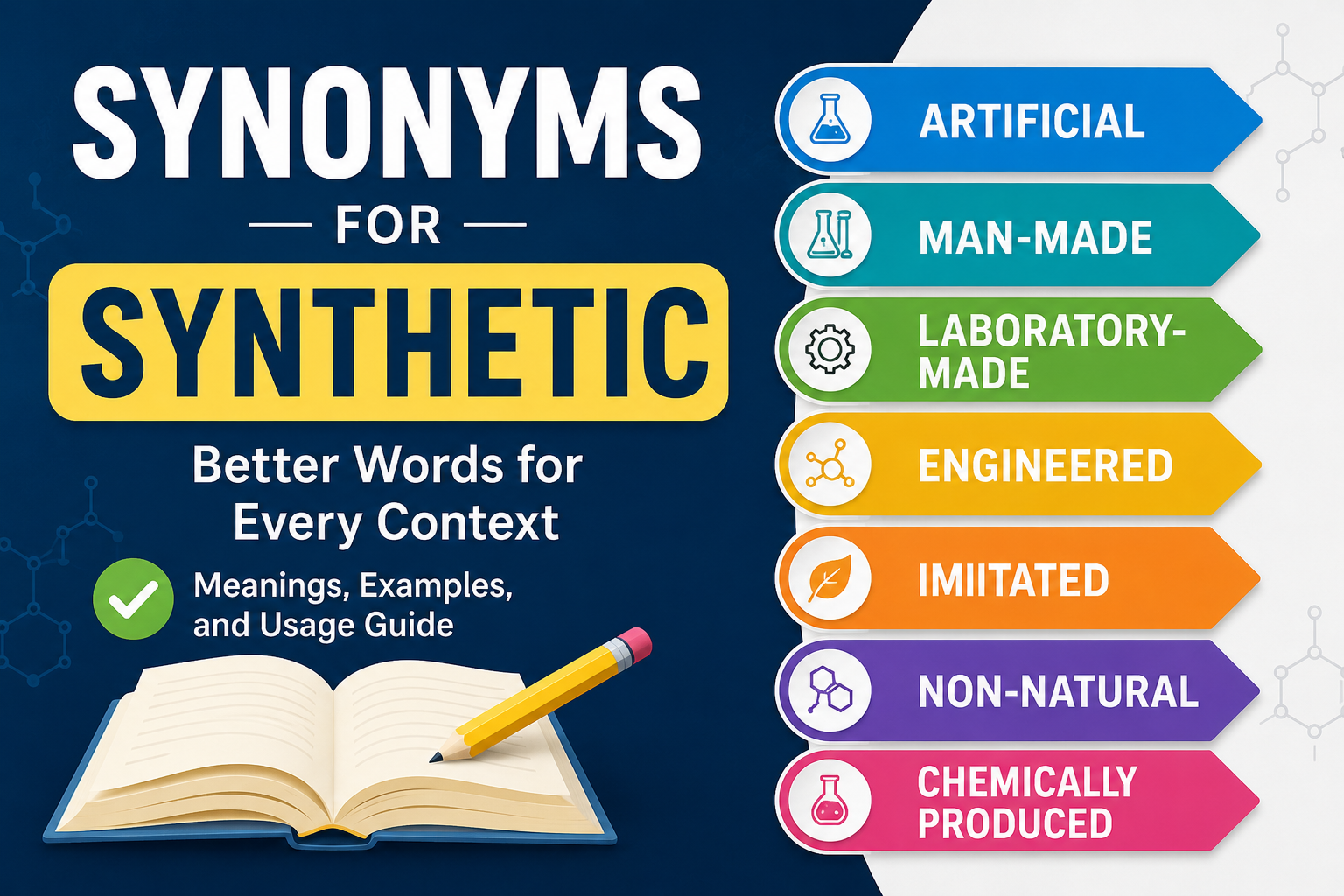
The closest synonyms of synthetic include artificial, human-made, imitation, faux, fake, simulated, fabricated, manufactured, and artificially produced. However, they are not exact substitutes. Artificial is the broadest alternative, while synthetic often emphasizes material or chemical production.
Imitation and faux emphasize copying the appearance of something natural, whereas fake often suggests that something is not genuine.
What Does “Synthetic” Mean?
Synthetic is primarily an adjective meaning made artificially, often by combining chemical substances or using processes rather than obtaining the substance directly from nature. It is commonly used for materials, chemicals, fibers, drugs, dyes, rubber, fabrics, and other manufactured products.
The word can also have specialized meanings. In linguistics, for example, a synthetic language uses inflections to express grammatical relationships. That meaning is quite different from the everyday meaning of “artificially produced.”
Part of speech
- Adjective: synthetic material, synthetic rubber, synthetic fiber
- Noun: a synthetic — an artificial substance or material
Pronunciation
- US: /sɪnˈθet̬ɪk/
- UK: /sɪnˈθetɪk/
Word origin
Synthetic entered English through French and Modern Latin from Greek roots associated with putting or combining things together. The word’s history reflects its modern sense of something produced through combination or synthesis.
Best Synonyms of Synthetic
Not every word below is a direct synonym. Some are near synonyms or contextual alternatives, because precision matters.
| Word | Relationship | Strength | Best Context |
|---|---|---|---|
| Artificial | Closest broad synonym | Equal | General descriptions |
| Human-made | Contextual alternative | Equal | Contrasting human production with nature |
| Imitation | Contextual alternative | Similar | Products designed to resemble another material |
| Faux | Contextual alternative | Similar | Fashion, décor, leather, fur |
| Fake | Near synonym | Stronger/negative | Something presented as genuine when it is not |
| Simulated | Near synonym | Similar | Experiences, environments, processes |
| Fabricated | Near synonym | Similar/strong | Manufactured or deliberately created |
| Manufactured | Contextual alternative | Similar | Industrial production |
| Artificially produced | Contextual alternative | Precise | Scientific and technical writing |
| Engineered | Contextual alternative | Similar | Designed materials and biological systems |
| Processed | Related/contextual | Not equivalent | Materials altered through processing |
| Constructed | Related/contextual | Not equivalent | Things deliberately created or assembled |
| Modeled | Contextual alternative | Similar | Designed to reproduce a pattern or form |
| Simulated | Contextual alternative | Similar | Reproduced conditions or behavior |
| Non-natural | Descriptive alternative | Broad | Explicit contrast with natural products |
The distinction between these words is important. Oxford specifically separates artificial from synthetic: artificial can mean something made to copy nature, while synthetic more specifically refers to something produced through chemical combination rather than directly from plants or animals.
1. Artificial
Artificial is usually the best general-purpose synonym for synthetic.
It means something is made or produced by people rather than occurring naturally, often as a copy or substitute for something natural. Cambridge uses examples such as artificial fibers, artificial flowers, and artificial sweeteners.
Example:
The jacket is made from artificial fibers.
Synthetic vs artificial
These words overlap substantially, but synthetic is often more technically specific.
- Synthetic rubber emphasizes how the rubber is produced.
- Artificial flowers emphasizes that the flowers are not natural.
- Artificial lighting is natural English; synthetic lighting is not normally the preferred phrase.
Best choice: Use artificial when you want a broad contrast with natural.
2. Human-made
Human-made can replace synthetic when the important idea is that something was created by people rather than occurring naturally.
For example:
The landscape contains several human-made features.
However, it is not a precise replacement for synthetic. A human-made object can be made from natural materials, while a synthetic material is typically produced through artificial or chemical processes.
Best choice: Use human-made when the contrast is human-created vs natural, rather than synthetically produced vs naturally occurring.
3. Imitation
Imitation describes something made to resemble another thing.
Examples include:
- imitation leather
- imitation pearls
- imitation jewelry
- imitation wood
Oxford notes that imitation is especially associated with something made to look like another thing.
She bought an imitation leather handbag.
Best choice: Use imitation when resemblance or copying is the main idea.
4. Faux
Faux is a useful alternative when something is deliberately designed to look like another material or style.
Common examples include:
- faux leather
- faux fur
- faux wood
- faux marble
The chairs have faux leather covers.
It is especially natural in fashion, furniture, interior design, and consumer-product descriptions.
Best choice: Use faux when you want to emphasize an attractive or designed substitute rather than deception.
5. Fake
Fake is stronger and more negative than synthetic.
Something synthetic can be completely genuine as a manufactured product. A fake, by contrast, is often something made to appear genuine when it is not.
Compare:
The laboratory developed a synthetic material.
with:
The seller was caught with a fake designer watch.
Cambridge places fake alongside artificial and synthetic in the semantic field of things made by humans, but the meanings are not identical.
Best choice: Use fake when authenticity or deception is important.
6. Simulated
Simulated means something is reproduced or made to behave like another thing without actually being that thing.
Common phrases include:
- simulated environment
- simulated experience
- simulated reality
- simulated conditions
The researchers tested the equipment under simulated conditions.
Best choice: Use simulated for situations, environments, experiences, or behaviors rather than ordinary manufactured materials.
7. Fabricated
Fabricated can mean manufactured or deliberately created.
The components were fabricated from a lightweight material.
However, fabricated also commonly means invented or made up, especially when talking about information or stories:
The report contained fabricated evidence.
Because of this second meaning, it should not automatically replace synthetic.
Best choice: Use fabricated when emphasizing deliberate construction or manufacture.
8. Manufactured
Manufactured emphasizes production, particularly industrial production.
The company uses manufactured materials in its products.
It is broader than synthetic. A manufactured product can be made from natural materials, so the two words are not interchangeable.
Best choice: Use manufactured when the production process is more important than whether the material is synthetic.
9. Engineered
Engineered is useful when a material or product has been deliberately designed to achieve particular properties.
The engineers developed an engineered polymer for high-temperature applications.
This word suggests intentional design or optimization, not merely artificial production.
Best choice: Use engineered for technical, scientific, industrial, or design-focused contexts.
10. Artificially Produced
Artificially produced is often clearer than a single synonym when precision matters.
The compound is artificially produced rather than extracted from plants.
This phrase works especially well in scientific and educational writing because it directly explains the production method.
11. Non-Natural
Non-natural is a descriptive alternative rather than a perfect synonym.
The study compared natural and non-natural materials.
It is useful when the central contrast is simply natural vs not natural.
However, it lacks the technical precision of synthetic.
Synthetic Synonyms by Context
For materials
Best choices:
- synthetic
- artificial
- manufactured
- engineered
- human-made
The company produces synthetic fibers for outdoor clothing.
Here, synthetic is more precise than fake because the fibers are genuine manufactured materials.
For leather and fur
Best choices:
- synthetic
- faux
- imitation
- artificial
The bag is made from faux leather.
Here, faux leather sounds more natural than fake leather in many commercial and fashion contexts.
For something pretending to be genuine
Best choices:
- fake
- counterfeit
- forged
- bogus
- imitation
These words should not automatically replace synthetic. They describe lack of authenticity or fraudulent representation, not simply artificial production.
For experiences or environments
Best choices:
- simulated
- artificial
- constructed
- modeled
The students practiced in a simulated environment.
For scientific writing
Best choices:
- synthetic
- artificially produced
- manufactured
- engineered
The researchers developed a synthetic compound for the experiment.
In technical writing, retaining synthetic is often preferable because it communicates a specific production concept.
Synthetic vs Artificial vs Fake vs Imitation
These four words are frequently confused.
| Word | Core idea | Example |
| Synthetic | Produced through artificial processes, often chemical synthesis | synthetic rubber |
| Artificial | Made by people or designed to resemble something natural | artificial flowers |
| Fake | Not genuine; often intended to appear genuine | a fake diamond |
| Imitation | Made to resemble another thing | imitation leather |
The simplest rule is:
Synthetic describes how something is produced; artificial describes its non-natural character; imitation emphasizes resemblance; fake emphasizes lack of genuineness.
That distinction is more useful than treating all four as interchangeable synonyms.
Which Word Should I Use?
Use synthetic when:
You are discussing a chemically or artificially produced material.
The laboratory developed a synthetic polymer.
Use artificial when:
You are contrasting something created by people with something natural.
The room was illuminated by artificial light.
Use imitation when:
You want to emphasize that something resembles another material or product.
The store sells imitation pearls.
Use faux when:
You are describing an attractive substitute, particularly in fashion or design.
She chose a faux-leather jacket.
Use fake when:
The issue is whether something is genuine or authentic.
The watch turned out to be fake.
Use simulated when:
Something reproduces conditions, behavior, or an experience.
The pilots trained in a simulated cockpit.
Common Mistakes with Synthetic Synonyms
Mistake 1: Treating “synthetic” and “fake” as identical
A synthetic product can be completely genuine.
Better:
The manufacturer uses synthetic rubber.
Not:
The manufacturer uses fake rubber.
Mistake 2: Using “imitation” for every synthetic material
Not all synthetic materials imitate another substance.
Synthetic materials can have properties deliberately developed for particular purposes rather than simply copying a natural material.
Mistake 3: Using “manufactured” as an exact synonym
Manufactured means produced, often industrially. It does not necessarily mean synthetic.
Manufactured cotton clothing
can still contain a natural material.
Mistake 4: Confusing artificial production with deception
Words such as fake, bogus, and counterfeit can imply that someone is trying to pass something off as genuine. Synthetic does not carry that implication.
Natural Collocations with Synthetic
Some common combinations include:
- synthetic fiber
- synthetic fibers
- synthetic material
- synthetic rubber
- synthetic leather
- synthetic fabric
- synthetic dye
- synthetic drug
- synthetic hormone
- synthetic compound
- synthetic polymer
- synthetic fuel
- synthetic chemicals
- synthetic biology
- synthetic speech
These collocations show why replacing synthetic mechanically with fake or imitation can make a sentence less precise.
For example:
The researchers developed a synthetic compound.
sounds natural and technical.
The researchers developed a fake compound.
changes the meaning and may suggest fraud or falsification.
Antonyms of Synthetic
The most useful opposites depend on context.
Natural
The broadest antonym:
natural fibers
Naturally occurring
Useful in scientific contexts:
a naturally occurring substance
Organic
Sometimes appropriate, but not a universal antonym. In chemistry, organic has a technical meaning and should not simply be treated as the opposite of synthetic.
Unprocessed
Useful only when the contrast concerns processing:
unprocessed natural materials
Therefore, natural is usually the safest general antonym, while more specific opposites depend on the context.
FAQ
What is the closest synonym for synthetic?
Artificial is generally the closest broad synonym. However, synthetic can be more specific because it often refers to substances produced through artificial or chemical processes.
What is another word for synthetic material?
Depending on context, you can use artificial material, manufactured material, engineered material, or human-made material. Synthetic material remains the most precise choice when the production method matters.
Is “fake” a synonym for synthetic?
Not exactly. Fake means not genuine and can imply deception. A synthetic product can be entirely genuine and legally manufactured.
Is “artificial” the same as “synthetic”?
They overlap, but they are not identical. Artificial is broader, while synthetic often emphasizes artificial production through chemical or other controlled processes.
What is a synonym for synthetic leather?
Common alternatives include faux leather, imitation leather, and artificial leather. Faux leather is particularly natural in fashion and consumer-product contexts.
What is the difference between synthetic and imitation?
Synthetic emphasizes how something is produced, while imitation emphasizes that it resembles another thing. A synthetic material does not necessarily imitate a natural one.
What is the difference between synthetic and natural?
Synthetic generally describes something produced artificially, whereas natural describes something occurring in or derived directly from nature. The precise distinction depends on the scientific or commercial context.
What is the opposite of synthetic?
The broadest opposite is natural. In specialized contexts, phrases such as naturally occurring or unprocessed may provide a more precise contrast.
Conclusion
The best synonyms of synthetic depend on the meaning you want to preserve. Artificial is the closest broad alternative, while faux and imitation work well when something is designed to resemble another material. Fake emphasizes lack of genuineness, simulated suits reproduced experiences or conditions, and manufactured focuses on production rather than chemical synthesis.

David Wilson is a content strategist and SEO expert who focuses on creating structured vocabulary content. He combines keyword research with simple explanations to make learning English both effective and search-friendly.