Synonyms for Trigger: 15 Better Alternatives With Examples
The word trigger is useful because it describes something that causes an event, process, reaction, or change to begin. However, it can sometimes sound repetitive, especially in formal writing, academic work, journalism, or professional communication.
The best synonym depends on what you mean. Cause is a broad and neutral alternative, while prompt often emphasizes encouraging someone to act. Provoke can suggest a strong or deliberate reaction, whereas activate is more appropriate for systems or mechanisms. Spark is more vivid and often describes the beginning of a sudden development.
This guide separates genuine synonyms from near-synonyms and explains which alternative sounds most natural in different contexts.
Quick Answer: What Are the Best Synonyms for Trigger?
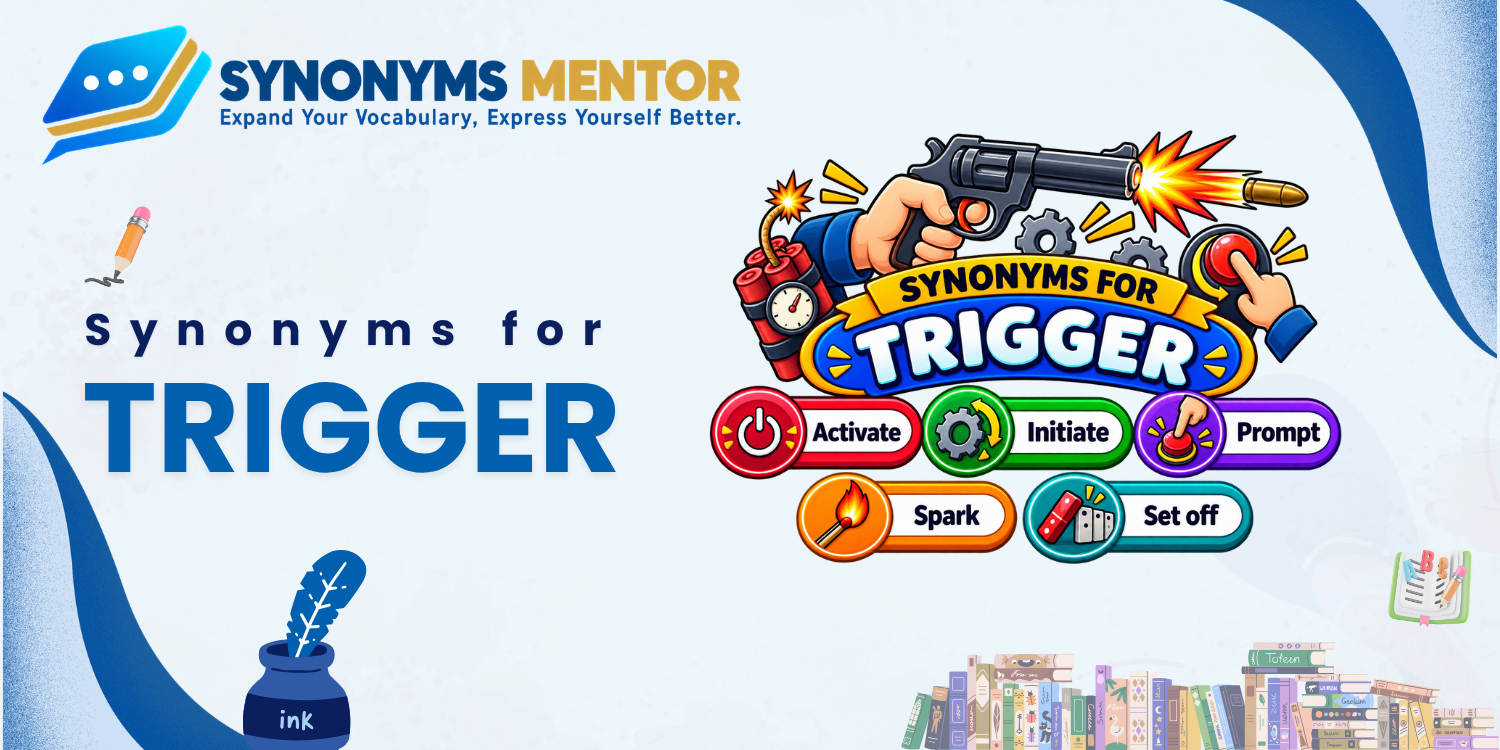
The closest synonyms for trigger include cause, prompt, provoke, activate, initiate, start, spark, set off, bring about, generate, produce, elicit, induce, and precipitate. The best choice depends on context. Use cause for a neutral explanation, activate for systems, prompt for motivating an action, provoke for reactions, and spark for a sudden beginning.
Core Synonyms for Trigger
| Word | Relationship | Meaning | Strength | Formality | Best Context |
|---|---|---|---|---|---|
| Cause | Direct synonym | Make something happen | Similar | Neutral | General cause and effect |
| Prompt | Near synonym | Encourage or lead someone/something to act | Similar | Neutral–formal | Decisions, actions, responses |
| Provoke | Near synonym | Cause a reaction, often strong | Stronger | Neutral–formal | Reactions, conflict, responses |
| Activate | Contextual alternative | Make a system or mechanism active | Similar | Neutral–technical | Systems, devices, processes |
| Initiate | Near synonym | Cause something to begin | Similar | Formal | Processes, projects, actions |
| Start | Direct/contextual synonym | Begin something | Similar | Neutral | Events and processes |
| Spark | Contextual alternative | Cause something to begin suddenly | More vivid | Neutral | Movements, debate, interest |
| Set off | Direct/contextual synonym | Cause something to begin or happen | Similar | Neutral | Events, reactions, alarms |
| Bring about | Near synonym | Cause something to happen | Similar | Neutral–formal | Changes and outcomes |
| Generate | Near synonym | Produce or create something | Similar | Formal | Interest, energy, effects |
| Produce | Near synonym | Cause or create a result | Similar | Neutral–formal | Results and effects |
| Elicit | Contextual alternative | Cause a response or reaction | Similar | Formal | Responses, emotions, information |
| Induce | Near synonym | Cause something to occur | Similar | Formal | Conditions, states, effects |
| Precipitate | Near synonym | Cause something to happen suddenly, often negatively | Stronger | Formal | Crises, conflicts, changes |
| Give rise to | Near synonym | Cause something to develop | Similar | Formal | Problems, effects, situations |
What Does “Trigger” Mean?
As a verb, trigger means to cause something to start or happen. Cambridge defines it as causing something to start, while Collins also uses it for causing an event or situation to begin or exist.
For example:
The announcement triggered a wave of discussion.
Here, trigger emphasizes the event that set the discussion in motion.
As a noun, trigger can also mean an event or situation that causes something else to happen. Cambridge gives this cause-related sense separately from its other meanings.
The important point is that trigger does not always mean exactly the same thing as cause. Trigger often highlights the event that starts a process, while cause can describe a broader causal relationship.
The Most Useful Synonyms for Trigger
1. Cause
Cause is probably the broadest and safest replacement for trigger.
It simply means to make something happen. Unlike trigger, it does not necessarily emphasize the beginning of an event.
Example:
The policy change caused widespread concern.
Best for: General writing, academic writing, reports, and straightforward cause-and-effect statements.
Choose “cause” when: You want the most neutral and universally understood alternative.
2. Prompt
Prompt means to cause or encourage someone to take an action or to cause a response.
It is especially useful when the result involves a decision, action, statement, or response.
Example:
The unexpected result prompted the researchers to investigate further.
Here, prompted suggests that the result led the researchers to do something.
Best for: Decisions, actions, investigations, responses, and professional writing.
3. Provoke
Provoke means to cause a reaction, particularly a strong, emotional, hostile, or otherwise noticeable reaction.
Example:
The proposal provoked a strong response from local residents.
Compared with trigger, provoke can carry a stronger sense of reaction and sometimes implies that the reaction was predictable or deliberately stimulated.
Best for: Reactions, criticism, anger, controversy, debate, and strong responses.
4. Activate
Activate means to make something active or cause a system or process to begin operating.
Example:
The sensor activates the security system.
This is not a universal synonym for trigger. It works particularly well when the object is a system, mechanism, feature, or process.
Best for: Technology, systems, mechanisms, software, and technical writing.
5. Initiate
Initiate means to cause something to begin.
Example:
The company initiated a review of its safety procedures.
It is more formal than start and often sounds appropriate in professional, academic, and institutional writing.
Best for: Processes, reviews, projects, procedures, investigations, and formal actions.
6. Start
Start is a simple, everyday alternative to trigger when the meaning is simply to begin something.
Example:
The announcement started a debate about the new policy.
However, start does not always preserve the subtle cause-and-effect emphasis of trigger.
Best for: Casual and general writing.
7. Spark
Spark is a vivid alternative that suggests something small causes a larger development.
Example:
The article sparked a national conversation.
It is particularly natural with debate, interest, discussion, controversy, movements, and conversations.
Best for: Journalism, creative writing, public discussion, and vivid descriptions.
8. Set Off
Set off is a natural phrasal-verb alternative to trigger.
Example:
The announcement set off a wave of speculation.
It often suggests that one event immediately causes another event or reaction.
Best for: Events, reactions, discussions, speculation, and sudden developments.
9. Bring About
Bring about means to cause something to happen.
Example:
The reforms brought about significant changes in the industry.
It is somewhat more formal than cause and works particularly well when discussing changes, improvements, or broader outcomes.
Best for: Formal writing, reports, essays, and discussions of change.
10. Generate
Generate means to produce or create something.
Example:
The campaign generated considerable interest.
It is especially natural when the result is something measurable or observable, such as interest, revenue, discussion, demand, energy, or activity.
Best for: Business, marketing, economics, research, and professional writing.
11. Produce
Produce can replace trigger when the emphasis is on creating a particular result or effect.
Example:
The treatment produced a noticeable improvement.
It is broader than trigger and focuses more on the result than on the initial event.
Best for: Results, effects, outcomes, research, and formal descriptions.
12. Elicit
Elicit means to draw out or cause a particular response, reaction, or piece of information.
Example:
The question elicited a detailed response.
This is a particularly useful formal alternative when trigger refers to a response.
Best for: Responses, reactions, information, feedback, and emotions.
13. Induce
Induce means to cause something to happen or bring about a particular state or condition.
Example:
The medication may induce drowsiness.
It has a more formal or technical tone than trigger.
Best for: Scientific, medical, academic, and technical contexts.
14. Precipitate
Precipitate is a strong and formal word meaning to cause something to happen suddenly, often an undesirable event or situation.
Example:
The dispute precipitated a major political crisis.
It is not interchangeable with trigger in every sentence. Its distinctive feature is the idea of bringing about a significant development, often abruptly.
Best for: Formal writing, crises, conflicts, political events, and serious developments.
15. Give Rise To
Give rise to means to cause something to develop or occur.
Example:
The new policy gave rise to several concerns.
It is formal and particularly useful when describing consequences or developments.
Best for: Academic writing, essays, reports, and formal explanations.
Which Synonym Should You Use?
The easiest way to choose is to identify what happens after the trigger.
Choose “cause” when:
You simply need a neutral word for making something happen.
The error caused a delay.
Choose “prompt” when:
Something leads a person or organization to take action.
The findings prompted the team to reconsider its approach.
Choose “provoke” when:
The result is a noticeable or strong reaction.
The decision provoked criticism.
Choose “activate” when:
A system, mechanism, or process becomes active.
The sensor activated the alarm.
Choose “initiate” when:
You are describing the formal beginning of a process or action.
The organization initiated an investigation.
Choose “spark” when:
A small event begins a larger or more energetic development.
The speech sparked a debate.
Choose “elicit” when:
Something produces a response.
The survey elicited useful feedback.
Choose “precipitate” when:
Something suddenly causes a major or often negative development.
The announcement precipitated a crisis.
Trigger vs. Cause
Although trigger and cause can overlap, the two words emphasize different aspects of why something happens. The distinction becomes clearer when you consider whether you are describing the underlying reason or the event that starts the process.
A trigger usually refers to a specific event, action, or circumstance that sets something in motion. It often occurs immediately before a reaction, change, or outcome.
By contrast, a cause refers more broadly to the reason something happens. It may describe an underlying factor rather than the immediate event that produces the result.
The announcement triggered a wave of public interest.
Poor planning was a major cause of the delay.
Trigger vs. Prompt
These words overlap when one thing leads another person or group to act.
The report prompted the company to investigate the issue.
The report triggered an investigation.
The first emphasizes the action taken in response. The second emphasizes the beginning of the investigation.
Rule of thumb: Use prompt for decisions and actions; use trigger for events and processes.
Trigger vs. Provoke
Both can describe causing a reaction, but provoke more strongly emphasizes the reaction itself.
The comment triggered a response.
The comment provoked an angry response.
The second sentence makes the reaction sound stronger and more emotionally charged.
Rule of thumb: Choose provoke when the nature or intensity of the reaction matters.
Trigger vs. Activate
These words are sometimes interchangeable when something causes a system to operate.
The sensor triggered the system.
The sensor activated the system.
Activate is more specifically associated with making something operational. Trigger is broader and can describe events, reactions, processes, and changes as well as systems.
Trigger vs. Spark
Both can describe the beginning of something, but their tone differs.
Trigger is neutral and analytical:
The announcement triggered a debate.
Spark is more vivid:
The announcement sparked a debate.
Spark works especially well when a relatively small event leads to a larger development.
Common Collocations With Trigger
Understanding common word combinations makes synonym selection easier.
Trigger + event or development
- trigger a crisis
- trigger a change
- trigger an event
- trigger a process
- trigger a reaction
- trigger a response
- trigger a debate
- trigger a discussion
Natural alternatives
| Phrase | Natural Alternative |
|---|---|
| trigger a reaction | provoke / elicit a reaction |
| trigger a response | prompt / elicit a response |
| trigger a debate | spark / start a debate |
| trigger a change | bring about / cause a change |
| trigger an investigation | prompt / initiate an investigation |
| trigger a process | initiate / activate a process |
| trigger interest | generate / spark interest |
| trigger a crisis | cause / precipitate a crisis |
The best replacement depends on the noun that follows trigger. That is why replacing the word mechanically can make otherwise grammatical writing sound unnatural.
Common Mistakes With Trigger Synonyms
Mistake 1: Treating every cause-related word as interchangeable
Words such as cause, prompt, provoke, activate, and elicit overlap with trigger, but their normal contexts differ.
Mistake 2: Using “activate” for every event
Activate works naturally with systems and mechanisms, but it is usually not the best choice for something like:
The speech activated public concern.
Sparked or triggered would normally be more natural.
Mistake 3: Using “provoke” when there is no reaction
Provoke is strongly associated with producing a response.
The announcement provoked criticism.
But for a neutral process:
The announcement triggered a review.
Triggered is more natural.
Mistake 4: Using “precipitate” in casual writing
Precipitate is formal and often carries a negative or serious association. It can sound unnecessarily sophisticated in everyday conversation.
Mistake 5: Confusing “elicit” with “illicit”
These words are unrelated.
- Elicit = draw out or obtain a response.
- Illicit = illegal or prohibited.
For example:
The question elicited an interesting answer.
Related Words That Are Not Always Direct Synonyms
Some words are connected to trigger but should not automatically be presented as exact synonyms.
Catalyst is a useful related noun. It describes something that causes or accelerates change, but it does not function as a direct verb replacement for trigger.
Stimulus is another related noun. It refers to something that encourages activity or produces a response.
Cause is broader than trigger, while reaction is normally the result rather than the trigger itself.
Understanding these relationships prevents a synonym list from becoming a collection of loosely related vocabulary.
Antonyms of Trigger
The opposite of trigger depends on the context.
For causing something to happen, useful opposites include:
- prevent
- stop
- halt
- inhibit
- suppress
- block
- avoid
For example:
The new measures prevented the problem from developing.
These words describe stopping or preventing an event rather than initiating it.
Frequently Asked Questions
What is the closest synonym for trigger?
Cause is one of the closest broad synonyms when trigger means “make something happen.” However, set off is often closer when the meaning is specifically to start an event, while activate is better for systems. Collins lists cause, start, set off, and activate among the relevant alternatives depending on the sense.
What is a formal synonym for trigger?
Good formal alternatives include initiate, bring about, induce, elicit, generate, and precipitate. The correct choice depends on context. Initiate works well for processes, elicit for responses, and precipitate for sudden serious developments.
What is a professional synonym for trigger?
Prompt, initiate, activate, cause, generate, and bring about are useful professional alternatives. For example, “The findings prompted further investigation” sounds natural in professional and academic writing.
Is “cause” the same as “trigger”?
Not exactly. Both can mean that one thing makes another happen, but trigger often emphasizes the event that starts a process or reaction. Cause is broader and can describe the overall causal relationship.
Is “provoke” a synonym for trigger?
Sometimes. Provoke is particularly appropriate when something causes a reaction, especially a strong or noticeable one. It is less suitable when trigger simply means starting a neutral process.
What is a synonym for “trigger a response”?
Depending on the context, use prompt a response, elicit a response, provoke a response, or generate a response. Elicit is particularly useful in formal writing when something draws a response from someone.
What is a synonym for “trigger a debate”?
Spark a debate, start a debate, and prompt a debate are natural alternatives. Spark is especially effective when you want a vivid expression suggesting that one event ignited a larger discussion.
What is a synonym for “trigger a change”?
Useful alternatives include cause a change, bring about a change, initiate a change, and prompt a change. Bring about is formal, while initiate emphasizes beginning the change process.
Conclusion
The best synonym for trigger depends on what you want to emphasize. Cause is the broadest neutral alternative; prompt highlights an action or decision; provoke emphasizes a reaction; activate suits systems; initiate fits formal processes; spark gives writing a more vivid tone; and elicit works especially well with responses.

Our editorial team is dedicated to making English vocabulary easier to understand and use correctly. We research and review synonyms, antonyms, definitions, word usage, and example sentences to ensure our content is clear, accurate, practical, and useful for students, writers, professionals, and English learners.