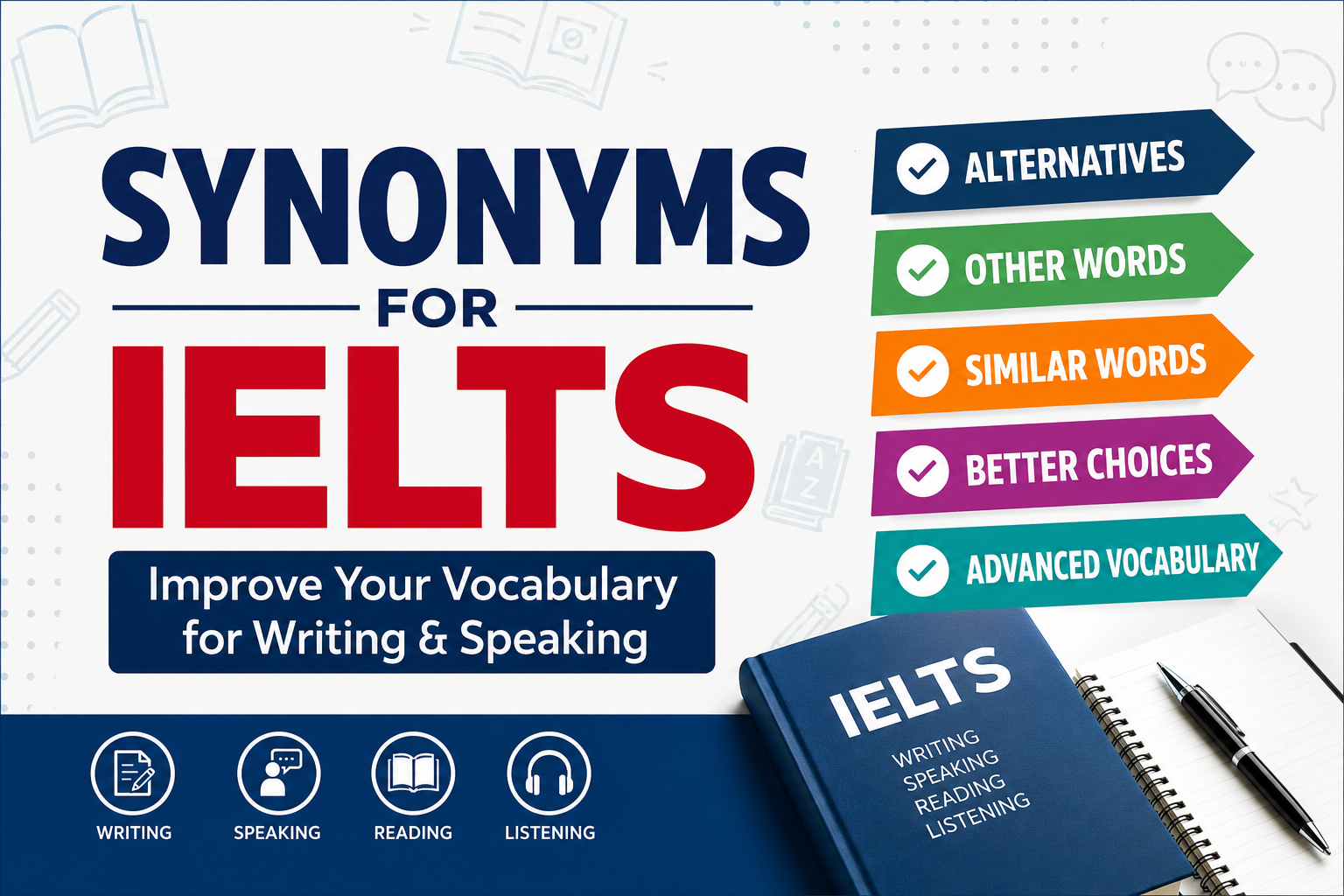
Synonyms for IELTS: 100+ Useful Words for Writing and Speaking
If you are searching for synonyms for IELTS, there is one important distinction to make first: IELTS is the name of an English-language test, so it does not have a normal synonym. In practice, however, people usually mean synonyms and alternative vocabulary to use in IELTS Writing and Speaking.
Learning useful alternatives can help you paraphrase questions, reduce unnecessary repetition, express ideas more precisely, and demonstrate a broader vocabulary. But replacing every simple word with a more complicated one is not the goal.
IELTS assesses Lexical Resource, including the range, accuracy, and appropriateness of vocabulary you use.
The best strategy is therefore to learn synonyms in context, understand their differences, and use only words that fit the meaning and grammar of your sentence.
Quick Answer: What Are the Best Synonyms for IELTS?
There are no direct synonyms for IELTS because it is the name of the International English Language Testing System. If you mean synonyms to use in the IELTS test, useful examples include:
- important → significant, crucial, essential
- good → beneficial, positive, effective
- bad → harmful, negative, detrimental
- big → large, substantial, considerable
- many → numerous, a large number of
- help → assist, support, facilitate
- show → demonstrate, illustrate, indicate
- increase → rise, grow, increase
- decrease → decline, fall, reduce
- problem → issue, difficulty, challenge
- change → alter, transform, modify
- think → believe, consider, argue
- improve → enhance, strengthen, develop
- use → employ, utilize
- different → diverse, varied, distinct
The best synonym depends on the sentence. A more advanced-looking word is not automatically a better IELTS choice.
What Does “Synonyms for IELTS” Mean?
The phrase “synonyms for IELTS” is slightly imprecise linguistically.
IELTS is an acronym for the International English Language Testing System, an English-language proficiency test. Because it is the name of a specific examination system, words such as test, exam, or assessment may describe IELTS in certain contexts, but they are not true synonyms.
For example:
I am preparing for the IELTS exam.
Here, exam describes what IELTS is, but it does not replace the name itself in every context.
The search phrase “synonyms for IELTS” is generally used to find vocabulary alternatives that candidates can use while preparing for or taking IELTS, particularly in Writing and Speaking.
That distinction matters because good vocabulary learning is about meaning and context, not simply replacing one word with another.
Why Are Synonyms Important in IELTS?
Synonyms can be useful across the IELTS test, but they should be used accurately.
In IELTS Writing, Lexical Resource is one of the four assessment criteria. Official IELTS guidance describes it as assessing the range of vocabulary used and how accurately and appropriately it is used.
The Speaking test also assesses Lexical Resource. The official Band 7 descriptor refers to flexible vocabulary use, some less common and idiomatic items, awareness of style and collocation, and effective paraphrase. Band 8 expects a wider resource that can be used flexibly to convey precise meaning.
This means that memorizing long lists of “advanced” words is not enough.
Compare:
Many people think that public transport is important.
with:
Many people believe that public transport is essential.
The second sentence is not automatically better simply because believe and essential sound more advanced. It is better only if those words accurately express the intended meaning.
100+ Useful Synonyms for IELTS
The following list focuses on common vocabulary that IELTS candidates frequently need when discussing ideas, trends, problems, advantages, disadvantages, education, society, technology, health, and the environment.
1. Important
Useful alternatives:
- significant
- crucial
- essential
- vital
- important
- influential
Example:
Education plays a significant role in economic development.
Nuance: Crucial, essential, and vital can suggest greater importance than the neutral word important.
2. Good
Useful alternatives:
- beneficial
- positive
- effective
- valuable
- advantageous
- favorable
Example:
Regular exercise has beneficial effects on physical health.
Do not use beneficial whenever you simply mean that something is enjoyable or morally good. It usually suggests a useful or positive effect.
3. Bad
Useful alternatives:
- harmful
- negative
- damaging
- detrimental
- unfavorable
- problematic
Example:
Excessive screen time can have detrimental effects on sleep quality.
Detrimental is formal and usually refers to something that causes harm or disadvantage.
4. Big
Useful alternatives:
- large
- considerable
- substantial
- significant
- enormous
- major
Example:
The country experienced a substantial increase in renewable-energy production.
Be careful: enormous is much stronger than big, while major often refers to importance rather than physical size.
5. Small
Useful alternatives:
- minor
- limited
- modest
- slight
- little
- negligible
Example:
There was a slight decline in the number of visitors.
Minor and slight are not interchangeable in every context. Negligible means so small that it has little practical importance.
6. Many
Useful alternatives:
- numerous
- several
- a large number of
- a considerable number of
- a wide range of
- countless
Example:
Numerous studies have examined the effects of air pollution.
Do not use countless when a precise or restrained academic style is required.
7. Few
Useful alternatives:
- limited
- a small number of
- relatively few
- not many
- scarce
Example:
Only a small number of participants supported the proposal.
Remember that scarce often means insufficiently available, not simply “few.”
8. Help
Useful alternatives:
- assist
- support
- facilitate
- aid
- enable
- contribute to
Example:
Technology can facilitate access to educational resources.
Facilitate means to make something easier or help a process happen. It cannot replace help in every sentence.
9. Show
Useful alternatives:
- demonstrate
- indicate
- illustrate
- reveal
- display
- highlight
Example:
The graph illustrates changes in household spending between 2010 and 2020.
This distinction is particularly useful in Academic Writing Task 1.
10. Increase
Useful alternatives:
- rise
- grow
- climb
- expand
- surge
- escalate
Example:
The percentage of university graduates rose steadily over the period.
Surge indicates a rapid or substantial increase, while rise is more neutral.
11. Decrease
Useful alternatives:
- decline
- fall
- drop
- decrease
- reduce
- diminish
- plummet
Example:
The unemployment rate declined gradually after 2015.
Plummet describes a very sharp fall, so it should not be used for a small decrease.
12. Change
Useful alternatives:
- alter
- modify
- transform
- shift
- adjust
- vary
Example:
Technological developments have transformed the way people communicate.
Transform suggests a major change, whereas adjust usually suggests a smaller modification.
13. Improve
Useful alternatives:
- enhance
- strengthen
- develop
- advance
- boost
- upgrade
Example:
Investment in public transport could enhance urban mobility.
14. Problem
Useful alternatives:
- issue
- difficulty
- challenge
- concern
- obstacle
- drawback
Example:
Traffic congestion is a major issue in rapidly growing cities.
These words are related but not identical. A challenge may be difficult without necessarily being a harmful problem, while an obstacle specifically prevents progress.
15. Solution
Useful alternatives:
- answer
- remedy
- approach
- measure
- strategy
- course of action
Example:
Expanding public transport may be an effective strategy for reducing congestion.
16. Think
Useful alternatives:
- believe
- consider
- argue
- suggest
- maintain
- assume
Example:
Many researchers argue that early education has long-term benefits.
These verbs express different levels of commitment and should not be treated as interchangeable.
17. Use
Useful alternatives:
- employ
- utilize
- apply
- adopt
- make use of
- implement
Example:
Governments can implement policies to reduce carbon emissions.
Implement normally refers to putting a plan, policy, or system into effect; it is not a universal synonym for use.
18. Get
Useful alternatives:
- obtain
- receive
- acquire
- gain
- achieve
- become
The correct alternative depends heavily on context.
Students can obtain valuable information online.
She achieved a high score.
Workers may gain practical experience.
Simply replacing every occurrence of get with obtain would sound unnatural.
19. Make
Useful alternatives:
- create
- produce
- develop
- generate
- construct
- establish
Example:
The project could generate employment opportunities.
20. Different
Useful alternatives:
- diverse
- varied
- distinct
- contrasting
- alternative
- dissimilar
Example:
The city has a diverse population.
Diverse often emphasizes variety within a group, so it is not a universal replacement for different.
21. Important IELTS Synonyms at a Glance
| Basic word | Useful alternatives | Main caution |
|---|---|---|
| important | significant, crucial, essential | Strength differs |
| good | beneficial, positive, effective | Context matters |
| bad | harmful, damaging, detrimental | Usually implies harm |
| big | substantial, considerable, major | Meaning varies |
| small | slight, minor, modest | Strength differs |
| many | numerous, several | Countability matters |
| help | assist, facilitate, support | Grammar differs |
| show | demonstrate, indicate, illustrate | Context matters |
| increase | rise, grow, surge | Rate and intensity differ |
| decrease | decline, fall, diminish | Strength differs |
| change | alter, transform, modify | Degree of change differs |
| improve | enhance, strengthen, boost | Object determines choice |
| problem | issue, challenge, obstacle | Meanings are not identical |
| solution | remedy, strategy, approach | Context matters |
| think | believe, argue, consider | Attitude differs |
| use | employ, apply, implement | Not universally interchangeable |
Synonyms for IELTS Writing
Synonyms are particularly useful when you need to paraphrase the wording of a task or avoid unnecessary repetition.
For Academic Writing, Task 1 requires candidates to describe visual information such as graphs, tables, charts, maps, or diagrams. Task 2 requires discussion of a point of view, argument, or problem. Both tasks assess Lexical Resource.
Useful Task 1 Vocabulary
| Basic expression | Better contextual alternatives |
| increase | rise, grow, climb, increase |
| decrease | fall, decline, drop, decrease |
| stay the same | remain stable, remain unchanged |
| change | fluctuate, vary, shift |
| show | illustrate, demonstrate, indicate |
| number | figure, total |
| percentage | proportion, percentage |
| compare | contrast, compare |
| about | approximately, around |
| from | starting at, from |
| highest | peak, highest point |
| lowest | lowest point, minimum |
Example
Basic:
The number of visitors increased from 2015 to 2020.
Alternative:
The number of visitors rose from 2015 to 2020.
Stronger trend:
The number of visitors surged from 2015 to 2020.
The last sentence should be used only when the data actually show a rapid or substantial rise.
Synonyms for IELTS Writing Task 2
Task 2 often requires vocabulary for arguments, causes, effects, advantages, disadvantages, problems, and solutions.
Opinion Vocabulary
Instead of repeatedly writing:
I think…
you can use:
- I believe…
- I would argue that…
- In my view…
- From my perspective…
- It can be argued that…
- I would suggest that…
However, these expressions are not identical in tone. I believe is natural and direct, while it can be argued that creates more distance from the writer’s personal position.
Cause and Effect
Useful vocabulary includes:
- cause
- lead to
- result in
- contribute to
- give rise to
- bring about
- stem from
Example:
Poor urban planning can contribute to traffic congestion.
Advantages and Disadvantages
Instead of repeating advantage and disadvantage, consider:
Advantage:
- benefit
- positive aspect
- merit
- strength
- favorable consequence
Disadvantage:
- drawback
- limitation
- weakness
- negative aspect
- adverse consequence
Example:
One major benefit of remote work is greater flexibility.
A potential drawback is reduced face-to-face interaction.
Synonyms for IELTS Speaking
IELTS Speaking is different from academic essay writing. You need vocabulary that is varied but still natural for spoken English.
The official Speaking criteria include Lexical Resource, and higher-band descriptors emphasize flexible vocabulary, precise meaning, appropriate style and collocation, and effective paraphrase.
For example, instead of repeatedly saying:
It was good.
You could naturally say:
It was enjoyable.
It was interesting.
It was memorable.
It was rewarding.
The best word depends on what you actually mean.
Example
Question:
What do you like about your hometown?
Weak repetition:
My hometown is good because the people are good and the food is good.
More natural:
I really enjoy living there because the people are friendly, the food is excellent, and the atmosphere is relaxed.
The second answer demonstrates vocabulary variety without sounding like a thesaurus was used to replace every basic word.
Formal Synonyms for IELTS
Formal vocabulary can be useful in IELTS Writing, particularly when the context calls for an academic or neutral style.
| Common | More formal alternative |
| help | assist |
| buy | purchase |
| get | obtain |
| show | demonstrate |
| start | commence |
| end | conclude |
| use | employ |
| about | approximately |
| enough | sufficient |
| keep | maintain |
| improve | enhance |
| explain | clarify |
| need | require |
| idea | concept |
| problem | issue |
But formal does not automatically mean better.
For example:
The government needs to act quickly.
is perfectly natural.
Replacing it with:
The government requires the necessity to commence immediate action.
would be unnecessarily complicated and unnatural.
The Most Important Rule: Do Not Replace Words Mechanically
One of the biggest mistakes IELTS candidates make is assuming that every synonym can replace the original word in every sentence.
Consider:
The government should address the problem.
Possible alternatives include:
- tackle the problem
- deal with the problem
- confront the problem
But:
The government should solve the problem.
is slightly different. Solve normally suggests successfully finding an answer, whereas address can mean taking action toward an issue without necessarily resolving it completely.
Similarly:
The graph shows a sharp increase.
can become:
The graph illustrates a sharp increase.
But illustrates may not fit every use of shows.
The goal is semantic precision, not maximum synonym replacement.
Common IELTS Synonym Mistakes
1. Choosing a word because it sounds advanced
Bad:
The government should utilize measures to solve crime.
Better:
The government should implement measures to reduce crime.
The problem is not that utilize is too advanced; it is that implement measures is the more natural collocation.
2. Ignoring collocations
Words that have similar dictionary meanings may combine with different nouns.
For example:
make a decision
is natural.
do a decision
is not.
Similarly:
significant increase
is natural.
significant amount of increase
may be awkward depending on the sentence.
Learning synonyms together with their common collocations is much more effective than memorizing isolated lists.
3. Using a stronger word than the evidence supports
If a graph shows a small increase, writing:
The figure skyrocketed.
would exaggerate the data.
Use:
The figure increased slightly.
when that is what the graph actually shows.
4. Using formal words in casual speaking
Words such as commence, facilitate, and obtain may be appropriate in formal writing, but they can sound unnatural when used repeatedly in everyday conversation.
5. Confusing related words with true synonyms
Problem, challenge, obstacle, and issue overlap, but they are not identical.
Likewise, large, substantial, significant, and major have different meanings depending on context.
Synonyms vs. Paraphrasing in IELTS
A synonym is only one tool for paraphrasing.
Suppose the task says:
Many people believe that technology has changed the way we work.
You could make a partial lexical change:
Many people argue that technology has transformed the way we work.
But stronger paraphrasing may also involve changing the grammatical structure:
It is widely argued that technological developments have transformed modern working practices.
This changes vocabulary and structure while preserving the original idea.
The key principle is preserve the meaning.
Do not paraphrase a question so aggressively that you accidentally change its meaning.
How to Learn IELTS Synonyms Effectively
Learn words in groups
Instead of memorizing:
important = significant
learn:
important → significant → crucial → essential → vital
Then study the differences.
Learn collocations
Do not learn only:
significant = important
Learn:
- significant increase
- significant difference
- significant impact
- significant role
- significant change
Write your own examples
For each new word, create one sentence related to a common IELTS topic such as:
- education
- technology
- health
- environment
- transportation
- employment
- crime
- globalization
Learn word families
For example:
- develop
- development
- developing
- developed
- developmental
This gives you more flexibility than memorizing unrelated vocabulary.
Practice paraphrasing
Take a simple IELTS-style statement and rewrite it in two different ways without changing its meaning.
That develops actual vocabulary flexibility rather than simple memorization.
Which IELTS Synonym Should You Use?
Use this simple decision process:
Use a direct synonym when:
The meaning and grammar are essentially the same.
begin → start
Use a near synonym when:
You want to express a slightly different shade of meaning.
important → crucial
Crucial suggests greater importance.
Use a contextual alternative when:
The word works naturally only in a particular situation.
show → illustrate
Illustrate works especially well when presenting information, examples, or visual data.
Avoid the word when:
You are unsure about its meaning, grammar, collocation, or register.
A familiar word used accurately is better than an impressive word used incorrectly.
A Useful IELTS Vocabulary Strategy
A strong vocabulary bank does not need to contain hundreds of difficult words.
A better approach is to build a smaller collection of high-value words that you can use accurately.
For each word, record:
- Meaning
- Synonyms
- Opposites
- Part of speech
- Common collocations
- Formality
- Example sentence
- Related word forms
For example:
Significant
Meaning: important or noticeably large in effect, degree, or amount.
Related words: importance, significantly, significance.
Common collocations:
- significant increase
- significant impact
- significant difference
- significant role
- significant change
Example:
Social media has had a significant impact on communication.
This type of vocabulary knowledge is much more useful than memorizing a long list without learning how the words behave in sentences.
IELTS Synonym Strength: A Practical Guide
Strength is not an official IELTS measurement, but it can help learners understand relative meaning.
| Word | Approximate strength | Typical nuance |
| important | moderate | general importance |
| significant | strong | noticeable importance/effect |
| crucial | very strong | essential to an outcome |
| essential | very strong | necessary |
| vital | very strong | extremely important |
These labels are editorial guidance, not scoring rules. IELTS does not award extra marks simply because a candidate chooses a “stronger” synonym.
Accuracy and appropriateness matter more.
Antonyms and Semantic Boundaries
Learning opposites can make synonyms easier to understand.
Examples:
- important ↔ unimportant
- beneficial ↔ harmful
- increase ↔ decrease
- improve ↔ worsen
- advantage ↔ disadvantage
- success ↔ failure
- significant ↔ insignificant
- abundant ↔ scarce
- flexible ↔ rigid
- complex ↔ simple
Understanding both sides of a word’s meaning helps you select vocabulary more precisely.
Frequently Asked Questions
Does IELTS have a synonym?
No. IELTS is the name of the International English Language Testing System. The phrase “synonyms for IELTS” normally refers to synonyms and alternative vocabulary that candidates can use in the IELTS test.
What are the best synonyms for IELTS Writing?
Useful choices include significant, crucial, essential, beneficial, detrimental, substantial, demonstrate, indicate, facilitate, enhance, decline, increase, and contribute to. The correct choice depends on context and grammar.
Are synonyms important for IELTS?
Yes, but accurate vocabulary is more important than simply using many synonyms. IELTS assesses Lexical Resource, including the range, accuracy, and appropriateness of vocabulary.
Do synonyms increase your IELTS band score?
Using a wider vocabulary can support performance in Lexical Resource, but there is no automatic score increase for replacing simple words with advanced synonyms. The vocabulary must be accurate, appropriate, and natural. Official higher-band descriptors emphasize flexible and precise vocabulary use rather than vocabulary difficulty alone.
What are good synonyms for “important” in IELTS?
Depending on the context, useful alternatives include significant, crucial, essential, vital, and influential. They are not interchangeable in every sentence.
What are good synonyms for “show” in IELTS Writing Task 1?
Depending on the visual information and sentence, useful choices include illustrate, demonstrate, indicate, reveal, and display.
Should I use advanced synonyms in IELTS Speaking?
Use vocabulary that you can pronounce and use naturally. Speaking is assessed partly on Lexical Resource, including flexibility, precision, style, collocation, and paraphrase.
Is memorizing IELTS synonym lists enough?
No. Memorization can introduce vocabulary, but effective learning also requires understanding meaning, grammar, collocations, register, and context. Practice using the words in original sentences and paraphrases.
Conclusion
The most useful interpretation of “synonyms for IELTS” is not synonyms for the name IELTS, but synonyms and alternative vocabulary that help candidates communicate more flexibly in the IELTS test.
Focus on practical words such as significant, crucial, beneficial, detrimental, substantial, demonstrate, indicate, facilitate, enhance, decline, increase, and contribute to. More importantly, learn how each word differs from its alternatives.

Our editorial team is dedicated to making English vocabulary easier to understand and use correctly. We research and review synonyms, antonyms, definitions, word usage, and example sentences to ensure our content is clear, accurate, practical, and useful for students, writers, professionals, and English learners.