Synonyms for Mistakes: 20 Better Words With Examples and Context
Looking for synonyms for mistakes can be surprisingly difficult because words such as error, blunder, misstep, oversight, and slip overlap in meaning but are not interchangeable in every situation. The best word depends on what actually went wrong, how serious it was, why it happened, and how formal you want your language to sound.
For example, error is often appropriate in technical, academic, or professional contexts, while blunder usually suggests a more serious or blameworthy mistake. Slip can describe a small, accidental mistake, whereas oversight usually involves something being forgotten or unintentionally left undone.
This guide explains the most useful alternatives so you can choose the word that fits your sentence naturally.
Quick Answer: What Are the Best Synonyms for Mistakes?
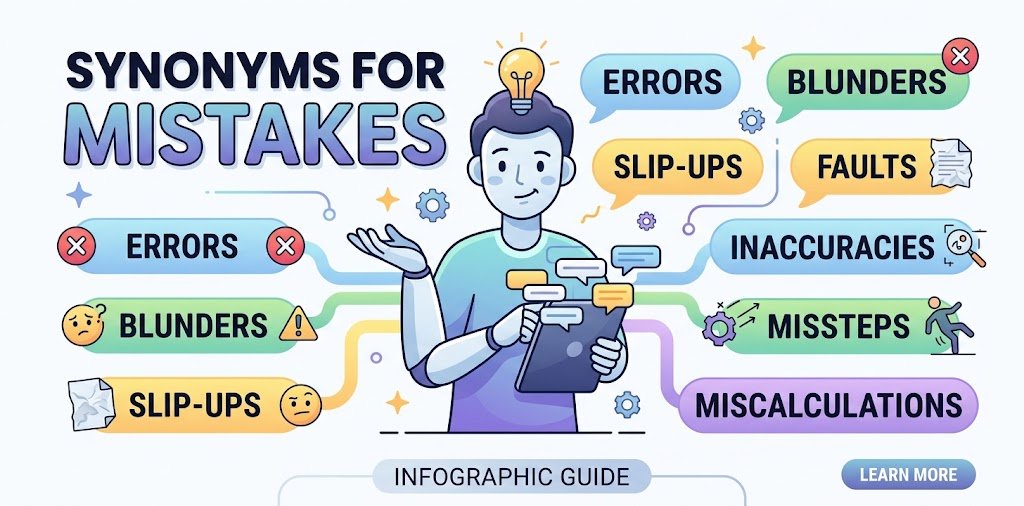
Some of the most useful synonyms for mistakes are errors, blunders, missteps, slips, lapses, oversights, faults, misjudgments, miscalculations, inaccuracies, misunderstandings, misinterpretations, gaffes, goofs, and faux pas.
However, they are not exact substitutes in every context. Error is often more formal, blunder is stronger, oversight suggests something was forgotten, and slip usually suggests an accidental or minor mistake.
Core Synonyms for Mistakes
| Word | Relationship | Meaning | Typical Tone | Best Context |
|---|---|---|---|---|
| Error | Direct/near synonym | A departure from correctness or an established standard | Neutral–formal | Academic, technical, professional |
| Blunder | Near synonym | A significant or embarrassing mistake | Strong, critical | Serious decisions, public mistakes |
| Misstep | Near synonym | An incorrect action or poor decision | Mild–moderate | Decisions, strategy, behavior |
| Slip | Near synonym | A small accidental mistake | Mild | Speech, writing, minor errors |
| Lapse | Near synonym | A temporary failure caused by inattention or weakness | Neutral | Judgment, concentration, standards |
| Oversight | Contextual alternative | Something unintentionally missed or forgotten | Neutral–formal | Documents, tasks, procedures |
| Fault | Contextual alternative | A defect or responsibility for something wrong | Neutral–critical | Systems, behavior, responsibility |
| Misjudgment | Contextual alternative | An incorrect assessment or decision | Neutral–formal | Decisions, people, situations |
| Miscalculation | Contextual alternative | An incorrect calculation, estimate, or assessment | Formal | Numbers, plans, strategy |
| Inaccuracy | Contextual alternative | A lack of correctness or precision | Formal | Facts, data, writing |
| Misunderstanding | Contextual alternative | Incorrect understanding of information or meaning | Neutral | Communication |
| Misinterpretation | Contextual alternative | An incorrect interpretation | Formal | Statements, data, texts |
| Gaffe | Contextual alternative | An embarrassing social or public mistake | Informal–neutral | Social situations, public remarks |
| Goof | Contextual alternative | A silly or careless mistake | Informal | Casual conversation |
| Faux pas | Contextual alternative | A social mistake that violates expected etiquette | Neutral–formal | Social behavior |
These distinctions are consistent with the way major thesaurus resources separate common alternatives. Merriam-Webster specifically identifies blunder, error, lapse, and slip as common synonyms while explaining their different nuances.
What Does “Mistakes” Mean?
Mistakes is the plural form of mistake, a noun referring broadly to an incorrect action, judgment, understanding, or result.
A mistake can happen because someone:
- misunderstands something
- makes an incorrect decision
- forgets something
- acts carelessly
- calculates something incorrectly
- says something unintentionally
- fails to follow a standard or procedure
For example:
I made several mistakes in my report.
This sentence is deliberately general. It does not tell us exactly what kind of mistakes occurred.
That is where more precise vocabulary becomes useful.
1. Error
Error is one of the closest and most useful alternatives to mistake. It is particularly common when there is a recognized standard, rule, calculation, or expected result.
Best contexts: academic writing, mathematics, software, science, business, technical work.
Example:
The report contained several calculation errors.
Compare:
The report contained several mistakes.
The second sentence is general. Calculation errors identifies the type of problem more precisely.
Merriam-Webster notes that error often implies deviation from an established standard or guide.
2. Blunder
A blunder is a more serious or conspicuous mistake and can imply poor judgment, carelessness, or ignorance.
Example:
The manager made a serious blunder by announcing the decision before the agreement was finalized.
Use blunder when you want the mistake to sound more significant than an ordinary mistake or error.
It is usually not the best choice for a tiny typographical error.
3. Misstep
A misstep usually refers to an incorrect action, decision, or move.
It is particularly useful when discussing strategy, relationships, politics, business, or personal behavior.
Example:
The company’s decision to ignore customer feedback was a major misstep.
Unlike error, which can refer to an incorrect fact or calculation, misstep often focuses on a poor action or decision.
4. Slip
A slip usually suggests an accidental or inadvertent mistake, particularly a relatively minor one.
Common expressions include:
- a slip of the tongue
- a slip of the pen
- a verbal slip
Example:
I made a slip and gave the wrong date during the presentation.
Merriam-Webster describes slip as emphasizing inadvertence or accident, especially for relatively trivial or embarrassing mistakes.
5. Lapse
A lapse is often caused by temporary inattention, forgetfulness, or a failure to maintain a normal standard.
Common collocations include:
- a lapse in judgment
- a lapse in concentration
- a lapse of memory
- a lapse in attention
Example:
It was a brief lapse in judgment, not a deliberate decision.
This makes lapse especially useful when explaining why something went wrong.
6. Oversight
An oversight is something that was unintentionally missed, forgotten, or neglected.
Example:
Leaving the attachment out of the email was an oversight.
This is one of the most useful professional alternatives because it can describe an omission without necessarily suggesting incompetence.
Choose “oversight” when:
Something should have been noticed or completed but was accidentally missed.
7. Fault
Fault can mean a defect or a responsibility for something going wrong. It is therefore not a universal substitute for mistake.
Example:
The engineer identified a fault in the electrical system.
Here, fault means a defect.
But:
It was my fault that the meeting started late.
Here, fault concerns responsibility.
So use fault when the sentence is about a defect or responsibility, not simply any incorrect action.
8. Misjudgment
A misjudgment is an incorrect assessment or decision.
Example:
Hiring the supplier without checking its history was a serious misjudgment.
It is more specific than mistake because it identifies the problem as poor judgment.
9. Miscalculation
A miscalculation can refer literally to an incorrect mathematical calculation or more broadly to an incorrect estimate or assessment.
Example:
The budget overrun resulted from a miscalculation of the project’s costs.
It can also be used figuratively:
The team’s decision to underestimate its competitor was a strategic miscalculation.
10. Inaccuracy
Example:
An inaccuracy is something that is not completely correct, precise, or factual.
The editor found several inaccuracies in the article.
This is especially appropriate for:
- facts
- statistics
- measurements
- reports
- descriptions
- written information
It is not necessarily the best word for every kind of personal mistake.
11. Misunderstanding
A misunderstanding occurs when someone incorrectly understands information, intentions, or meaning.
Example:
The disagreement was caused by a misunderstanding about the deadline.
This is different from an ordinary mistake. The problem specifically involves incorrect understanding.
12. Misinterpretation
A misinterpretation is an incorrect interpretation of something.
Example:
The article resulted from a misinterpretation of the original statement.
It is particularly useful for:
- language
- data
- instructions
- statements
- laws
- literature
13. Gaffe
A gaffe is an embarrassing mistake, especially one made publicly or socially.
Example:
The spokesperson made a gaffe during the interview.
Use gaffe when the embarrassing or socially awkward nature of the mistake matters.
14. Goof
Goof is informal and usually suggests a silly, careless, or relatively harmless mistake.
Example:
I made a little goof while editing the presentation.
It works well in casual conversation but is generally unsuitable for formal reports.
15. Faux Pas
A faux pas is a social mistake or breach of expected etiquette.
Example:
Forgetting the host’s name was an awkward faux pas.
It is more specific than mistake: the issue must involve social behavior or etiquette.
Which Word Should I Use?
The easiest way to choose is to identify what kind of mistake occurred.
Use “error” when:
The mistake involves correctness, rules, data, calculations, or a recognized standard.
The spreadsheet contains an error.
Use “blunder” when:
The mistake is serious, conspicuous, or blameworthy.
The decision was a costly blunder.
Use “misstep” when:
The mistake is an action or strategic decision.
The company’s response was a political misstep.
Use “slip” when:
The mistake was accidental and relatively minor.
It was just a slip.
Use “oversight” when:
Something was accidentally forgotten or missed.
The missing attachment was an oversight.
Use “misjudgment” when:
The problem was an incorrect assessment or decision.
It was a serious misjudgment.
Use “misunderstanding” when:
Someone understood information incorrectly.
The conflict began with a misunderstanding.
Use “faux pas” when:
The mistake involved social etiquette.
His comment was an unfortunate faux pas.
Mistake vs Error vs Blunder vs Misstep
These four words overlap, but their emphasis differs.
| Word | Main emphasis | Typical severity | Common use |
|---|---|---|---|
| Mistake | General incorrect action or judgment | Low–high | Everyday language |
| Error | Departure from correctness or a standard | Low–high | Technical/formal |
| Blunder | Serious or embarrassing mistake | Usually higher | Decisions/public actions |
| Misstep | Poor action or decision | Mild–serious | Strategy/behavior |
A useful rule is:
Mistake is the broadest everyday term. Error is often more precise or formal. Blunder emphasizes seriousness or blame. Misstep emphasizes a wrong action or decision.
Merriam-Webster makes similar distinctions among these terms rather than treating them as completely interchangeable.
Mistake vs Oversight
These words are often confused.
A mistake can happen for many reasons:
I made a mistake in the calculation.
An oversight specifically suggests that something was missed or forgotten:
Leaving the calculation out of the report was an oversight.
So:
Mistake = broad category
Oversight = a specific type of mistake involving something missed or forgotten
Mistake vs Misstep
A mistake can refer to almost any incorrect action, judgment, or result.
A misstep usually focuses on a wrong move, decision, or course of action.
Compare:
There was a mistake in the calculation.
Natural.
There was a misstep in the calculation.
Less natural.
But:
The company made a strategic misstep.
Very natural.
The context determines which word sounds appropriate.
Mistake vs Slip
A slip emphasizes accident or inadvertence.
I made a mistake in the report.
General.
I made a slip in the report.
Possible, but more marked and context-dependent.
It was a slip of the tongue.
Very natural.
Therefore, slip is particularly useful for small accidental mistakes in speech, writing, or behavior.
Common Mistakes When Using These Synonyms
1. Treating every synonym as interchangeable
Words can share a core meaning without working in the same sentence.
For example, faux pas cannot replace error in:
The software contains several errors.
2. Using informal vocabulary in formal writing
Words such as goof and screw-up are conversational. In a formal report, error, inaccuracy, or oversight will usually be more appropriate.
3. Calling every omission a general error
If something was simply forgotten or missed, oversight may communicate the cause more precisely.
4. Using “blunder” for a trivial mistake
Blunder normally carries more weight than mistake. Calling a tiny spelling error a blunder can sound exaggerated.
5. Confusing misunderstanding with mistake
A misunderstanding specifically involves incorrect understanding. Someone can make a mistake without misunderstanding anything.
Formal and Professional Synonyms for Mistakes
For professional or academic writing, these options are often useful:
- error — broad and professional
- inaccuracy — incorrect information or detail
- oversight — something unintentionally missed
- miscalculation — incorrect calculation or estimate
- misjudgment — incorrect assessment
- misinterpretation — incorrect interpretation
- discrepancy — a difference or inconsistency that may indicate an error
Be careful with discrepancy: it is not a direct synonym for mistake. It describes an inconsistency or difference, not necessarily the act that caused it.
Informal Words for Mistakes
In casual English, you may hear:
- goof
- slip-up
- flub
- fumble
- screw-up
- boo-boo
These vary in tone and region. They should not automatically be transferred into formal writing.
For example:
I made a small goof in the presentation.
sounds casual.
For a business report:
I identified a minor error in the presentation.
is more appropriate.
Antonyms of Mistakes
The natural opposites of mistakes depend on the context.
Possible antonyms include:
- accuracies
- correct decisions
- correct judgments
- precise calculations
- successes
- correct interpretations
There is no single antonym that works in every sentence because mistake can describe different kinds of incorrect outcomes.
FAQ
What is the best synonym for mistakes?
Error is often the best general alternative, especially in formal, academic, technical, or professional writing. However, mistake remains more natural in many everyday situations. The best choice depends on what caused the problem and what kind of problem it was.
What is a professional word for mistakes?
Errors, inaccuracies, oversights, miscalculations, and misjudgments are useful professional alternatives. Choose based on the situation rather than simply replacing mistakes with a more complicated word.
What is a synonym for a serious mistake?
Blunder is one of the strongest common choices. Misstep can also work when the serious mistake involves a decision or course of action.
What is a synonym for a small mistake?
Slip, slip-up, or goof can work depending on the context and level of formality. Slip is particularly suitable when the mistake was accidental.
Is “error” the same as “mistake”?
They overlap substantially, but they are not identical in every context. Error often suggests deviation from a rule, standard, calculation, or expected result, while mistake is broader and more common in everyday language.
Is “blunder” stronger than “mistake”?
Usually, yes. Blunder commonly suggests a conspicuous, serious, careless, or blameworthy mistake. It therefore carries a stronger negative connotation than the neutral word mistake.
What is another word for a mistake in judgment?
Misjudgment is the most direct choice. Lapse in judgment is also natural when the poor judgment appears temporary or results from inattention.
What is another word for a social mistake?
Faux pas is a precise choice for a social or etiquette-related mistake. Gaffe can also describe an embarrassing public or social mistake.
Conclusion
The best synonym for mistakes depends on the type of mistake you are describing. Use error for a broad professional or technical sense, blunder for a serious or embarrassing mistake, misstep for a poor action or decision, slip for a minor accidental mistake, and oversight when something was unintentionally missed.

Sophia Martinez is an ESL educator who specializes in teaching vocabulary and word meanings. She writes beginner-friendly content that helps learners understand synonyms and improve their English fluency step by step.