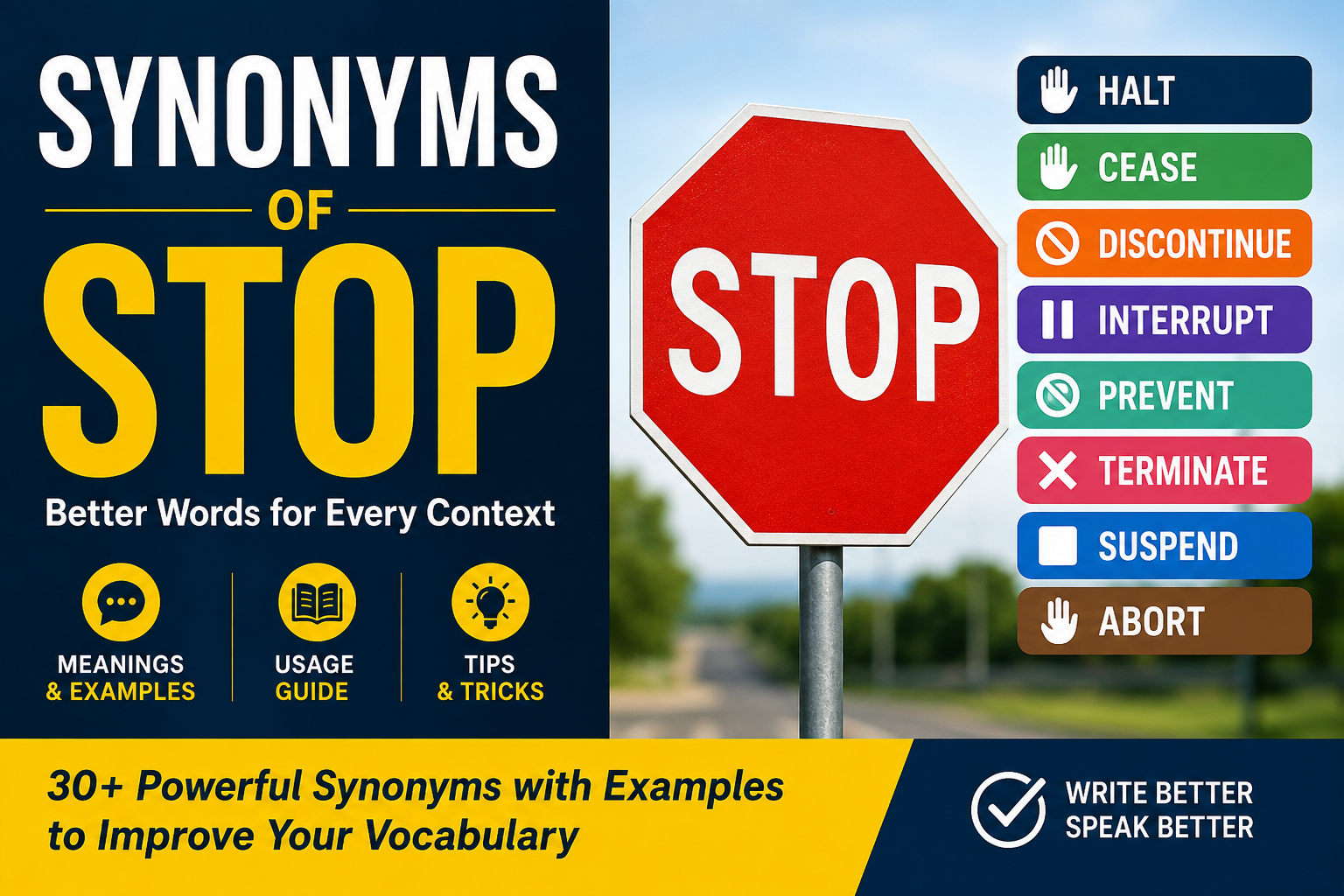
Synonyms of Stop: 15+ Accurate Alternatives for Every Context
If you need synonyms of stop, the best alternative depends on what you mean by stop. You might mean ending an activity, bringing movement to an end, taking a temporary break, preventing something from happening, or giving up an activity. Words such as cease, halt, end, quit, discontinue, suspend, pause, desist, and terminate overlap with stop, but they are not interchangeable in every sentence.
This guide explains the closest synonyms, their differences, formality, strength, and natural contexts so you can choose the right word instead of simply replacing stop with the first synonym you find.
Quick Answer: What Are the Best Synonyms of Stop?
The closest synonyms of stop include cease, halt, end, quit, discontinue, suspend, desist, pause, finish, terminate, and break off. The best choice depends on context. Cease is more formal, halt often emphasizes bringing movement or progress to a standstill, quit can emphasize giving something up, pause normally suggests a temporary interruption, and discontinue is especially natural for an established activity, service, or product.
What Does “Stop” Mean?
Stop is primarily a verb meaning to bring an activity, movement, process, or action to an end, or to cause something to no longer continue. It can also mean to prevent someone or something from doing something.
For example:
- Please stop talking.
- The car stopped outside the house.
- The company stopped producing the product.
- The police stopped the fight.
Cambridge identifies several important uses of stop, including finishing an activity, temporarily pausing, no longer operating, ending movement, and preventing an action.
As a noun, stop can refer to the act or state of stopping, a short stay during a journey, or a place where a bus or train pauses.
Pronunciation
- UK: /stɒp/
- US: /stɑːp/
The verb has the forms stop, stopped, stopping.
The Closest Synonyms of Stop
The following are strong alternatives, but their meanings are not identical in every context.
| Word | Relationship | Strength | Formality | Best Context |
|---|---|---|---|---|
| cease | Near/direct synonym | Strong | Formal | Activities, conditions, operations |
| halt | Near/direct synonym | Strong | Neutral–formal | Movement, progress, operations |
| end | Near/direct synonym | Neutral | Neutral | Activities, events, situations |
| quit | Near synonym | Strong | Neutral | Habits, jobs, activities |
| discontinue | Near synonym | Strong | Formal | Services, products, practices |
| suspend | Near synonym | Temporary | Formal | Activities, services, operations |
| pause | Contextual synonym | Temporary | Neutral | Activities, media, conversations |
| desist | Near synonym | Strong | Formal | Deliberate actions or attempts |
| terminate | Near synonym | Final | Formal | Contracts, processes, services |
| finish | Near synonym | Final | Neutral | Tasks, work, activities |
| break off | Contextual alternative | Strong | Neutral | Conversations, relationships, negotiations |
| leave off | Contextual alternative | Usually temporary/final | Neutral | Activities or speech |
1. Cease
Cease means to stop happening or to stop doing something. It is generally more formal than stop and is especially common in formal, academic, legal, and official writing.
Example:
The factory ceased production in December.
Best used for: operations, activities, conflicts, processes, and conditions.
Compare:
- The fighting stopped. — neutral and everyday
- The fighting ceased. — more formal
Cease can suggest a complete ending and is often used for states or activities that come to an end. Merriam-Webster distinguishes it from stop by noting that cease can apply particularly to states, conditions, or existence and may suggest finality.
2. Halt
Halt means to bring movement, activity, or progress to a stop. It often sounds stronger or more deliberate than ordinary stop.
Example:
The storm halted construction work.
It works particularly well with:
- traffic
- construction
- production
- progress
- operations
- movement
Example:
The unexpected problem brought the project to a halt.
3. End
End is one of the simplest alternatives to stop when you mean that something finishes or is brought to an end.
Example:
The meeting ended at noon.
Use end naturally for:
- meetings
- conversations
- events
- relationships
- periods
- situations
However, end is not interchangeable with stop in every context.
Stop the car. ✓
End the car. ✗
Here, stop refers to movement, whereas end refers to bringing something to a conclusion.
4. Quit
Quit can mean to stop doing something, particularly an activity, habit, or job. It can carry a stronger sense of giving something up.
Examples:
She quit smoking last year.
He quit his job.
I quit playing tennis after my injury.
It is therefore not always a natural substitute for stop.
Stop talking. ✓
Quit talking. ✓, especially in some informal contexts
But:
The bus quit at the station. ✗
For mechanical or physical stopping, quit is usually not the natural choice.
Merriam-Webster notes that quit may emphasize finality or abruptness compared with the broader stop.
5. Discontinue
Discontinue means to stop an established activity, practice, product, service, or process. It is more formal than everyday stop.
Example:
The company discontinued the product.
Other natural examples include:
The hospital discontinued the treatment.
The publisher discontinued the magazine.
This is particularly useful in business, medical, technical, and professional writing.
Merriam-Webster specifically distinguishes discontinue as applying to the stopping of an accustomed activity or practice.
6. Suspend
Suspend means to stop something temporarily, usually with the possibility that it will resume later.
Example:
The school suspended classes because of the storm.
The important distinction is temporary interruption.
Compare:
- The company stopped production. — production ended or was halted.
- The company suspended production. — production was put on hold, potentially temporarily.
This makes suspend especially useful in formal and professional contexts.
7. Pause
Pause normally means to stop temporarily before continuing.
Examples:
Let’s pause the video.
She paused before answering.
The speaker paused for a moment.
If you expect the activity to continue, pause is usually more precise than stop.
Compare:
I stopped watching the movie.
This may mean I finished watching it or decided not to continue.
I paused the movie.
I temporarily interrupted it and expect to continue.
8. Desist
Desist is a formal verb meaning to stop doing something, especially an action or attempt that someone is being urged to stop.
It is commonly followed by from:
The protesters were asked to desist from blocking the entrance.
He was warned to desist from making further threats.
It is considerably more formal than everyday stop. Merriam-Webster notes that desist can emphasize restraint or forbearance as the reason for stopping.
9. Terminate
Terminate means to bring something to a definite end. It is formal and common in professional, legal, technical, and administrative contexts.
Examples:
The company terminated the contract.
The program was terminated after five years.
The service will be terminated next month.
Do not use terminate simply because it sounds more sophisticated. In ordinary conversation, stop or end is usually more natural.
10. Finish
Finish means to complete something rather than simply interrupting or preventing it.
Example:
She finished her homework.
This differs from:
She stopped her homework.
The first means the homework was completed. The second means she ceased doing it, possibly before completing it.
11. Break Off
Break off means to suddenly or deliberately end something, especially a conversation, relationship, negotiation, or agreement.
Examples:
They broke off negotiations.
She broke off the conversation.
The two countries broke off diplomatic talks.
It is a useful contextual alternative rather than a universal synonym for stop.
12. Leave Off
Leave off means to stop doing or saying something. It can sound somewhat more idiomatic or conversational than formal alternatives.
Example:
He left off complaining and went back to work.
It is less universal than stop, so it should be used when the context naturally supports it.
Synonyms of Stop by Meaning
Because stop has several meanings, the most accurate synonym changes according to the situation.
When “Stop” Means “End an Activity”
Use:
- cease
- end
- quit
- discontinue
- finish
- desist
Examples:
Stop arguing.
End the argument.
The company stopped making the product.
The company discontinued the product.
He stopped smoking.
He quit smoking.
When “Stop” Means “Bring Movement to an End”
Use:
- halt
- pull up
- come to a standstill
- bring to a halt
Examples:
The driver stopped the car.
The driver halted the car.
Traffic came to a standstill.
Here, halt is much closer to stop than words such as cease or discontinue.
When “Stop” Means “Take a Temporary Break”
Use:
- pause
- suspend
- take a break
Examples:
Let’s stop for lunch.
Let’s pause for lunch.
The meeting was suspended until Monday.
The choice depends on context and expected duration.
When “Stop” Means “Prevent”
In this meaning, words such as prevent, avert, block, prohibit, thwart, check, and impede can be appropriate—but they should not be treated as universal synonyms of stop.
Cambridge groups prevent, avoid, avert, prohibit, and check with the “prevent something from happening” sense of stop.
For example:
The barrier stopped people from entering.
The barrier prevented people from entering.
But:
She stopped walking.
cannot normally be replaced with:
She prevented walking. ✗
The meanings and grammatical structures are different.
Formal Synonyms of Stop
For academic, professional, legal, or official writing, these alternatives can be useful:
- cease
- halt
- discontinue
- suspend
- desist
- terminate
Examples:
Everyday:
The company stopped production.
Formal:
The company discontinued production.
Everyday:
The negotiations stopped.
Formal:
The negotiations ceased.
Everyday:
The service stopped temporarily.
Formal:
The service was suspended temporarily.
Choose the word according to its meaning, not simply because it sounds more formal.
Casual Alternatives to Stop
In informal conversation, stop itself is usually the most natural choice.
Depending on context, speakers may also use:
- quit
- cut it out
- knock it off
- give it a rest
- leave off
Examples:
Stop making that noise.
Cut it out!
Knock it off!
These expressions are conversational and should generally be avoided in formal academic or professional writing.
Stop vs Cease
| Word | Main Difference | Example |
| stop | General, everyday word | The rain stopped. |
| cease | More formal; often emphasizes ending | The fighting ceased. |
Stop is broader and more common in everyday English. Cease is more formal and often works particularly well for activities, conditions, or ongoing situations.
The company stopped operations.
The company ceased operations.
Both are possible, but the second sounds more formal.
Stop vs Halt
Stop is the general word. Halt often emphasizes bringing movement, activity, or progress to a standstill.
The car stopped.
The car halted.
Both can be grammatical, but halt sounds more deliberate or formal.
Halt is particularly natural in phrases such as:
- halt production
- halt construction
- halt progress
- bring something to a halt
- come to a halt
Stop vs Quit
These words overlap, but quit often suggests giving up an activity, habit, job, or pursuit.
I stopped smoking.
I quit smoking.
Both are natural.
But:
The machine stopped working. ✓
The machine quit working. ✗/unusual in standard usage
When referring to giving up a job:
She quit her job.
This is much more natural than:
She stopped her job.
Stop vs Discontinue
Discontinue is especially appropriate for something that has been regularly provided, produced, practiced, or maintained.
The manufacturer stopped making the model.
The manufacturer discontinued the model.
The second sentence sounds more professional and specifically suggests that an established product or production line is no longer being continued.
Stop vs Pause
This is one of the most important distinctions for English learners.
Pause normally suggests temporary interruption.
Pause the video.
Stop is broader and does not necessarily indicate that the activity will resume.
Stop the video.
If you intend to continue later, pause is often the clearer choice.
Stop vs Finish
These words are not interchangeable.
Finish means complete something.
I finished my homework.
Stop means cease doing something.
I stopped doing my homework.
The first tells us the homework was completed. The second suggests the activity ended, potentially before completion.
Which Synonym Should You Use?
Use this quick guide:
Use stop when:
You want the most general, natural word.
Please stop talking.
Use cease when:
You want a formal word for something coming to an end.
Hostilities finally ceased.
Use halt when:
You want to emphasize movement, progress, or activity coming to a standstill.
The strike halted production.
Use quit when:
Someone gives up an activity, habit, job, or pursuit.
He quit smoking.
Use discontinue when:
An established product, service, practice, or activity is no longer continued.
The company discontinued the service.
Use suspend when:
Something stops temporarily.
The service was suspended.
Use pause when:
Something stops briefly and is expected to continue.
Pause the recording.
Use desist when:
You need a formal word for deliberately stopping an action.
They were ordered to desist from further interference.
Use terminate when:
Something is brought to a definite end, particularly in formal or administrative contexts.
The contract was terminated.
Common Collocations with “Stop”
Some combinations are especially natural in English.
Stop + -ing
One of the most important grammar patterns is:
stop + gerund (-ing)
It means to cease an activity.
She stopped talking.
He stopped smoking.
They stopped arguing.
Stop + object + from + -ing
This pattern means prevent someone or something from doing something.
The police stopped him from entering.
The rain stopped us from playing outside.
Cambridge specifically identifies this use of stop for preventing someone from doing something.
Stop to + verb
This has a different meaning.
stop to do something means interrupt one activity in order to do another.
I stopped to answer the phone.
Compare:
I stopped talking.
I ceased talking.
I stopped to talk.
I interrupted another activity so that I could talk.
This distinction is particularly important for ESL/EFL learners.
Common Mistakes with Synonyms of Stop
Mistake 1: Treating every related word as a direct synonym
Words such as prevent, hinder, obstruct, prohibit, and impede can overlap with one meaning of stop, but they cannot replace stop everywhere.
Incorrect approach:
She impeded talking. ✗
Natural:
She stopped talking. ✓
Mistake 2: Using “pause” for permanent endings
The company paused the product permanently. ✗
If the product will no longer be offered, discontinued is usually more precise.
Mistake 3: Using “quit” for everything
The machine quit working. ✗/unusual
The machine stopped working. ✓
Quit is especially useful when a person gives up an activity, habit, job, or pursuit.
Mistake 4: Using “finish” when something was not completed
I finished my work halfway through. ✗
If you mean you stopped before completing it:
I stopped working halfway through. ✓
Mistake 5: Choosing a formal word just to sound advanced
Please desist from speaking.
Grammatically possible, but unnecessarily formal in ordinary conversation.
Please stop talking.
is much more natural.
Examples of “Stop” Synonyms in Real Contexts
Workplace
The manager halted the project after discovering a major problem.
Academic Writing
The researchers discontinued the experiment after identifying a safety concern.
Business
The company ceased operations in the region.
Everyday Conversation
Please stop making so much noise.
Personal Habits
She quit drinking coffee.
Temporary Interruption
The presenter paused to answer a question.
Formal Instruction
The organization was ordered to desist from the activity.
Legal or Administrative Context
The agreement was terminated after repeated violations.
Antonyms of Stop
The most useful opposites of stop depend on its meaning.
When describing the ending of an activity, suitable words include stop, finish, end, and cease. To express the beginning of an activity, consider start, begin, initiate, or launch. For an activity that continues after a pause, continue, resume, proceed, and carry on are useful choices. When referring to the ending of movement, words such as stop, halt, and come to a standstill work well. To describe preventing something, appropriate alternatives include prevent, block, prohibit, and stop.
Examples:
Stop the meeting. → Start the meeting.
Stop the car. → Move the car.
Stop him from entering. → Allow him to enter.
Frequently Asked Questions About Synonyms of Stop
What is the closest synonym for stop?
The closest synonym depends on context, but cease, halt, and end are among the strongest general alternatives. Stop remains the broadest and most natural everyday choice.
What is a formal synonym for stop?
Common formal alternatives include cease, halt, discontinue, suspend, desist, and terminate. The correct choice depends on what is being stopped.
What is another word for stop in professional writing?
Discontinue, cease, suspend, halt, or terminate may work in professional writing, but each carries a different meaning. For example, discontinue is especially useful for products or services, while terminate is common for contracts or formal arrangements.
What is the strongest synonym for stop?
There is no universally “strongest” synonym. Halt can sound forceful when referring to movement or activity, while terminate can emphasize a definite ending. Cease can also sound formal and final.
Is “quit” a synonym for stop?
Yes, in some contexts. Quit can mean to stop doing an activity or to give something up, as in quit smoking or quit a job. It is not a universal substitute for stop.
Is “pause” the same as “stop”?
Not exactly. Pause normally indicates a temporary interruption, while stop can indicate either a temporary or final ending.
What is the difference between “stop” and “cease”?
Stop is more general and common in everyday English. Cease is more formal and often emphasizes an activity, condition, or operation coming to an end.
What is the opposite of stop?
Depending on the context, opposites include start, begin, continue, resume, proceed, allow, and permit.
Conclusion
The best synonyms of stop depend on the exact meaning you want to express. Cease is a formal alternative for ending an activity or condition, halt emphasizes bringing movement or progress to a standstill, quit often means giving up an activity or habit, discontinue suits established products and services, suspend suggests a temporary interruption, and pause normally means stopping briefly before continuing.

David Wilson is a content strategist and SEO expert who focuses on creating structured vocabulary content. He combines keyword research with simple explanations to make learning English both effective and search-friendly.