Said Sadly Synonyms: Better Words for Expressing Sadness in Dialogue
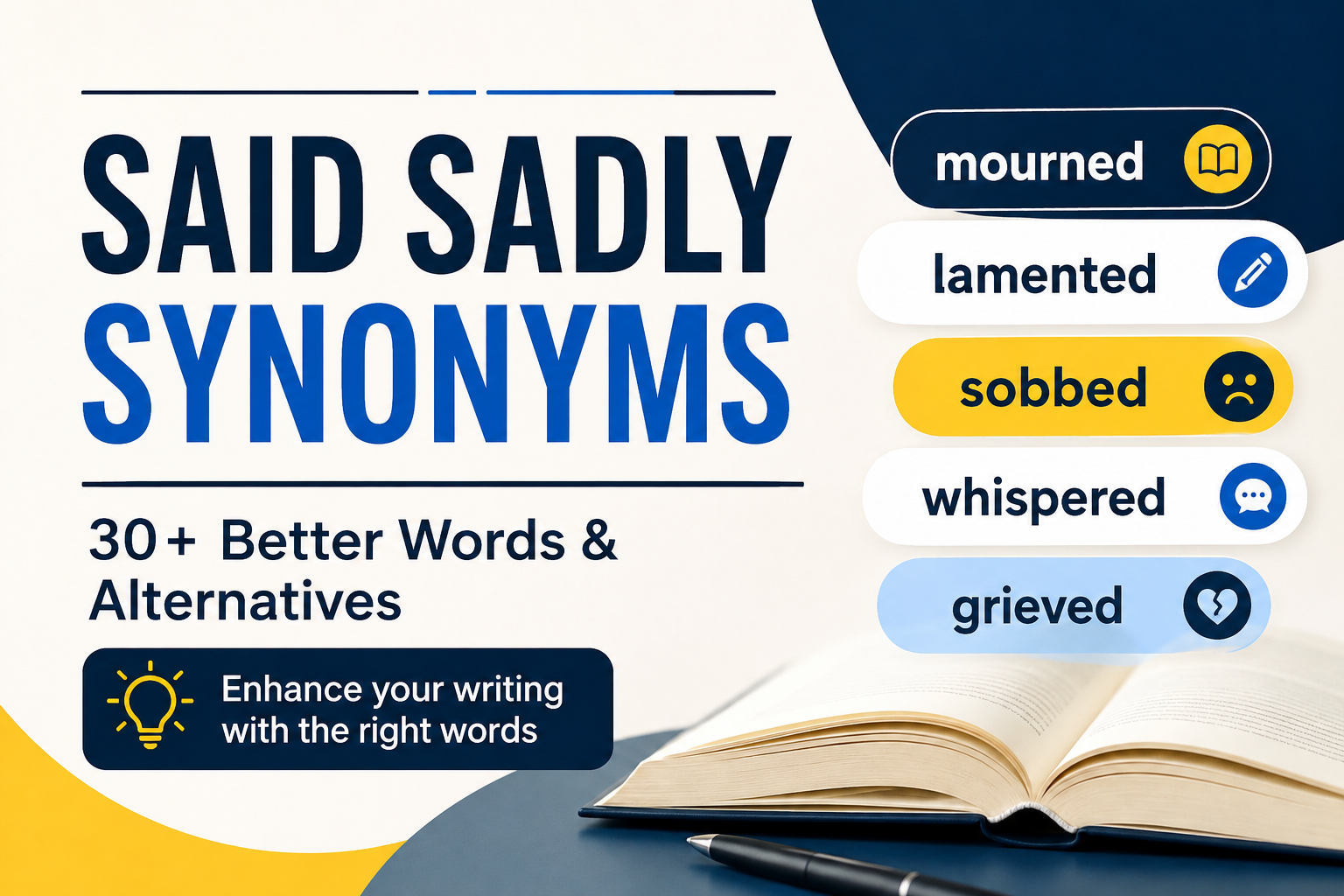
When you write dialogue, “said sadly” is perfectly understandable, but it is not always the most precise choice. Depending on the emotion and situation, a character might lament, sigh, murmur, whisper, cry, wail, moan, or say something sorrowfully.
However, these words are not interchangeable. Some describe the way someone speaks, while others describe the character’s emotional state or a particular kind of vocal action. Choosing the right expression makes dialogue more natural and gives readers a clearer sense of what is happening.
Quick Answer
Useful alternatives to “said sadly” include said sorrowfully, said mournfully, said regretfully, murmured, whispered, sighed, lamented, cried, wailed, and bemoaned. The best choice depends on the type and intensity of sadness. For subtle sadness, murmured or said quietly may work better; for grief, lamented or mourned can be more appropriate. Not every alternative is a direct synonym for said sadly.
What Does “Said Sadly” Mean?
“Said sadly” means that someone spoke in a way that showed sadness, unhappiness, sorrow, or emotional pain.
Here, said is a verb functioning as a dialogue tag, while sadly is an adverb describing how the words were spoken.
For example:
“I wish you could stay,” she said sadly.
The phrase tells the reader that the character’s speech carries a sad emotional tone.
The adverb sadly commonly means “in an unhappy way” when it describes speech or behavior. Cambridge gives examples such as someone saying something sadly or shaking their head sadly. Merriam-Webster similarly defines this sense as being in a sad manner or in a way that shows sadness.
There is an important distinction, however: sadly can also mean “unfortunately” or “regrettably.” For example:
Sadly, the museum is closed today.
In that sentence, sadly does not describe the way someone speaks. It expresses regret about an unfortunate situation.
This article focuses on the emotional-speech meaning of “said sadly.”
Best Synonyms and Alternatives for “Said Sadly”
Not all of the following are strict synonyms. Some are near synonyms or contextual alternatives that change the emotional nuance.
| Word or phrase | Relationship | Emotional strength | Best use |
|---|---|---|---|
| said sorrowfully | Near synonym | Moderate | General sadness |
| said mournfully | Near synonym | Strong | Grief or loss |
| said regretfully | Near synonym | Moderate | Regret or remorse |
| said ruefully | Near synonym | Moderate | Sadness mixed with regret |
| murmured | Contextual alternative | Mild | Quiet, subdued sadness |
| whispered | Contextual alternative | Mild | Very soft or intimate speech |
| sighed | Contextual alternative | Mild–moderate | Resignation, weariness, sadness |
| lamented | Contextual alternative | Strong | Expressing sorrow or regret |
| bemoaned | Contextual alternative | Strong | Complaining sadly about a situation |
| cried | Contextual alternative | Moderate–strong | Emotional speech or tears |
| sobbed | Contextual alternative | Very strong | Speech interrupted by crying |
| wailed | Contextual alternative | Very strong | Loud, uncontrolled grief |
1. Said sorrowfully
Said sorrowfully is one of the closest alternatives to “said sadly.”
It emphasizes genuine sorrow without necessarily suggesting tears, grief, or dramatic behavior.
“I never got to say goodbye,” she said sorrowfully.
Use it when the character’s voice clearly conveys sadness but remains controlled.
2. Said mournfully
Mournfully suggests deeper sadness, especially sadness connected with loss, death, separation, or grief.
“He used to sit here every morning,” she said mournfully.
It is stronger and more emotionally specific than simply sadly.
3. Said regretfully
Regretfully is appropriate when sadness comes from wishing something had happened differently.
“I should have listened to you,” he said regretfully.
The key nuance is regret, rather than sadness alone.
4. Said ruefully
Ruefully often combines regret, disappointment, embarrassment, or reluctant acceptance.
“I suppose you were right after all,” he said ruefully.
This can sound more restrained and reflective than sadly.
5. Murmured
Murmured describes speech that is quiet and often soft or indistinct. It does not inherently mean sad, but it can naturally convey subdued sadness when the surrounding context supports it.
“I don’t want to leave,” she murmured.
This is often more natural in fiction than replacing said with an overly dramatic emotional verb.
6. Whispered
Whispered means speaking very quietly. Like murmured, it is not a direct synonym for “said sadly.”
“Please don’t go,” he whispered.
The sadness comes from the words and context, while whispered describes the voice.
7. Sighed
Sighed can suggest sadness, disappointment, resignation, relief, exhaustion, or frustration.
“I knew this would happen,” she sighed.
It works particularly well when the character’s emotional state is shown through the physical act of sighing.
8. Lamented
Lamented means expressed sorrow, grief, or regret about something.
“We lost everything that night,” he lamented.
It can be a strong alternative when the character is actively expressing grief rather than merely speaking in a sad tone.
9. Bemoaned
Bemoaned means complained or expressed sorrow about something, often because it is considered unfortunate or undesirable.
“We missed our only chance,” she bemoaned.
It is more specific than said sadly because it usually involves complaint, regret, or sorrow about a situation.
10. Cried
Cried can function as a speech verb when someone speaks loudly or emotionally.
“Don’t leave me!” she cried.
It does not necessarily mean the character is literally crying. Context determines the meaning.
11. Sobbed
Sobbed is much stronger than said sadly. It suggests that the speaker is crying intensely, often causing the speech to break or become difficult.
“I tried to stop him,” she sobbed.
Do not use sobbed simply because a character is mildly sad.
12. Wailed
Wailed suggests loud, uncontrolled, or prolonged expression of grief or distress.
“Why did you leave me?” she wailed.
This is appropriate for intense emotional scenes, not ordinary sadness.
Closest Synonyms for “Said Sadly”
If you want the closest meaning rather than a dramatic dialogue tag, these are the safest choices:
- said sorrowfully
- said mournfully
- said regretfully
- said ruefully
- said unhappily
Of these, said sorrowfully is often the closest general replacement because it preserves the basic structure and meaning of said sadly.
Words such as lamented, sobbed, and wailed should be treated as more specific alternatives rather than exact replacements.
Mild, Moderate, and Strong Ways to Express Sadness
The emotional intensity matters.
Mild sadness
Use restrained expressions when the character is disappointed, wistful, or quietly unhappy:
- said quietly
- murmured
- whispered
- sighed
- said softly
- said sorrowfully
“I thought we’d have more time,” she murmured.
Moderate sadness
Use these when the sadness is obvious but controlled:
- said sadly
- said sorrowfully
- said mournfully
- said regretfully
- said ruefully
- lamented
“Things will never be the same,” he said mournfully.
Intense sadness
Use stronger verbs when the character is visibly overwhelmed:
- cried
- sobbed
- wailed
- wept as she spoke
- choked out
“I didn’t want this to happen,” she sobbed.
These expressions should not be used interchangeably. A character who whispers is not necessarily crying, and someone who wails is expressing emotion much more dramatically than someone who simply speaks sadly.
“Said Sadly” vs. “Mournfully”
These expressions are close, but mournfully is more specific.
Sadly can describe many kinds of sadness:
“I’ll miss this place,” she said sadly.
Mournfully tends to suggest deeper grief, loss, or melancholy:
“I’ll never see him again,” she said mournfully.
Choose sadly for general emotional sadness and mournfully when the scene has a stronger sense of grief or loss.
“Said Sadly” vs. “Regretfully”
Use sadly when the main emotion is sorrow.
Use regretfully when the speaker wishes something had been different.
Compare:
“I don’t want you to leave,” she said sadly.
The speaker is simply expressing sadness.
“I shouldn’t have said that,” she said regretfully.
The speaker feels regret about a previous action.
“Said Sadly” vs. “Lamented”
Lamented is not simply a more sophisticated version of said sadly.
To lament means to express sorrow, grief, or regret, often about a particular loss or unfortunate situation.
“Our old home is gone,” he lamented.
It works best when the speech itself is an expression of sorrow.
“Said Sadly” vs. “Sobbed”
This is an important distinction for writers.
“I miss my mother,” she said sadly.
The character is sad but controlled.
“I miss my mother,” she sobbed.
The character is crying while speaking.
Sobbed therefore carries much stronger emotional information than said sadly.
Should You Replace “Said” Every Time?
No.
Said is a normal and useful dialogue tag. Writers do not need to replace it whenever it appears.
For example:
“I don’t know,” she said.
This sentence is perfectly natural.
If the emotional context is already clear, adding sadly may even be unnecessary:
She looked down at the photograph. “I don’t know,” she said.
The character’s action can communicate sadness without explicitly telling the reader how she spoke.
This is particularly useful in fiction. Writing advice from experienced writers often favors using said when appropriate and varying the surrounding action, rather than replacing every instance with a dramatic dialogue verb. Community discussions among writers also frequently emphasize that excessive decorative dialogue tags can become distracting.
Showing Sadness Instead of Saying “Said Sadly”
Sometimes the strongest alternative is not another dialogue tag.
Instead, show the character’s emotion through an action, expression, or physical response.
Telling
“I thought you’d come back,” she said sadly.
Showing
She lowered her eyes. “I thought you’d come back.”
Or:
Her voice trembled. “I thought you’d come back.”
Or:
She stared at the empty doorway. “I thought you’d come back.”
These versions allow the reader to infer the sadness instead of explicitly labeling it.
The best choice depends on the style of writing. “Said sadly” is not grammatically wrong or inherently poor writing. It simply isn’t always the most vivid option.
Common Mistakes With “Said Sadly” Synonyms
Mistake 1: Treating every word as an exact synonym
Words such as whispered, sobbed, and wailed describe different speech behaviors.
“I can’t do this,” she whispered.
does not mean exactly the same thing as:
“I can’t do this,” she sobbed.
Mistake 2: Using an overly dramatic word
If a character is mildly disappointed, wailed may sound exaggerated.
“The movie was canceled,” he wailed.
Unless the scene is intentionally comic or extremely dramatic, this is probably too strong.
Mistake 3: Using “lamented” for ordinary dialogue
Lamented is more literary and specific than said sadly.
“I forgot my umbrella,” she lamented.
This can sound unnatural if the situation is trivial.
Mistake 4: Confusing sadness with regret
Regretfully focuses on regret, while sadly has a broader emotional meaning.
“I shouldn’t have lied,” he said regretfully.
The regret is central.
Mistake 5: Forcing unusual vocabulary into dialogue
A rare word is not automatically a better word.
Natural dialogue is usually more effective than a sentence that sounds like it was built around a thesaurus entry.
Natural Examples for Different Writing Situations
Fiction
“I wanted to tell you sooner,” she said sorrowfully.
Emotional scene
“He’s never coming home,” she said mournfully.
Quiet sadness
“Maybe it was for the best,” he murmured.
Regret
“I should have stayed,” she said regretfully.
Deep grief
“I can’t believe she’s gone,” he sobbed.
Loud grief
“Why did this happen?” he wailed.
Resignation
“There’s nothing we can do now,” she sighed.
A Simple Decision Guide
Choose the expression according to what the character is actually doing. “Said sadly” works well when the main purpose is simply to show sadness. For a slightly more literary expression of sorrow, “said sorrowfully” is a natural choice.
When grief or loss is central to the scene, “said mournfully” fits better. If the character regrets something, “said regretfully” makes the meaning clear. For sadness combined with regret or reluctant acceptance, “said ruefully” is more precise.
For quiet speech, “murmured” can suggest that the character is speaking softly, while “whispered” is appropriate when the voice is especially quiet. If the emotion comes through a sigh or sense of resignation, “sighed” may be the better choice.
More intense expressions require stronger verbs. “Lamented” suits a character who openly expresses grief or regret. When the character is crying while speaking, use “sobbed.” In moments of overwhelming and uncontrolled grief, “wailed” conveys the strongest emotional intensity.
Pronunciation of Key Words
For learners, these pronunciations can help:
- sadly — /ˈsæd.li/
- sorrowfully — /ˈsɒr.əʊ.fəl/ (UK), /ˈsɑːr.oʊ.fəl/ (US)
- mournfully — /ˈmɔːn.fəl/
- regretfully — /rɪˈɡret.fəl/
- murmured — /ˈmɜː.məd/ (UK), /ˈmɝː.mɚd/ (US)
- lamented — /ləˈmen.tɪd/
- sobbed — /sɒbd/ (UK), /sɑːbd/ (US)
Cambridge lists sadly as /ˈsæd.li/ in both British and American English.
Other Words Related to Sad Speech
Depending on the exact emotional shade, writers may also encounter:
- unhappily
- sorrowfully
- mournfully
- regretfully
- ruefully
- wistfully
- dolefully
- gloomily
- dejectedly
- despondently
- morosely
- joylessly
These should not automatically be substituted for sadly. They describe different shades of sadness and emotional tone. Thesaurus references distinguish several of these as words describing a sorrowful manner rather than treating every one as a perfect equivalent.
What Is the Best Alternative to “Said Sadly”?
For a general, close alternative, use “said sorrowfully.” When expressing grief, “said mournfully” or “lamented” is more precise. If the character feels regret, consider “said regretfully” or “said ruefully.”
For quiet sadness, “murmured” or “whispered” can work when the context supports a softer delivery. In scenes involving intense crying, “sobbed” is usually the clearest choice, while “wailed” may suit moments of extreme grief.
Above all, describe the character’s actual behavior rather than simply choosing the most dramatic word available.
FAQ
What is another word for “said sadly”?
The closest alternatives include said sorrowfully, said mournfully, said regretfully, and said ruefully. Context determines which one is most accurate.
What is the best synonym for “said sadly” in creative writing?
Said sorrowfully is a close general alternative. However, action-based descriptions such as she lowered her eyes can sometimes create a more natural emotional effect.
What word means speaking with sadness?
Sorrowfully and mournfully can describe speaking with sadness. Mournfully generally suggests deeper grief or loss.
Is “lamented” the same as “said sadly”?
Not exactly. Lamented means expressed sorrow, grief, or regret, usually about something specific. It is more precise than simply speaking sadly.
Is “sobbed” a synonym for “said sadly”?
Not exactly. Sobbed indicates crying while speaking and therefore expresses a much stronger emotional state.
What is a softer alternative to “said sadly”?
Depending on the scene, murmured, whispered, said softly, or said quietly can work. These describe subdued delivery rather than sadness itself.
Should writers avoid “said sadly”?
No. “Said sadly” is grammatically correct and natural. The issue is not correctness; it is whether the phrase is the most effective choice for the particular scene.
How can I show sadness without using “said sadly”?
Show the emotion through actions, facial expressions, voice, or body language:
She wiped away a tear. “I hoped you’d stay.”
This can communicate sadness without explicitly naming it.
Conclusion
The best “said sadly” synonym depends on the emotion you want readers to notice. Sorrowfully is a close general alternative, mournfully suggests grief, regretfully emphasizes regret, and ruefully combines sadness with reluctant regret. Words such as murmured, whispered, sobbed, and wailed describe specific ways of speaking rather than simply meaning “said sadly.”

Sophia Martinez is an ESL educator who specializes in teaching vocabulary and word meanings. She writes beginner-friendly content that helps learners understand synonyms and improve their English fluency step by step.