Synonyms of Reader: 20+ Better Words & Phrases With Examples
Looking for the right synonyms of reader depends on what you mean by reader. In its most common sense, a reader is simply a person who reads. However, the word can describe very different people: someone who reads for pleasure, someone who reads a lot, a person who follows a newspaper, or someone who professionally evaluates manuscripts.
Therefore, not every alternative to reader works in every sentence. Bookworm, for example, suggests someone who reads frequently, whereas bibliophile emphasizes a strong love of books. Similarly, reviewer and literary critic refer to people who evaluate or analyze written works rather than simply read them.
This guide separates direct synonyms, near-synonyms, and context-specific alternatives so you can choose the most natural word.
Quick Answer: What Are the Best Synonyms of Reader?
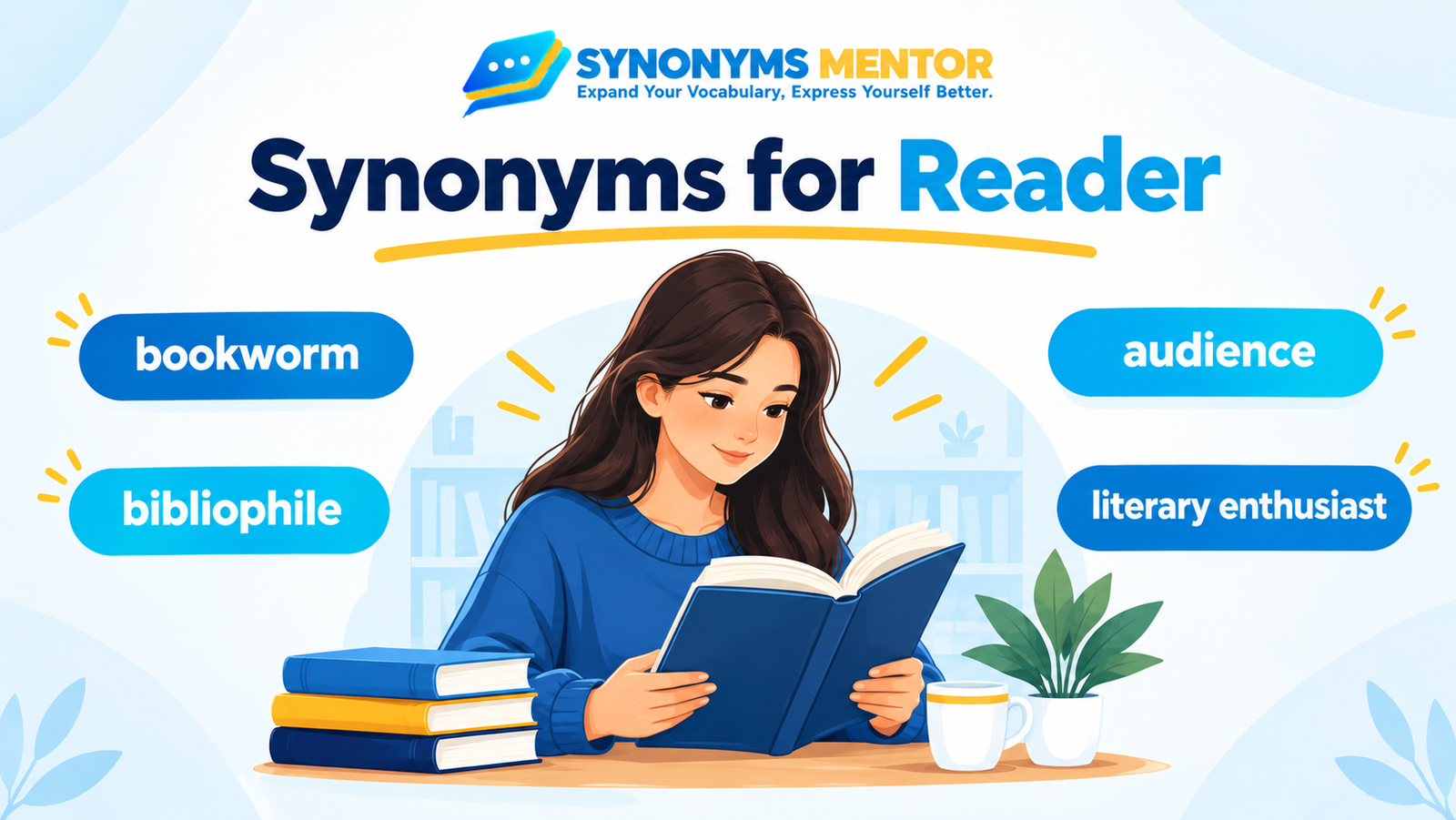
The closest alternatives to reader include book reader, book lover, bookworm, bibliophile, reading enthusiast, and peruser. However, each carries a slightly different meaning.
Book lover and bookworm work well for enthusiastic readers, while bibliophile is more formal and specifically emphasizes a strong interest in books. For someone who evaluates written works, reviewer or literary critic is more precise.
Core Synonym Resource
| Word or phrase | Relationship | Meaning | Strength | Formality | Best context |
|---|---|---|---|---|---|
| Book reader | Direct/contextual | A person who reads books | Neutral | Neutral | Books |
| Book lover | Near synonym | Someone who loves books | Stronger | Neutral | Personal interests |
| Bookworm | Near synonym | Someone who reads a lot | Stronger | Informal | Casual writing |
| Bibliophile | Near synonym | Someone with a strong love of books | Stronger | Formal/literary | Literary contexts |
| Reading enthusiast | Contextual alternative | Someone highly interested in reading | Stronger | Neutral | General/professional |
| Avid reader | Descriptive alternative | Someone who reads eagerly and frequently | Stronger | Neutral | General writing |
| Voracious reader | Descriptive alternative | Someone who reads a very large amount | Stronger | Neutral | Emphasis on quantity |
| Peruser | Contextual alternative | Someone who reads or examines something carefully | Similar | Formal | Documents/texts |
| Reviewer | Role-specific | Someone who evaluates a book, product, or work | Different | Neutral | Reviews |
| Literary critic | Role-specific | Someone who analyzes and evaluates literature | Different | Formal | Literature |
| Scholar | Related/contextual | Someone engaged in advanced academic study | Different | Formal | Academic reading |
| Researcher | Related/contextual | Someone who reads to investigate a subject | Different | Formal | Research |
| Subscriber | Contextual alternative | Someone who receives or follows a publication/service | Different | Neutral | Newspapers/magazines |
| Audience member | Contextual alternative | A person consuming a publication or presentation | Broader | Neutral | Media |
| Readership | Related noun | The collective group of readers | Not a person | Formal | Publications |
The distinction matters. Cambridge defines reader as someone who reads and gives examples involving books, newspapers, and magazines. It also recognizes specialized meanings, including a publishing professional and a university academic rank.
What Does “Reader” Mean?
Reader is a countable noun referring most commonly to a person who reads. It can describe someone who reads for pleasure, someone who reads frequently, or someone who reads a particular publication.
For example:
- She is an avid reader of historical fiction.
- The magazine has thousands of readers.
- The author thanked her readers.
Cambridge lists reader at an intermediate learner level as simply “someone who reads,” while its fuller dictionary entry also distinguishes specialized meanings.
US pronunciation: /ˈriː.dɚ/
UK pronunciation: /ˈriː.dər/
Direct and Near Synonyms of Reader
1. Book Reader
Meaning: A person who reads books.
This is one of the clearest descriptive alternatives to reader. However, book reader is less idiomatic in many situations than simply reader.
Example:
The library offers several programs for young book readers.
Use it when you specifically need to distinguish people who read books from people who read other types of material.
2. Book Lover
Meaning: Someone who has a strong affection for books.
Unlike reader, book lover describes attitude as well as behavior. A person can be a book lover even when they are not currently reading.
Example:
The gift shop is a great place for book lovers.
Best for: Casual, descriptive, and lifestyle writing.
3. Bookworm
Meaning: Someone who reads a lot, especially for pleasure.
Bookworm is informal and often affectionate. It emphasizes a person’s reading habit rather than merely their ability to read.
Example:
My sister has always been a bookworm.
Best for: Conversational and informal writing.
4. Bibliophile
Meaning: A person who loves books.
Bibliophile is more formal and literary than bookworm. It can also suggest a particular appreciation of books as objects, collections, or cultural works.
Example:
The rare-book exhibition attracted bibliophiles from across the city.
Best for: Literary, formal, and sophisticated contexts.
Collins specifically lists book lover, bookworm, bibliophile, and book reader for the “person who reads” sense of reader.
5. Reading Enthusiast
Meaning: Someone who is highly interested in reading.
This phrase is transparent and versatile. It is useful when you want a positive description without the informal tone of bookworm.
Example:
The conference attracted reading enthusiasts from several countries.
Best for: General, educational, and promotional writing.
6. Avid Reader
Meaning: Someone who reads eagerly and frequently.
This is not a perfect dictionary synonym because avid reader adds information about intensity. Nevertheless, it is one of the most natural alternatives when the original sentence means “someone who reads a lot.”
Example:
He is an avid reader of science fiction.
Cambridge itself uses avid reader in examples describing people who read particular genres extensively.
7. Voracious Reader
Meaning: Someone who reads a very large amount.
Voracious literally carries a strong sense of consuming something eagerly, so the phrase is more emphatic than avid reader.
Example:
She is a voracious reader who finishes several books each month.
Use it when the amount or intensity of reading is important.
8. Peruser
Meaning: Someone who reads or examines something, often carefully or casually.
This word is more formal than reader and is especially useful with documents, reports, articles, and other written material.
Example:
The report was written with the average peruser in mind.
However, peruser is considerably less common in everyday English. Therefore, do not replace reader with it automatically.
Context-Specific Alternatives
Some words are related to reader but should not be treated as direct synonyms.
For Someone Who Reviews Books
Reviewer
A reviewer reads a work and evaluates it, usually producing an opinion or review.
Example:
The reviewer praised the novel’s unusual structure.
A reviewer is therefore more specific than a reader.
For Someone Who Analyzes Literature
Literary Critic
A literary critic studies, interprets, and evaluates literature.
Example:
The literary critic examined the novel’s treatment of memory.
A literary critic is certainly a reader, but reader is much broader.
For Academic Reading
Scholar
A scholar is someone engaged in serious academic or intellectual study.
Example:
The book is aimed at scholars of medieval history.
Not every scholar is primarily defined by reading, so this is a contextual alternative rather than a direct synonym.
Researcher
A researcher reads sources as part of investigating a question or subject.
Example:
Researchers reviewed hundreds of historical documents.
Again, the word describes a broader role rather than simply someone who reads.
For Newspaper or Magazine Readers
Subscriber
A subscriber is someone who pays for or receives a publication or service.
Example:
The newspaper introduced a new feature for its subscribers.
A subscriber may be a reader, but the two words describe different things. Reader focuses on reading; subscriber focuses on receiving or paying for access.
Readership
Readership is not a synonym for an individual reader. Instead, it means the collective group of people who read a publication.
Correct:
The newspaper has a large readership.
Incorrect:
She is a large readership.
This distinction is especially useful for writers and SEO editors because reader and readership frequently appear in the same publishing context.
Which Word Should I Use?
The easiest way to choose is to identify the extra meaning you want to communicate.
Choose “reader” when:
You simply mean a person who reads.
The article is written for general readers.
Choose “book lover” when:
You want to emphasize someone’s love of books.
The store is popular with book lovers.
Choose “bookworm” when:
You want an informal, friendly description of someone who reads a lot.
He’s a complete bookworm.
Choose “bibliophile” when:
You want a more formal or literary expression for someone with a strong love of books.
The collection attracted serious bibliophiles.
Choose “avid reader” when:
You want to emphasize frequent or enthusiastic reading.
She is an avid reader of biographies.
Choose “voracious reader” when:
You want to emphasize an especially high amount of reading.
He is a voracious reader.
Choose “peruser” when:
You need a formal term for someone examining written material.
The document should be clear to every peruser.
Choose “reviewer” when:
The person reads something specifically to evaluate it.
The reviewer gave the novel four stars.
Choose “literary critic” when:
The person analyzes literature professionally or academically.
The literary critic discussed the author’s use of symbolism.
Choose “scholar” or “researcher” when:
Reading is part of academic investigation rather than the person’s defining characteristic.
Reader vs. Bookworm vs. Bibliophile
These three words overlap, but they are not interchangeable in every context.
| Word | Main emphasis | Tone | Example |
|---|---|---|---|
| Reader | Someone who reads | Neutral | The reader understood the argument. |
| Bookworm | Someone who reads a lot | Informal | Her brother is a bookworm. |
| Bibliophile | Strong love of books | Formal/literary | The bibliophile collected rare editions. |
In short, reader is the broadest term. Bookworm emphasizes frequent reading, whereas bibliophile emphasizes a strong love of books.
Reader vs. Reviewer
These words are particularly easy to confuse.
A reader simply reads something. A reviewer reads it with the purpose of assessing or commenting on it.
Compare:
The reader enjoyed the novel.
with:
The reviewer praised the novel’s characters.
The first sentence describes the person’s experience. The second describes an evaluative role.
Therefore, reviewer is not a direct synonym for reader.
Reader vs. Readership
The grammatical difference is straightforward.
Reader = one person who reads.
Readership = the collective audience of readers.
For example:
The article attracted many readers.
but:
The article attracted a large readership.
This distinction is important in publishing, journalism, blogging, and content marketing.
Common Mistakes With Reader Synonyms
1. Treating “reviewer” as a direct synonym
A reviewer is a type of reader with an evaluative role. The words are related, but they are not equivalent.
2. Using “bibliophile” for every reader
A bibliophile has a strong love of books. Someone who reads one article does not automatically qualify as a bibliophile.
3. Using “bookworm” in formal writing
Bookworm is natural in conversation and informal writing. In a formal academic article, avid reader or frequent reader may be more appropriate.
4. Confusing “reader” with “readership”
One is a person; the other is a collective noun describing an audience.
5. Assuming “avid reader” means exactly “reader”
Avid reader adds the idea of enthusiasm or frequency. Consequently, it is better viewed as a descriptive alternative than a perfect replacement.
6. Using “scholar” simply because someone reads
A scholar studies a subject intellectually or academically. Reading alone does not make someone a scholar.
Common Collocations With “Reader”
Understanding collocations can help you select a more natural alternative.
Common phrases
- avid reader
- avid reader of fiction
- voracious reader
- regular reader
- frequent reader
- enthusiastic reader
- average reader
- general reader
- young reader
- adult reader
- online reader
- newspaper reader
- magazine reader
- loyal reader
- returning reader
- target reader
Cambridge’s corpus-based material includes combinations such as anonymous reader, average reader, and avid reader, demonstrating that reader naturally combines with descriptive modifiers.
Antonyms of Reader
There is no single perfect antonym for reader because reader describes an activity or role rather than a simple binary state.
Depending on context, useful contrasts may include:
- nonreader — someone who does not read
- illiterate person — someone unable to read or write, though this is a much stronger and more specific term
- listener — someone receiving spoken rather than written material
- viewer — someone consuming primarily visual material
These are contextual opposites, not universal antonyms.
FAQ
What is another word for a reader?
The most natural alternatives include book reader, book lover, bookworm, bibliophile, reading enthusiast, avid reader, and voracious reader. The best choice depends on what you want to emphasize. For example, bookworm suggests frequent reading, while bibliophile emphasizes a strong love of books.
What is a synonym for an avid reader?
Good alternatives include bookworm, voracious reader, reading enthusiast, and bibliophile, although they are not identical. Avid reader emphasizes enthusiasm and frequency, voracious reader emphasizes quantity, and bibliophile emphasizes a strong love of books.
What is a formal word for reader?
Bibliophile can be a formal or literary alternative when you mean someone who loves books. Peruser is another formal term, particularly for someone reading or examining written material. However, in many formal sentences, simply using reader remains the most natural choice.
What is a fancy word for a book lover?
Bibliophile is the most established formal or literary term for a person who loves books. Bookworm is more familiar and informal, while book lover is straightforward and neutral.
Is “bookworm” a synonym for reader?
It is a near-synonym, not a perfect substitute. A bookworm is generally someone who reads frequently or enthusiastically. Therefore, the word adds information that the person is particularly devoted to reading.
Is “bibliophile” the same as “reader”?
No. A reader is simply someone who reads, whereas a bibliophile has a strong love of books. A bibliophile is likely to be a reader, but the meanings are not identical.
What is another word for someone who reads a lot?
The most natural choices are avid reader, voracious reader, bookworm, and reading enthusiast. Among these, voracious reader puts the strongest emphasis on the amount someone reads.
What is the difference between reader and readership?
A reader is an individual person who reads. Readership refers collectively to the people who read a publication, website, newspaper, magazine, or other material.
Conclusion
The best synonym for reader depends on the exact meaning you want to communicate. If you simply mean someone who reads, reader is usually the clearest choice. Emphasize rapid reading speed by using speed reader, fast-paced consumer, or quick page-turner. If you want to emphasize a love of books, book lover or bibliophile is more appropriate.

Our editorial team is dedicated to making English vocabulary easier to understand and use correctly. We research and review synonyms, antonyms, definitions, word usage, and example sentences to ensure our content is clear, accurate, practical, and useful for students, writers, professionals, and English learners.