Synonyms of Canal: 12 Better Words With Examples and Context
Looking for synonyms of canal can be surprisingly tricky because the word has more than one meaning. In its most common geographical sense, a canal is a human-made waterway used for navigation, irrigation, drainage, or transporting water. It can also describe a narrow passage or tube inside the body, as in ear canal or root canal.
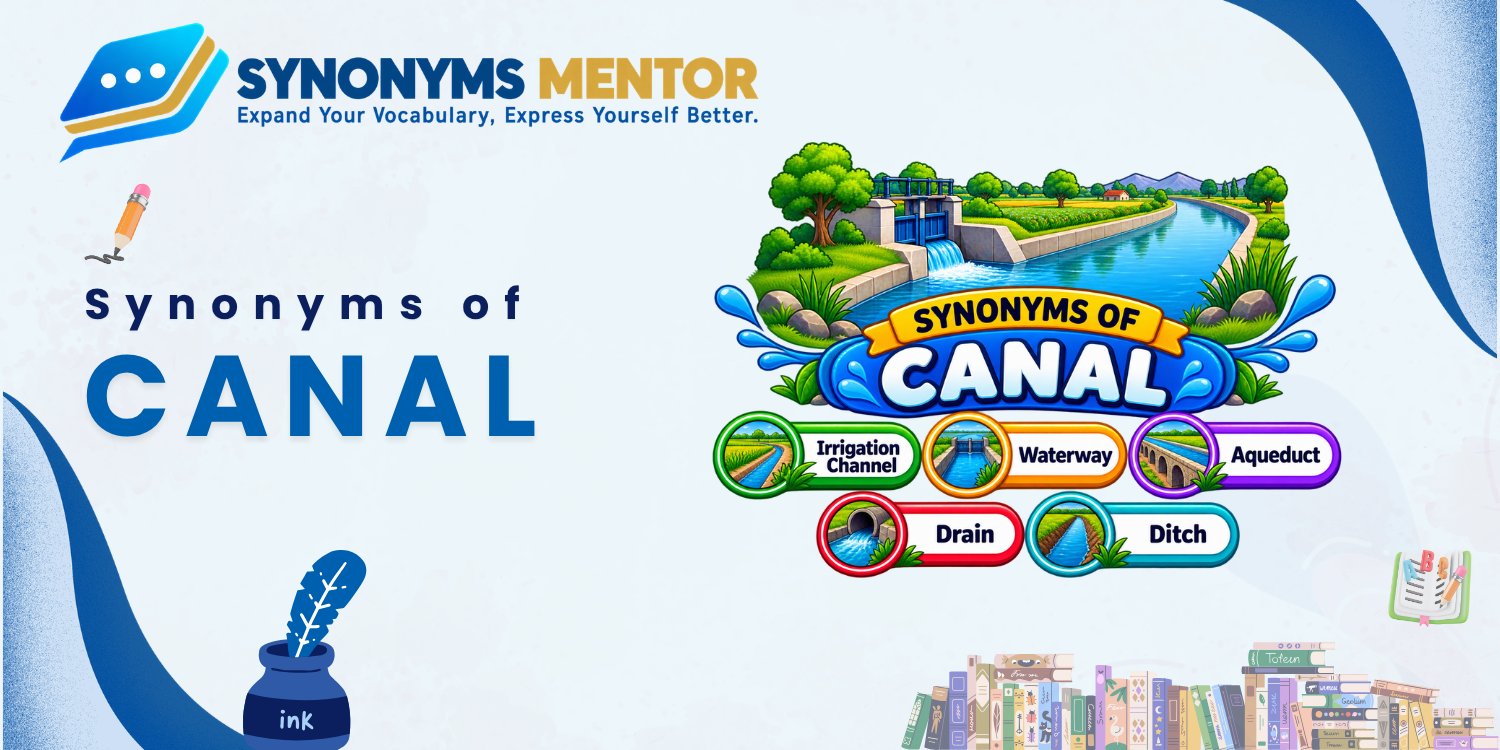
Because of these different meanings, words such as waterway, channel, watercourse, aqueduct, conduit, and duct overlap with canal but are not always interchangeable. The best alternative depends on what kind of canal you mean and what you want to emphasize.
Quick Answer: What Are the Synonyms of Canal?
The closest synonyms of canal include waterway, channel, watercourse, aqueduct, conduit, duct, and passage. However, they differ in meaning and context. Waterway is a broad term for a route through which watercraft can travel, while aqueduct specifically refers to a structure designed to carry water. Duct and conduit are more appropriate for enclosed passages that transport fluids or other substances.
Core Synonyms of Canal
| Word | Relationship | Meaning | Strength | Formality | Best Context |
|---|---|---|---|---|---|
| Waterway | Direct/near synonym | A route or channel through which boats or ships can travel | Similar | Neutral | Navigation, geography |
| Channel | Near synonym | A passage or course through which water flows or ships travel | Similar | Neutral | Rivers, seas, canals |
| Watercourse | Near synonym | A natural or artificial channel through which water flows | Similar | Formal | Geography, environmental writing |
| Aqueduct | Contextual alternative | A structure built to carry water from one place to another | More specific | Formal | Water supply, engineering |
| Conduit | Contextual alternative | A channel, pipe, or passage that carries something | Broader | Formal | Engineering, utilities |
| Duct | Contextual alternative | A tube or passage for carrying air, fluid, or another substance | More technical | Technical | Anatomy, engineering |
| Passage | Near synonym | A route or opening through which something passes | Broader | Neutral | General or anatomical contexts |
| Channelway | Related/contextual | A channel or route through which something moves | Similar in limited contexts | Neutral | Technical descriptions |
| Sluice | Contextual alternative | A controlled passage for water, often with a gate | More specific | Technical | Drainage, irrigation |
| Raceway | Contextual alternative | A channel designed to carry flowing water | More specific | Technical | Hydrology, engineering |
| Ditch | Contextual alternative | A narrow excavation used to carry or drain water | Usually narrower/less formal | Neutral | Drainage, agriculture |
| Pipe | Related/contextual | A hollow tube used to transport liquids or gases | More specific | Neutral | Plumbing, engineering |
The strongest general-purpose alternatives are waterway, channel, and watercourse. Major dictionaries and thesauruses also connect canal with terms such as aqueduct, waterway, channel, conduit, duct, passage, and watercourse, but their definitions reveal important differences.
What Does Canal Mean?
A canal is generally a long, narrow, artificially created waterway. It may be constructed for boats and ships, irrigation, drainage, or moving water from one location to another. Oxford describes it as a passage dug in the ground and filled with water for navigation or for carrying water to fields and crops.
Examples include:
- The canal carries irrigation water to nearby farms.
- Cargo ships passed through the canal.
- The city is famous for its historic canals.
The word also has an anatomical meaning: a canal can be a tube or passage inside the body through which air, liquid, food, or another substance passes. Examples include ear canal, root canal, and alimentary canal.
The Most Useful Synonyms of Canal
1. Waterway
Waterway is one of the closest general alternatives when canal refers to a route used for boats or ships.
Unlike canal, however, waterway does not necessarily imply that humans constructed it. A waterway can be a canal, river, lake route, or another navigable body of water.
Example:
The canal became an important waterway for transporting agricultural products.
Best for: navigation, geography, shipping, and transportation.
2. Channel
Channel overlaps with canal when it means a route or passage through which water flows or vessels travel. It is broader than canal, because a channel can be natural or artificial.
Example:
The boats entered the narrow channel leading to the harbor.
Use channel when the emphasis is on the route or passage rather than on the fact that it was artificially constructed.
Best for: waterways, rivers, navigation, and coastal geography.
3. Watercourse
A watercourse is a channel through which water flows. It can refer to a natural stream or river channel as well as certain artificial channels.
It is more formal and technical than canal, making it useful in geography, environmental science, and engineering.
Example:
The project changed the direction of the local watercourse.
Best for: geography, environmental writing, and technical descriptions.
4. Aqueduct
An aqueduct is not a perfect substitute for canal. It is a more specific structure designed to carry water, often across a valley, bridge, or other obstacle.
For example, Roman aqueducts transported water over considerable distances. Collins lists canal and waterway among related terms for aqueduct, but the underlying meanings are different.
Example:
The ancient aqueduct supplied water to the city.
Use aqueduct when: the focus is on a water-carrying structure rather than a navigable canal.
5. Conduit
A conduit is a channel, pipe, or passage used to carry something from one place to another. It can carry water, fluids, cables, or even be used metaphorically for communication.
Because of this broader meaning, it is usually a contextual alternative, not a direct replacement for canal.
Example:
The underground conduit carries water to the treatment facility.
Best for: engineering, infrastructure, utilities, and technical writing.
6. Duct
Duct refers to a tube or passage through which air, liquid, or another substance moves. It is especially common in technical, engineering, and anatomical contexts.
Example:
The drainage system uses a separate duct to carry excess water.
You would not normally replace canal with duct when discussing a major navigable waterway.
Best for: anatomy, ventilation, engineering, and enclosed passages.
7. Passage
Passage is a broad word for a route or opening through which something can move. It can sometimes replace canal when the emphasis is on movement through a narrow route.
However, it does not specifically communicate the idea of an artificial waterway.
Example:
The canal provided a safe passage for commercial vessels.
Here, passage describes the function of the canal rather than naming the structure itself.
Best for: routes, movement, navigation, and anatomy.
8. Sluice
A sluice is a controlled channel or passage for water, commonly associated with gates used to regulate water flow.
It is therefore more specific than canal.
Example:
Engineers opened the sluice to release excess water.
Best for: irrigation, drainage, flood control, and water management.
9. Raceway
A raceway can refer to a channel designed to carry flowing water. It is a specialized term and is not a natural replacement for canal in ordinary writing.
Example:
Water flows through the raceway before entering the treatment system.
Best for: engineering, hydrology, and specialized water systems.
10. Ditch
A ditch is an excavated channel, commonly used for drainage or irrigation. Some canals may function similarly, but the terms differ in scale, construction, and typical usage.
Example:
The farmers dug a drainage ditch beside the field.
Calling a major shipping canal a ditch would usually sound inaccurate or overly informal.
Best for: agriculture, drainage, and small-scale water management.
11. Pipe
A pipe is a hollow structure designed to transport liquids, gases, or other materials. It overlaps with canal only in the broad idea of carrying something from one place to another.
Example:
The pipe carries irrigation water beneath the road.
Do not use pipe as a general synonym for a navigable canal.
Best for: plumbing, irrigation infrastructure, and engineering.
12. Channelway
Channelway can describe a defined channel or route through which something moves, but it is much less common in everyday English than channel or waterway.
Because it is relatively specialized, channel is usually the more natural choice.
Example:
The engineers created a channelway to direct excess water.
Best for: technical descriptions where a defined channel needs to be emphasized.
Which Word Should I Use Instead of Canal?
The right choice depends on the context.
Choose waterway when:
You mean a route used by boats or ships and want a broad term that does not necessarily imply artificial construction.
The canal is an important waterway for regional trade.
Choose channel when:
You want to emphasize a water route, passage, or flow path.
The vessel entered the narrow channel.
Choose watercourse when:
You are writing about flowing water in a geographical or environmental context.
The project restored the damaged watercourse.
Choose aqueduct when:
You mean a structure specifically designed to transport water.
The ancient aqueduct supplied water to the city.
Choose conduit when:
You mean a passage or structure carrying water, fluids, cables, or another substance.
The underground conduit carries water to the reservoir.
Choose duct when:
You mean an enclosed passage, especially in anatomy or engineering.
Air passes through the ventilation duct.
Choose sluice when:
The channel controls or regulates the movement of water.
Workers opened the sluice to lower the water level.
Canal vs. Waterway
These words are closely related but not identical.
| Canal | Waterway |
|---|---|
| Usually artificially constructed | Can be natural or artificial |
| Often designed for navigation, irrigation, or drainage | Broad term for a route through which watercraft or water can move |
| More specific | More general |
| The canal connects two rivers. | The river is an important waterway. |
Bottom line: Every canal used as a navigable route can be described as a waterway, but not every waterway is a canal.
Canal vs. Channel
Canal usually suggests an artificially constructed water route. Channel is broader and can refer to a natural or artificial route through which water flows or vessels travel.
The canal was built to connect the two rivers.
The boat entered the deep channel.
A channel can exist within a river, lake, sea, or canal, so the two words should not automatically be treated as interchangeable.
Canal vs. Aqueduct
A canal and an aqueduct can both transport water, but their structures and functions differ.
A canal is generally a water-filled channel, often at or near ground level, that may be used for navigation, irrigation, or drainage. An aqueduct is a structure designed to carry water, frequently across an obstacle or between different elevations.
The canal allowed boats to reach the inland port.
The aqueduct carried drinking water across the valley.
Canal vs. Conduit
A conduit is a broader technical term for something that carries or channels a substance. It can refer to water infrastructure, pipes, electrical cables, or even a means of communication.
A canal, by contrast, normally evokes a specific water channel or, in anatomy, a bodily passage.
The irrigation canal runs through the fields.
An underground conduit carries water beneath the highway.
Canal in Anatomy
The word canal has an important specialized meaning in anatomy. It can describe a narrow tube or passage through which air, fluids, food, or other substances move. Cambridge gives examples such as the alimentary canal, while Oxford lists the ear canal and root canal among related uses.
In this context, the best alternatives are usually:
- duct
- passage
- channel
- tube
For example:
The ear canal carries sound toward the eardrum.
Here, waterway or aqueduct would obviously be inappropriate because the meaning is anatomical.
Common Mistakes With Canal Synonyms
Mistake 1: Treating waterway as an exact synonym
Waterway is broader than canal. A waterway can include rivers and other navigable routes.
Mistake 2: Calling every aqueduct a canal
An aqueduct is specifically associated with carrying water through a structure. It is not simply another name for every artificial waterway.
Mistake 3: Using duct for a shipping canal
Duct normally suggests an enclosed or technical passage, not a large navigable waterway.
Mistake 4: Using ditch for major canals
A ditch may carry or drain water, but describing a major commercial canal as a ditch can be misleading or overly informal.
Mistake 5: Ignoring the anatomical meaning
If canal refers to the body, alternatives such as duct, tube, and passage are more appropriate than geographical terms.
Antonyms of Canal
There is no single perfect antonym for canal because the word describes a physical structure rather than a simple quality.
Depending on context, useful contrasts might include:
- land barrier — when discussing a navigable route
- obstruction — when focusing on blocked movement
- dry land — when contrasting a water route with land
- closed passage — when emphasizing lack of access
These are contextual opposites rather than dictionary-level antonyms.
Pronunciation of Canal
US: /kəˈnæl/
UK: /kəˈnæl/
The pronunciation is the same in standard American and British English, with the primary stress on the second syllable. Cambridge and Oxford both give /kəˈnæl/.
Etymology of Canal
Canal ultimately comes from Latin canālis, meaning a pipe, groove, or channel. Oxford traces the English word through Old French chanel and Latin canalis, related to canna, meaning a cane or reed.
This origin helps explain why the word developed meanings involving both water channels and tubular passages in the body.
FAQ About Synonyms of Canal
What is the closest synonym for canal?
Waterway and channel are among the closest general alternatives, especially when canal refers to a navigable water route. However, waterway is broader because it can include natural bodies of water, while canal usually implies artificial construction.
Is waterway another word for canal?
Often, but not always. A canal is a type of waterway, while waterway is the broader term. A river can be a waterway without being a canal.
What is a formal synonym for canal?
Watercourse can work in formal geographical or environmental writing, while conduit may work in technical contexts. Neither is a universal substitute for canal, so the intended meaning matters.
Is channel a synonym for canal?
Channel is a near-synonym rather than a perfect replacement. A channel can be natural or artificial and may refer to a passage within a river, sea, or other body of water.
What is a synonym for canal in anatomy?
Depending on the specific anatomical structure, duct, tube, passage, or channel may work. For example, ear canal can be described as an anatomical passage, but the exact replacement depends on context.
Is aqueduct the same as canal?
No. Both can transport water, but an aqueduct is a structure designed to carry water, often across an obstacle, whereas a canal is generally an artificial water-filled channel that may serve navigation, irrigation, or drainage.
What is another word for an irrigation canal?
Depending on the context, irrigation channel, watercourse, or waterway may work. Irrigation channel is especially clear when you want to emphasize that the channel distributes water to crops.
What is another word for a shipping canal?
Waterway or navigable channel can work, depending on the sentence. Waterway is more general, while navigable channel emphasizes the route used by vessels.
Conclusion
The best synonyms of canal depend strongly on context. For a general water route, waterway is usually the most useful alternative. Channel works when the emphasis is on a water passage, while watercourse suits geographical and environmental writing. Aqueduct, conduit, duct, sluice, and ditch are more specialized alternatives rather than universal replacements.

Our editorial team is dedicated to making English vocabulary easier to understand and use correctly. We research and review synonyms, antonyms, definitions, word usage, and example sentences to ensure our content is clear, accurate, practical, and useful for students, writers, professionals, and English learners.