Synonyms of Lunar: Better Words for Moon-Related Things
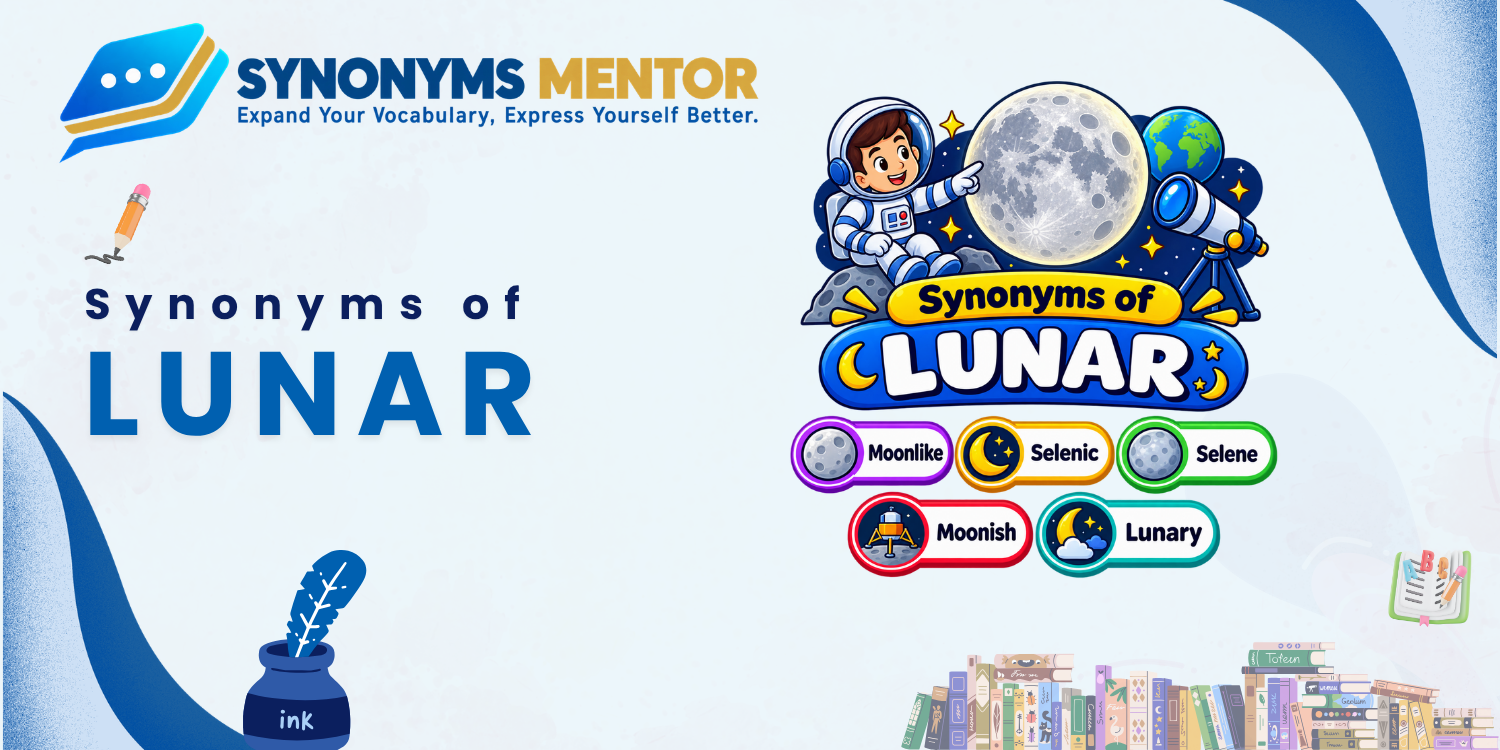
If you’re looking for synonyms of lunar, the choices are more limited than they might appear. Lunar specifically means “of or relating to the Moon,” so words such as moonlike, selenian, and selenic can overlap with it in particular contexts, but they are not equally interchangeable.
The best alternative depends on what you mean. Moonlike describes something that resembles the Moon, while selenian is a specialized term connected with the Moon. Moony can mean moonlike or moonlit, but it also has unrelated meanings such as dreamy or sentimental.
Meanwhile, words such as celestial and astronomical are related to the subject of space but are not direct synonyms of lunar.
Quick Answer: What Are the Synonyms of Lunar?
The closest alternatives to lunar are moon-related, moonlike, selenian, and selenic, although each has a different range of use. Moon-related is the clearest plain-English replacement, while moonlike means resembling the Moon rather than simply being connected to it. Selenian and selenic are specialized terms used in scientific or literary contexts.
Core Synonym Resource
| Word | Relationship | Meaning | Strength | Formality | Best Context |
|---|---|---|---|---|---|
| Moon-related | Direct paraphrase | Connected with the Moon | Same | Neutral | Plain English |
| Moonlike | Near synonym | Resembling the Moon | Similar | Neutral/Literary | Appearance, imagery |
| Selenian | Specialized synonym | Of or relating to the Moon | Same | Scientific/Literary | Astronomy, technical writing |
| Selenic | Specialized synonym | Of or relating to the Moon | Same | Scientific | Scientific terminology |
| Moony | Contextual alternative | Moonlike or moonlit; sometimes dreamy | Variable | Literary/Informal | Creative writing |
| Moonish | Contextual alternative | Resembling or characteristic of the Moon | Similar | Literary/Uncommon | Descriptive writing |
| Lunary | Historical/rare alternative | Relating to the Moon | Same | Archaic/Rare | Historical or literary contexts |
| Celestial | Related word | Relating to the sky or heavens | Broader | Formal | Astronomy, poetic writing |
| Astronomical | Related word | Relating to astronomy or celestial objects | Broader | Formal | Science and astronomy |
| Satellite | Related word | An object orbiting a planet or other body | Different | Neutral/Scientific | Astronomy |
The distinction matters because lunar itself has a relatively precise meaning. Oxford defines it as “connected with the moon,” while Cambridge likewise defines it as “of or relating to the moon.”
What Does Lunar Mean?
Lunar is an adjective meaning connected with, relating to, or occurring on the Moon.
For example:
Scientists studied the lunar surface.
Here, lunar means that the surface belongs to or is associated with the Moon.
The word can also describe things measured by the Moon’s movements:
The traditional calendar follows a lunar cycle.
Collins gives several related senses, including something occurring on or designed to land on the Moon and something measured by the Moon’s orbital motion.
In most modern English, however, the central meaning is simply “related to the Moon.”
Lunar as an adjective
Lunar is primarily an adjective and is commonly used before nouns:
- lunar eclipse
- lunar surface
- lunar landscape
- lunar module
- lunar cycle
- lunar calendar
- lunar orbit
- lunar mission
Oxford specifically notes collocations such as lunar calendar, lunar crater, and lunar cycle.
The Most Useful Alternatives to Lunar
1. Moon-related
Moon-related is the clearest plain-English paraphrase of lunar.
Unlike some specialized alternatives, it is immediately understandable to virtually any reader.
Example:
The museum has an exhibition about moon-related discoveries.
This could be rewritten as:
The museum has an exhibition about lunar discoveries.
Choose “moon-related” when: clarity matters more than brevity or technical style.
2. Moonlike
Moonlike means resembling the Moon, rather than simply being associated with it. Collins defines it as “resembling or like the moon.”
That distinction is important.
The astronaut photographed a lunar landscape.
means the landscape is on or associated with the Moon.
But:
The pale rock had a moonlike appearance.
means the rock looked like the Moon.
Choose “moonlike” when: you are describing appearance, shape, color, atmosphere, or imagery that resembles the Moon.
3. Selenian
Selenian is a specialized adjective associated with the Moon.
It is related to Selene, the Greek personification of the Moon, and appears primarily in specialized, scientific, or literary vocabulary.
Example:
The researchers discussed possible selenian geological formations.
Because it is uncommon in everyday English, lunar is normally the better choice for general readers.
Choose “selenian” when: a specialized or literary astronomical term is appropriate.
4. Selenic
Selenic is another specialized term relating to the Moon.
It is closely associated with scientific vocabulary and is much less common in ordinary English than lunar.
Example:
The paper examined the selenic characteristics of the sample.
Choose “selenic” when: you are working in a specialized scientific context where the terminology is appropriate.
For general communication, lunar is clearer.
5. Moony
Moony can describe something resembling the Moon or associated with moonlight. It is also used in other senses, including describing someone as dreamy or sentimental.
Example:
The valley looked strangely moony under the night sky.
Because moony has additional meanings and a more informal or literary feel, it is not a universal substitute for lunar.
Choose “moony” when: writing creatively or describing a moonlit, dreamy, or moonlike atmosphere.
6. Moonish
Moonish is an uncommon adjective meaning roughly resembling or characteristic of the Moon.
It is much less common than lunar or moonlike.
Example:
The artist used pale, moonish shapes throughout the painting.
Choose “moonish” when: you deliberately want an unusual or literary description.
7. Lunary
Lunary is a rare or historical alternative associated with the Moon.
It is not a normal modern replacement for lunar, so using it in everyday or professional writing may sound archaic or unusual.
Choose “lunary” when: the historical or literary character of the word is intentional.
Which Word Should I Use?
Choose lunar when:
You mean something directly connected with the Moon.
The spacecraft entered lunar orbit.
Choose moon-related when:
You want a simple phrase that any reader can understand.
The conference covered several moon-related technologies.
Choose moonlike when:
You mean something resembles the Moon.
The crater created a moonlike landscape.
Choose selenian when:
You need a specialized or literary term for something associated with the Moon.
The paper discussed selenian geology.
Choose selenic when:
You are writing in a specialized scientific context.
Choose moony when:
You want a literary, atmospheric, or dreamy description.
The garden looked moony in the pale light.
Choose celestial when:
You mean something connected with the sky or heavenly bodies more generally—not specifically the Moon.
Lunar vs. Moonlike
These words are related but not interchangeable.
| Lunar | Moonlike |
|---|---|
| Connected with the Moon | Resembling the Moon |
| Often scientific | Often descriptive |
| Common in astronomy | Common in creative description |
| lunar surface | moonlike landscape |
Compare:
Scientists mapped the lunar surface.
The surface is actually associated with the Moon.
The desert had a moonlike surface.
The desert is not the Moon; it merely resembles it.
This is one of the most important distinctions when choosing a synonym for lunar.
Lunar vs. Selenian
Both can refer to something associated with the Moon, but their usage differs substantially.
Lunar is the standard modern English adjective.
Selenian is specialized and considerably less common.
For most readers:
lunar geology
is more natural than:
selenian geology
Use selenian only when the specialized terminology adds value.
Lunar vs. Celestial
Celestial is not an exact synonym for lunar.
Celestial refers broadly to the sky, heavens, or objects in space.
The Moon is celestial, but so are:
- stars
- planets
- comets
- asteroids
- galaxies
Therefore:
a lunar eclipse
is specifically connected with the Moon.
But:
a celestial event
could involve many different astronomical objects or phenomena.
Choose “celestial” when: the meaning is broader than the Moon.
Lunar vs. Astronomical
Astronomical is another related but broader term.
It can describe things associated with astronomy, the scientific study of celestial objects and phenomena.
For example:
The observatory conducts astronomical research.
That research could involve the Moon, planets, stars, galaxies, or other objects.
By contrast:
The observatory conducts lunar research.
specifically points to the Moon.
So astronomical should be treated as a related word, not a direct synonym.
Lunar vs. Solar
These words are sometimes confused because both belong to astronomical vocabulary.
They are actually opposites in reference:
- lunar → related to the Moon
- solar → related to the Sun
For example:
lunar eclipse
and
solar eclipse
refer to different astronomical events.
Solar is not a synonym of lunar.
Context-Specific Alternatives
Because lunar appears in many different phrases, the best replacement may depend on the noun that follows it.
| Lunar Phrase | Possible Alternative | Why |
|---|---|---|
| lunar surface | Moon’s surface | Plain-English phrasing |
| lunar landscape | moonlike landscape | Emphasizes resemblance |
| lunar mission | Moon mission | More conversational |
| lunar research | Moon research | Less formal |
| lunar eclipse | Moon eclipse | Usually unnatural; keep lunar eclipse |
| lunar calendar | Moon-based calendar | Explains the concept |
| lunar cycle | Moon cycle | Plain-English alternative |
| lunar light | moonlight | More natural when referring to light |
| lunar soil | Moon soil / lunar soil | Lunar soil is more standard scientifically |
| lunar orbit | Moon’s orbit | Clear plain-English alternative |
This illustrates an important principle: a phrase-level alternative is not necessarily a one-word synonym.
For example, replacing lunar eclipse with moonlike eclipse would change the meaning and would be incorrect.
Common Collocations With Lunar
Some of the most natural expressions with lunar include:
- lunar eclipse
- lunar surface
- lunar landscape
- lunar orbit
- lunar module
- lunar mission
- lunar calendar
- lunar cycle
- lunar crater
- lunar soil
- lunar geology
- lunar exploration
- lunar research
- lunar rocks
- lunar environment
These established combinations are one reason lunar is often preferable to a more obscure synonym.
Common Mistakes With Lunar Synonyms
1. Treating celestial as an exact synonym
Celestial is broader than lunar. It can refer to anything associated with the heavens or outer space.
2. Using solar instead of lunar
The two words refer to different objects:
solar = Sun
lunar = Moon
3. Using moonlike when you mean “on the Moon”
Moonlike means resembling the Moon.
It does not normally mean located on or belonging to the Moon.
4. Using moony in scientific writing
Moony can sound informal, literary, or ambiguous. Lunar is normally much better for scientific communication.
5. Assuming every thesaurus suggestion is interchangeable
Some thesaurus lists include broad or loosely associated words such as celestial, planetary, solar, and stellar. These are related to astronomy but do not mean “lunar.”
Related Words That Are Not Synonyms
These words belong to the same semantic field but should not be presented as direct synonyms:
Celestial
Relating to the sky, heavens, or celestial objects.
Astronomical
Relating to astronomy or the study of celestial objects.
Planetary
Relating to a planet or planets.
Solar
Relating to the Sun.
Stellar
Relating to stars.
Satellite
An object that orbits another astronomical body.
These words may appear in the same articles or discussions as lunar, but each has its own meaning.
Pronunciation of Lunar
Lunar is pronounced:
- US: /ˈluː.nɚ/
- UK: /ˈluː.nər/
The first syllable sounds like “loo.” Cambridge gives /ˈluː.nɚ/ for US English and /ˈluː.nər/ for UK English.
Etymology of Lunar
Lunar comes from Latin lūnāris, meaning “of the moon,” from lūna, meaning “moon.” Oxford identifies the origin as Late Middle English from Latin lunaris.
The connection remains transparent in modern English: lunar essentially means “of the Moon.”
Frequently Asked Questions
What is the closest synonym for lunar?
The clearest plain-English equivalent is moon-related. Depending on context, moonlike, selenian, and selenic can overlap with lunar, but they are not interchangeable in every sentence. Moonlike emphasizes resemblance, while selenian and selenic are specialized terms.
What is another word for lunar?
Moon-related is the most straightforward phrase. Moonlike can work when you mean something resembling the Moon, while selenian and selenic are specialized alternatives in scientific or literary contexts.
Is moonlike a synonym for lunar?
Moonlike is a near synonym, not a perfect synonym. Lunar means connected with or relating to the Moon, whereas moonlike means resembling the Moon. A desert can be moonlike without being lunar.
Is celestial a synonym for lunar?
No. Celestial is broader than lunar. It can describe the Moon, Sun, stars, planets, and other objects or phenomena associated with the heavens. Therefore, something can be celestial without being lunar.
Is solar the opposite of lunar?
Not exactly in every linguistic sense, but the words refer to different celestial bodies. Solar relates to the Sun, while lunar relates to the Moon. They are often contrasted in astronomy, as in solar eclipse and lunar eclipse.
What is a scientific synonym for lunar?
Selenian and selenic are specialized terms associated with the Moon, but lunar remains the standard and widely understood scientific adjective. In most scientific writing, replacing lunar with an obscure alternative is unnecessary unless the terminology has a specific purpose.
What is the simplest synonym for lunar?
Moon-related is the simplest direct paraphrase. In many sentences, however, simply using Moon in a possessive phrase is more natural, such as “the Moon’s surface” instead of “the lunar surface.”
What is the difference between lunar and moonlike?
Lunar means related to or associated with the Moon. Moonlike means resembling the Moon. For example, a lunar landscape is a landscape on or associated with the Moon, while a moonlike landscape can be any landscape that looks similar to the Moon.
Conclusion
The best synonym of lunar depends on what you are trying to express. Moon-related is the clearest plain-English alternative, while moonlike works when the emphasis is on resemblance. Selenian and selenic are specialized alternatives, and moony or moonish may suit literary description.

Olivia Brown is a vocabulary expert and content writer who focuses on synonyms, antonyms, and word usage. She helps learners understand English words in a simple and practical way, making communication clearer and more effective