Synonyms of Convergence: Meaning, Alternatives, and Usage
Finding the right synonym for convergence depends on what is coming together. You might mean two roads meeting, different ideas becoming similar, several factors combining, or separate technologies merging into one system.
Words such as confluence, merging, combination, union, junction, unification, and consolidation can work in the right context, but they are not interchangeable in every sentence.
This guide explains the closest synonyms of convergence, shows how their meanings differ, and gives practical examples so you can choose the most natural word for your context.
Quick Answer: What Are the Best Synonyms of Convergence?
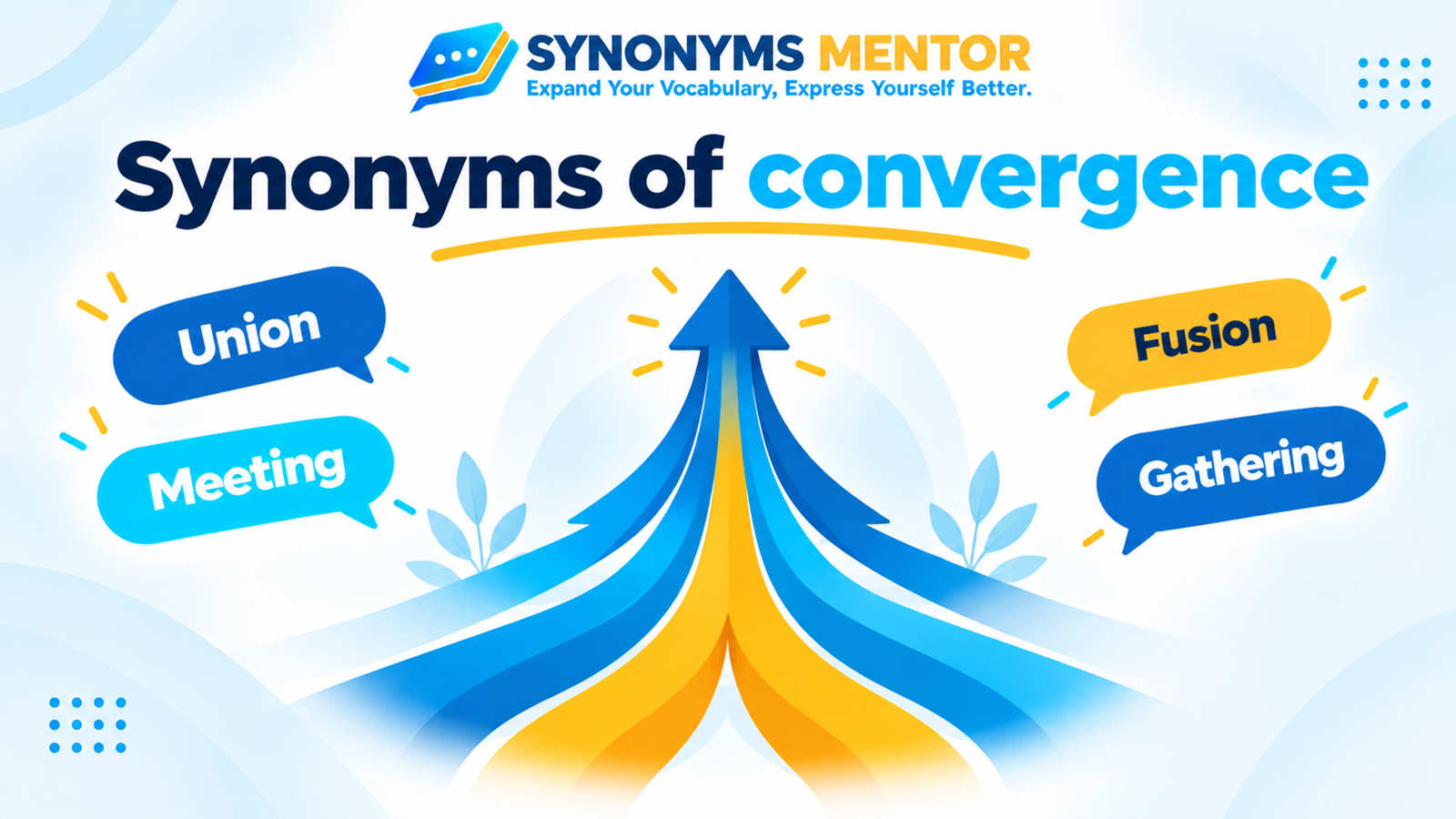
The closest synonyms of convergence include confluence, merging, combining, combination, union, unification, junction, joining, consolidation, and meeting.
The best choice depends on context. Confluence emphasizes things flowing or coming together, merging emphasizes becoming one, junction usually refers to a physical meeting point, and unification emphasizes becoming a unified whole.
What Does “Convergence” Mean?
Convergence is a noun meaning the process or state of moving toward the same point, coming together, or becoming more similar.
It can describe both physical and abstract situations:
- Two roads move toward the same point.
- Different opinions become more alike.
- Several trends combine to produce a result.
- Separate technologies become integrated.
- Different biological species independently develop similar characteristics.
Part of speech: Noun
Pronunciation:
- US: /kənˈvɝː.dʒəns/
- UK: /kənˈvɜː.dʒəns/
Core Synonyms of Convergence
Not every word associated with convergence is a perfect substitute. The table below separates close alternatives from words that work mainly in particular contexts.
| Word | Relationship | Strength | Formality | Best Context |
|---|---|---|---|---|
| Confluence | Near synonym | Strong | Neutral/Formal | Ideas, events, rivers, influences |
| Merging | Near synonym | Strong | Neutral | Businesses, systems, technologies |
| Combining | Near synonym | Moderate | Neutral | Elements, factors, resources |
| Combination | Near synonym | Moderate | Neutral | Multiple elements forming a result |
| Union | Near synonym | Strong | Neutral/Formal | Groups, interests, states, entities |
| Unification | Near synonym | Strong | Formal | Bringing separate things into one |
| Junction | Contextual alternative | Moderate | Neutral | Roads, lines, networks |
| Joining | Contextual alternative | Moderate | Neutral | People, objects, parts |
| Consolidation | Contextual alternative | Strong | Formal/Professional | Organizations, resources, systems |
| Meeting | Contextual alternative | Moderate | Neutral | People, paths, points |
| Connection | Related alternative | Moderate | Neutral | Systems, relationships, networks |
| Intersection | Contextual alternative | Moderate | Neutral | Roads, lines, ideas |
| Concurrence | Near/contextual synonym | Moderate | Formal | Opinions, events, circumstances |
The Closest Synonyms of Convergence
1. Confluence
Confluence is one of the strongest alternatives when several things come together and produce a combined effect.
It is especially natural for rivers, events, influences, cultures, ideas, and circumstances.
Example:
The project succeeded because of a confluence of favorable circumstances.
Best choice when: several influences or elements come together.
A useful distinction is that confluence often suggests a coming together from separate sources, whereas convergence can emphasize movement toward similarity or a common point.
2. Merging
Merging emphasizes separate things becoming one.
It is particularly common in business, technology, transportation, and organizational contexts.
Example:
The merger represents the merging of two previously independent companies.
Best choice when: separate entities are actually combining into one.
3. Combining
Combining focuses on putting separate elements together.
Example:
The researchers are combining data from several independent studies.
It is generally more straightforward and less abstract than convergence.
Use it when: you want plain, direct language rather than a more formal or conceptual expression.
4. Combination
Combination refers to the resulting arrangement or mixture of different elements.
Example:
The product’s success came from a combination of innovative design and practical features.
Unlike convergence, which often describes a process, combination can describe the resulting collection of elements.
5. Union
Union emphasizes things being joined into a single whole or relationship.
Example:
The agreement strengthened the union of the two organizations.
It works particularly well for groups, organizations, interests, territories, and political or social entities.
6. Unification
Unification emphasizes the process of making separate things into one unified entity.
Example:
The policy encouraged the unification of several regional systems.
This is more formal than joining or combining and is common in academic, political, organizational, and historical writing.
Context-Specific Alternatives
Some alternatives are useful only when convergence has a particular meaning.
Junction
Use junction when separate physical routes, lines, or systems meet at a particular point.
The railway junction connects three major routes.
Junction is therefore a strong choice for roads, railways, electrical systems, and networks, but it is usually not a natural replacement for convergence when discussing opinions or trends.
Intersection
Intersection refers to a point where lines, roads, paths, or sometimes ideas cross.
The two major roads meet at a busy intersection.
It can also be used metaphorically:
The conference was held at the intersection of technology and education.
Consolidation
Consolidation emphasizes bringing separate resources, organizations, or operations together into a stronger or more unified arrangement.
The company announced the consolidation of its regional offices.
This word is particularly useful in business, finance, administration, and organizational writing.
Joining
Joining is a simpler and more everyday alternative.
The joining of the two paths creates a single trail.
It is less formal and less abstract than convergence.
Connection
Connection emphasizes a link or relationship rather than necessarily implying that two things become one.
The study examines the connection between language and culture.
Because of this distinction, connection is often related to convergence but is not a direct substitute.
Convergence in Different Contexts
Convergence of Ideas
When separate ideas become increasingly similar, convergence is usually the most precise term.
There is growing convergence between the two researchers’ views.
Possible alternatives include:
- agreement
- alignment
- consensus
- coming together
- concurrence
However, these words introduce different nuances. Consensus, for example, means general agreement, while convergence can describe a process of becoming similar without complete agreement.
Convergence of Interests
For interests becoming aligned, alignment, agreement, or confluence may work depending on the sentence.
The negotiations revealed a convergence of interests between the two organizations.
Alignment is particularly natural when the emphasis is on shared goals.
Convergence in Technology
Technology frequently uses convergence to describe separate functions or technologies becoming integrated.
The convergence of computing, communication, and entertainment has transformed consumer devices.
Possible alternatives include:
- integration
- merging
- combination
- consolidation
- convergence of technologies
Integration is often preferable when the important idea is that separate systems have been incorporated into a unified system.
Physical Convergence
For roads, paths, lines, or moving objects, useful alternatives include:
- meeting
- junction
- intersection
- joining
- confluence
The two hiking trails converge near the lake.
Here, meet is simpler, while junction or intersection may be more precise if the sentence refers to a physical point.
Mathematical Convergence
In mathematics, convergence has a specialized meaning involving a sequence, series, or function approaching a particular limit.
The sequence shows convergence toward a finite value.
In this technical context, ordinary alternatives such as joining or merging are inappropriate. The specialized meaning should be preserved.
Biological Convergence
In evolutionary biology, convergence can describe the independent development of similar traits in unrelated or distantly related organisms. Merriam-Webster identifies this as a distinct sense of the noun.
The similar body shapes are an example of evolutionary convergence.
The phrase convergent evolution is the standard technical expression and should not normally be replaced with a casual synonym.
Convergence vs. Confluence
These words overlap strongly, but they are not identical.
| Word | Main idea | Example |
| Convergence | Moving toward a common point or becoming similar | convergence of opinions |
| Confluence | Coming together from separate sources | confluence of events |
Confluence has a particularly strong association with things flowing together. Its historical physical sense is connected with rivers joining, although modern English also uses it figuratively for events, interests, and influences.
Use “convergence” when similarity or movement toward a common point matters.
Use “confluence” when several separate influences or sources come together.
Convergence vs. Merging
Convergence does not always mean that separate things become one.
There is convergence between the two political positions.
The positions may become more similar while remaining separate.
By contrast:
The two companies are merging.
Here, the entities are actually combining.
Choose “convergence” for movement toward similarity or a common point.
Choose “merging” when separate entities are becoming one.
Convergence vs. Union
Union emphasizes the resulting state of being joined.
The union of the two organizations created a larger institution.
Convergence can emphasize the process of moving toward that shared state.
The convergence of the two organizations’ interests made cooperation possible.
So union often suggests joining, while convergence can suggest movement toward commonality.
Convergence vs. Junction
Junction is usually physical or structural.
The two railway lines meet at a junction.
Convergence is broader:
The convergence of several railway lines created an important transportation hub.
Use junction when the meeting point itself is important. Use convergence when the process or pattern of coming together is the focus.
Which Word Should I Use?
Use “confluence” when:
Several independent factors, events, ideas, or influences come together.
A confluence of economic and social factors caused the change.
Use “merging” when:
Separate entities or systems become one.
The merging of the two databases simplified the process.
Use “combination” when:
You are emphasizing multiple elements working together.
The combination of experience and creativity produced excellent results.
Use “unification” when:
Separate groups, systems, or elements are deliberately brought into one unified whole.
The reform promoted the unification of the administrative system.
Use “junction” when:
Physical roads, paths, lines, or networks meet.
Turn left at the junction.
Use “intersection” when:
Two or more roads, lines, paths, or conceptual areas cross.
The issue lies at the intersection of science and ethics.
Use “alignment” when:
Different interests, goals, positions, or strategies become compatible.
The agreement reflects an alignment of interests.
Common Mistakes With Convergence Synonyms
Mistake 1: Treating every related word as interchangeable
Words such as connection, agreement, intersection, union, and convergence overlap in some contexts but have different meanings.
Better: Choose the word according to what is actually happening.
Mistake 2: Using “merging” when things are only becoming similar
The two theories are merging.
This may imply that the theories are becoming one.
If they are simply becoming more alike, converging or showing convergence is usually more accurate.
Mistake 3: Using “junction” for abstract ideas
The junction of their opinions was surprising.
This sounds unnatural in ordinary English.
Better:
The convergence of their opinions was surprising.
Mistake 4: Confusing convergence with agreement
Two ideas can converge without becoming identical or producing complete agreement.
Their views showed increasing convergence.
This means the views became more similar; it does not necessarily mean the people reached full agreement.
Mistake 5: Replacing technical convergence with a general synonym
In mathematics, computer science, or evolutionary biology, convergence may have a specialized technical meaning. Replacing it with joining or combining can remove important meaning.
Natural Collocations With Convergence
Common phrases include:
- convergence of ideas
- convergence of interests
- convergence of opinions
- convergence of technologies
- convergence of trends
- convergence of cultures
- convergence of factors
- convergence between two systems
- economic convergence
- technological convergence
- media convergence
- evolutionary convergence
- mathematical convergence
- convergence point
- point of convergence
Examples:
The report examines the convergence of economic and environmental interests.
Technological convergence has changed how consumers use digital devices.
The city became a point of convergence for several major trade routes.
Antonym of Convergence
The clearest antonym of convergence is divergence.
Convergence means moving toward similarity, unity, or a common point.
Divergence means moving apart, becoming different, or developing in different directions.
The two theories initially showed convergence but later developed significant divergence.
Other contextual opposites include:
- separation
- division
- dispersal
- fragmentation
- disagreement
- differentiation
The exact opposite depends on the meaning being used. Merriam-Webster identifies divergence as the principal antonym.
Frequently Asked Questions
What is another word for convergence?
Common alternatives include confluence, merging, combining, combination, union, unification, junction, joining, and consolidation. The best choice depends on the context.
What is the closest synonym for convergence?
Confluence is one of the closest general alternatives, while merging is especially close when separate entities or systems are becoming one. Merriam-Webster lists both among the principal synonyms.
What is a formal synonym for convergence?
Depending on context, formal alternatives include confluence, unification, consolidation, concurrence, and convergence itself. Unification works particularly well when separate systems or groups are brought together.
What is a synonym for convergence of ideas?
Useful alternatives include alignment, agreement, concurrence, consensus, confluence, and coming together. However, they are not identical: consensus implies general agreement, while convergence emphasizes increasing similarity.
What is the difference between convergence and merging?
Convergence can mean becoming increasingly similar or moving toward a common point. Merging more strongly suggests that separate things actually combine into one.
What is the difference between convergence and confluence?
Convergence emphasizes movement toward a common point or increasing similarity. Confluence emphasizes separate sources coming together, especially influences, events, or physical flows.
What is the opposite of convergence?
The main antonym is divergence. Other context-dependent opposites include separation, division, dispersal, and fragmentation.
Is “convergence” formal or informal?
Convergence is a neutral-to-formal word and is especially common in academic, scientific, technological, business, and analytical writing. It is also natural in everyday contexts when describing roads, paths, or things coming together.
Conclusion
The best synonym for convergence depends on the exact relationship you want to describe. Choose confluence for several influences coming together, merging when separate entities become one, combination when elements are put together, unification when separate systems become unified, and junction or intersection for physical meeting points.

Sophia Martinez is an ESL educator who specializes in teaching vocabulary and word meanings. She writes beginner-friendly content that helps learners understand synonyms and improve their English fluency step by step.