Give Up Synonyms: 25 Better Alternatives With Examples
The best synonym for give up depends on what you mean. You might give up because you stop trying, give up a habit because you stop doing it, or give up something because you surrender or relinquish it. That makes a simple thesaurus list less useful than a context-based guide.
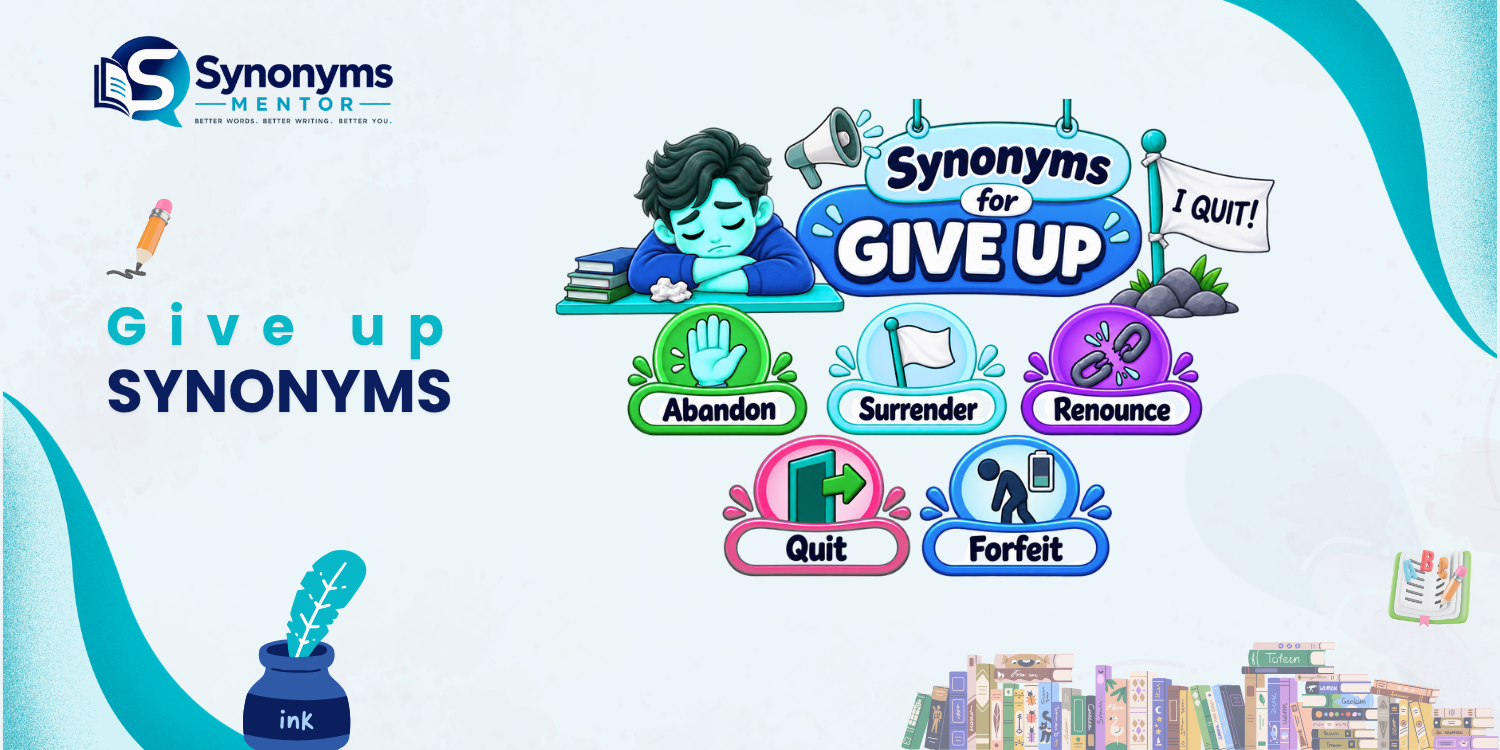
Common alternatives include quit, stop, abandon, surrender, relinquish, yield, renounce, forgo, cease, discontinue, and desist. But these words are not interchangeable in every sentence. For example, quit naturally describes stopping an activity, while surrender usually suggests yielding to someone or something.
This guide explains the differences so you can choose the word that actually fits your sentence.
Quick Answer
The closest synonyms for give up include quit, stop, abandon, surrender, relinquish, yield, renounce, forgo, cease, and discontinue. When someone stops making an attempt, quit, stop trying, or abandon usually fits best. In situations involving the transfer of control or possession, surrender and relinquish are more precise choices. To describe ending a habit or activity, quit and discontinue often sound the most natural.
Core Synonyms for Give Up
| Word | Relationship | Meaning | Formality | Best Context |
|---|---|---|---|---|
| quit | Direct/contextual | Stop doing something | Neutral | Activities, jobs, habits |
| stop | Direct/contextual | Cease an action | Neutral | General situations |
| abandon | Near synonym | Leave or stop completely | Neutral–formal | Plans, efforts, projects |
| surrender | Contextual | Yield or hand something over | Neutral–formal | Defeat, possession, control |
| relinquish | Contextual | Voluntarily give up possession, control, or a right | Formal | Rights, authority, responsibilities |
| yield | Contextual | Give way or concede | Formal/neutral | Pressure, demands, disputes |
| renounce | Contextual | Formally reject or give up a claim or belief | Formal | Rights, titles, beliefs |
| forgo | Contextual | Decide not to have or do something | Formal/neutral | Benefits, opportunities, pleasures |
| cease | Near synonym | Stop | Formal | Actions, processes, activities |
| discontinue | Near synonym | Stop something, often deliberately | Formal/neutral | Services, products, activities |
| desist | Contextual | Stop doing something, especially after being told | Formal | Actions or behavior |
| forsake | Near synonym | Abandon completely | Literary/formal | People, principles, places |
| waive | Contextual | Voluntarily give up a right or requirement | Formal | Rights, fees, claims |
| cede | Contextual | Give control or territory to another | Formal | Territory, authority, rights |
| resign | Contextual | Voluntarily leave a position | Neutral/formal | Jobs, offices |
| capitulate | Contextual | Stop resisting and accept defeat or demands | Formal | Conflict, negotiations |
| concede | Contextual | Admit or yield something | Neutral/formal | Arguments, disputes |
| submit | Contextual | Yield to authority or pressure | Neutral/formal | Rules, authority |
| give in | Near synonym | Stop resisting or agree unwillingly | Informal/neutral | Pressure, persuasion |
| throw in the towel | Idiomatic alternative | Admit defeat and stop trying | Informal | Competition, difficult efforts |
| call it a day | Contextual phrase | Stop working for now | Informal | Work or activities |
| leave off | Contextual | Stop doing something | Neutral, somewhat less common | Activities |
| drop | Contextual | Stop pursuing something | Informal/neutral | Plans, subjects, projects |
| let go of | Contextual | Stop holding, keeping, or pursuing something | Neutral | Possessions, ideas, attachments |
| sacrifice | Related/contextual | Give something up for a purpose | Neutral/formal | Goals, benefits, priorities |
The important point is that dictionary thesauruses themselves group give up under several meanings rather than treating all these words as perfect substitutes.
What Does “Give Up” Mean?
Give up is a phrasal verb with several common meanings.
1. To stop trying
I tried three times, but I finally gave up.
Here, give up means to stop attempting something, often because it seems too difficult or unsuccessful. Cambridge specifically gives this sense as stopping an activity before finishing it, usually because it is difficult.
Best alternatives:
- quit
- stop trying
- abandon
- desist
- throw in the towel
2. To stop an activity or habit
She gave up drinking soda.
Here, give up means to stop doing or having something. Cambridge gives this usage for habits such as smoking and other regular activities.
Best alternatives:
- quit
- stop
- discontinue
- cease
- forgo
3. To surrender or hand something over
The company was forced to give up control of the property.
Here, give up means to surrender or relinquish possession or control. Merriam-Webster identifies this as a separate meaning of the verb.
Best alternatives:
- surrender
- relinquish
- yield
- hand over
- cede
4. To lose hope in someone or something
The construction give up on has a related but distinct meaning:
Don’t give up on your goal.
It suggests stopping your belief, hope, or effort regarding someone or something. It should not automatically be treated as identical to give something up.
The Best Synonyms for “Give Up” by Context
For “stop trying”: quit
Quit is one of the most natural alternatives when someone stops attempting something.
She quit trying to solve the puzzle.
It is generally more direct and conversational than desist, which is more formal.
For “stop doing something”: stop
Stop is the simplest and broadest alternative.
He gave up playing tennis.
He stopped playing tennis.
Unlike more specialized synonyms, stop works naturally in everyday conversation.
For abandoning a plan: abandon
Abandon suggests leaving something behind or stopping it completely.
They abandoned the project after several months.
It works especially well with:
- plans
- projects
- attempts
- efforts
- ideas
- goals
It can sound stronger than stop because it often suggests leaving something behind rather than merely pausing it.
For surrendering: surrender
Use surrender when someone yields control, possession, or resistance.
The soldiers were ordered to surrender.
It is also used figuratively:
She refused to surrender control of the company.
It is not normally the best replacement for give up when you simply mean stopping an everyday activity.
For formally giving something away: relinquish
Relinquish is a strong formal alternative when someone gives up possession, control, authority, or a right.
He agreed to relinquish control of the organization.
It is especially useful in legal, professional, and formal writing. Merriam-Webster and Cambridge both associate relinquish with the possession or control sense of give up.
For voluntarily going without something: forgo
Forgo means to decide not to have or use something that is available.
We decided to forgo dessert.
This is different from quit. You generally quit something you have been doing, while you forgo something you could choose to have or do.
For formally stopping: cease
Cease means to stop, but it is more formal than stop or quit.
The company ordered the workers to cease operations.
It is particularly common in formal, legal, and official writing.
For stopping after resistance: give in
Give in is related to give up, but the meanings are not identical.
After several hours of discussion, he gave in.
Give in usually means stop resisting and accept something, often because of pressure or persuasion.
By contrast:
He gave up after several failed attempts.
Here, he stopped trying rather than yielding to another person’s demand.
Give Up vs. Quit
Give up and quit overlap when they mean stopping an activity or attempt.
I gave up trying to fix the computer.
I quit trying to fix the computer.
Both are natural.
However, quit is especially common when talking about leaving a job or stopping a habit:
She quit her job.
He quit smoking.
Give up can also work with habits:
He gave up smoking.
So the words overlap, but their typical collocations are not identical.
Give Up vs. Abandon
Abandon usually carries a stronger sense of leaving something behind or ending involvement with it.
They gave up their attempt to reach the summit.
They abandoned their attempt to reach the summit.
Both work, but abandoned can sound more deliberate and final.
Use abandon particularly well for:
- projects
- plans
- attempts
- efforts
- strategies
Give Up vs. Surrender
The distinction is important.
Give up can mean simply stopping:
She gave up trying to solve the problem.
Surrender normally involves yielding to another person, group, force, or authority:
The team surrendered after a long struggle.
You can also surrender something:
He surrendered his passport.
Therefore, surrender is not a universal replacement for give up.
Give Up vs. Relinquish
Relinquish is more formal and focuses on voluntarily giving up control, possession, authority, or a right.
The CEO relinquished his position.
Compare:
She gave up her position.
The second sentence is ordinary and conversational. The first sounds more formal and deliberate.
Give Up vs. Give In
These two phrasal verbs are frequently confused.
| Expression | Main idea | Example |
|---|---|---|
| give up | Stop trying or doing something | He gave up trying to fix it. |
| give in | Stop resisting | She finally gave in to the pressure. |
| give up something | Stop having or doing something | He gave up coffee. |
| give up on something | Lose hope or stop expecting success | Don’t give up on your goal. |
A useful shortcut is:
Give up = stop.
Give in = yield.
The distinction is supported by the separate senses presented in major dictionary and thesaurus resources.
Common Phrases Similar to “Give Up”
Sometimes a phrase is more natural than a single-word synonym.
Throw in the towel
An informal idiom meaning to admit defeat and stop trying.
After months of negotiations, they decided to throw in the towel.
This is particularly natural in conversations about difficult efforts, competitions, or struggles. Collins lists it among alternatives associated with admitting defeat.
Call it a day
Means to stop working on something, usually for the current day or session.
We’ve been working for six hours. Let’s call it a day.
It does not necessarily mean abandoning the project permanently.
Stop trying
This is often the clearest replacement when give up means admitting that an attempt will not succeed.
She stopped trying to solve the problem.
Common Mistakes With “Give Up” Synonyms
Mistake 1: Treating every synonym as interchangeable
You cannot replace give up with relinquish, surrender, or renounce in every sentence.
❌ I relinquished trying to solve the puzzle.
✓ I gave up trying to solve the puzzle.
Relinquish normally concerns possession, control, rights, or responsibilities.
Mistake 2: Confusing “give up” with “give in”
❌ He gave in because the problem was too difficult.
If he simply stopped trying, gave up is more appropriate.
✓ He gave up because the problem was too difficult.
Mistake 3: Using “abandon” for every kind of stopping
Abandon is stronger than the basic stop and often suggests leaving something behind.
She stopped reading the book.
This does not necessarily mean she permanently abandoned it.
Mistake 4: Using formal words in casual situations
Words such as relinquish, renounce, desist, and cede can sound overly formal in everyday conversation.
Formal: The owner relinquished control.
Everyday: The owner gave up control.
Choose according to register, not just dictionary meaning.
Antonyms of Give Up
When give up means stop trying, useful opposites include:
- continue
- persist
- persevere
- keep trying
- carry on
- pursue
- persist in
- maintain one’s effort
For example:
She refused to give up.
can be contrasted with:
She decided to persist.
When give up means relinquish possession, the opposite may be:
- keep
- retain
- hold
- maintain
- preserve
The correct antonym therefore depends on the sense of give up. Cambridge and Merriam-Webster likewise provide different antonym groups for its different meanings.
FAQ
What is the closest synonym for “give up”?
There is no single synonym that works in every context. Quit is often the closest choice when give up means stop doing something or stop trying. Surrender is better when it means yield, while relinquish works well for formally giving up control, possession, or a right.
What is a formal word for “give up”?
Depending on the meaning, formal alternatives include relinquish, renounce, surrender, cease, desist, and forgo. The best choice depends on what is being given up. For example, relinquish control is natural, while desist from an activity is appropriate in formal writing.
What is another word for “give up trying”?
Good alternatives include quit, stop trying, abandon the attempt, desist, and throw in the towel. Quit is natural and direct, while throw in the towel is informal and idiomatic.
Is “quit” a synonym for “give up”?
Yes, in some contexts. Quit can mean to stop doing something or leave something, so it overlaps with give up. However, quit cannot replace every meaning of give up. For example, relinquish or surrender may be more appropriate when give up means handing over control or possession.
What is the difference between “give up” and “surrender”?
Give up can simply mean stop trying, while surrender usually means yield to someone or something or hand over control or possession. Surrender therefore has a narrower, stronger sense in many contexts.
What is the difference between “give up” and “give in”?
Give up usually means stop trying or stop doing something. Give in means stop resisting or agree to something, often because of pressure or persuasion. For example, you might give up trying to solve a puzzle but give in to someone’s request.
What is a synonym for “give up a habit”?
Depending on the sentence, use quit, stop, discontinue, or cease. Quit is especially natural for habits such as smoking or drinking, while discontinue is more formal.
What is a synonym for “give up a right”?
Relinquish, waive, renounce, surrender, and forgo may work, depending on the exact legal or practical meaning. Waive is especially useful when someone voluntarily chooses not to exercise a right or requirement.
Conclusion
Give up is a flexible phrasal verb, so the best synonym depends on its meaning in the sentence. Use quit or stop for everyday activities, abandon for plans or efforts, surrender for yielding, relinquish for formally giving up control or possession, and forgo when choosing not to have or do something.

David Wilson is a content strategist and SEO expert who focuses on creating structured vocabulary content. He combines keyword research with simple explanations to make learning English both effective and search-friendly.