Synonyms for Cure: 20 Better Alternatives With Examples
Finding a good synonym for cure is not simply a matter of replacing one word with another. The best alternative depends on what you mean: making someone healthy again, dealing with an illness, solving a problem, reducing symptoms, or restoring something to a better condition.
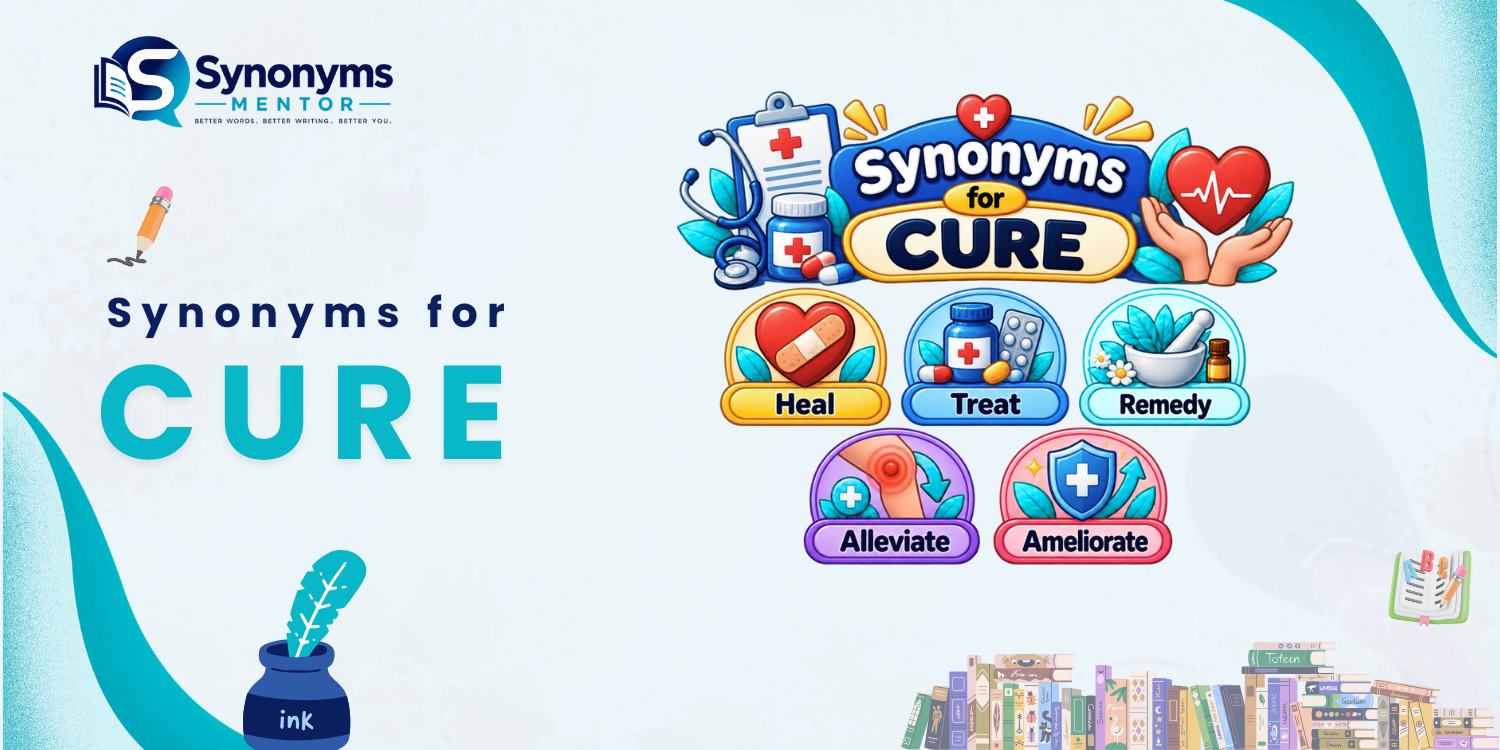
Common alternatives include heal, remedy, treat, restore, rehabilitate, fix, relieve, alleviate, and resolve. However, these words are not interchangeable in every sentence. For example, heal often focuses on recovery, treat describes medical care, and relieve means reducing a symptom rather than eliminating its underlying cause.
This guide explains the most useful alternatives so you can choose the word that fits your context naturally.
Quick Answer: What Are the Best Synonyms for Cure?
The closest synonyms for cure include heal, remedy, restore, treat, and fix, depending on context. Heal is particularly close when someone or something returns to health. Remedy emphasizes correcting a problem or condition, while treat usually means providing care rather than guaranteeing that an illness is eliminated. Relieve and alleviate are weaker alternatives because they generally mean reducing symptoms rather than curing the underlying condition.
Core Synonyms for Cure
| Word | Relationship | Meaning | Strength | Best Context |
|---|---|---|---|---|
| heal | Direct/near synonym | Make healthy or whole again | Similar | Illnesses, wounds, injuries |
| remedy | Near synonym | Correct or improve a problem | Similar | Illnesses and problems |
| treat | Contextual alternative | Provide medical care or attention | Usually weaker | Diseases, conditions, symptoms |
| restore | Near synonym | Bring back to a previous healthy or normal state | Similar | Health, function, condition |
| fix | Contextual alternative | Correct or solve something | Broad | Problems, informal contexts |
| rehabilitate | Contextual alternative | Help restore health or function | Specific | Recovery and physical function |
| relieve | Near synonym | Reduce pain, discomfort, or symptoms | Weaker | Pain and symptoms |
| alleviate | Near synonym | Make something less severe | Weaker | Pain, suffering, problems |
| resolve | Contextual alternative | Successfully deal with a problem | Similar for problems | Nonmedical problems |
| correct | Contextual alternative | Remove an error or defect | Specific | Problems, mistakes, conditions |
| repair | Contextual alternative | Restore something damaged | Specific | Physical or technical problems |
| mend | Contextual alternative | Repair or restore | Specific | Injuries, relationships, objects |
| revive | Contextual alternative | Bring back to life or activity | Different | People, systems, organizations |
| recover | Related rather than exact | Return to health | Different grammar | The person recovering |
| medicine | Related noun | A substance used in treatment | Not interchangeable | Medical contexts |
| therapy | Related noun | A method of treatment | Not interchangeable | Medical and psychological contexts |
| antidote | Contextual synonym | Counteract a poison or harmful substance | Specific | Poisoning |
| solution | Contextual alternative | Answer to a problem | Broad | Problems and difficulties |
| corrective | Contextual alternative | Something intended to correct a problem | Formal | Technical/professional writing |
| curative | Near synonym | Having the ability to cure | Formal | Medical or academic writing |
Not every word above can replace cure grammatically. For example, medicine and therapy are nouns, while heal and remedy can function as verbs in relevant contexts. Dictionary sources similarly organize the alternatives according to different senses of cure.
What Does “Cure” Mean?
Cure can function as both a verb and a noun.
As a verb, cure means to make someone healthy again or cause an illness to go away. It can also mean solving a problem. Cambridge also records a separate meaning in which cure refers to preserving food or other products through processes such as drying, smoking, or salting.
Examples:
- The treatment helped cure the infection.
- The new policy may cure several problems.
- The meat was cured with salt.
As a noun, cure can mean something that makes a sick person healthy again or a solution to a problem.
1. Heal
Heal is one of the closest alternatives to cure, particularly when talking about recovery from an illness, wound, or injury.
Example:
The wound took several weeks to heal.
The distinction is subtle. Cure often emphasizes eliminating an illness or condition, whereas heal can emphasize the process of becoming healthy or whole again. Dictionary.com specifically distinguishes heal as especially suitable for wounds and sores.
Best for: wounds, injuries, illness, emotional recovery.
2. Remedy
Remedy can be both a noun and a verb. As a verb, it means to correct or improve a problem or undesirable condition.
The new policy was designed to remedy the problem.
As a noun:
The doctor recommended a different remedy.
Remedy is especially useful when the focus is on correcting a problem, not necessarily promising complete elimination of a disease.
3. Treat
Treat is related to cure, but the two words are not interchangeable.
When a doctor treats an illness, injury, or medical condition, they provide care intended to manage or improve it. The goal may be to relieve symptoms, control the condition, or support recovery. However, treatment does not always eliminate the underlying cause, whereas cure generally suggests that the condition has been resolved.
Doctors are working to treat the condition.
Compare:
Doctors are working to cure the disease.
The second sentence suggests eliminating the disease, while the first focuses on medical management or care. Cambridge explicitly distinguishes treatment from curing: something can treat a condition without curing it.
4. Restore
Restore means to bring something back to an earlier, healthier, or more normal condition.
Physical therapy helped restore his mobility.
It is useful when the emphasis is on returning something to its previous state rather than eliminating a disease itself.
Best for: health, function, strength, normal condition.
5. Fix
Fix is an informal and broad alternative to cure, especially when talking about problems rather than illnesses.
We need to fix the problem before it gets worse.
You would normally avoid fix in formal medical writing when a more precise term such as treat, remedy, or correct is available.
6. Rehabilitate
Rehabilitate means helping someone regain health, abilities, or normal functioning after illness, injury, or another setback.
The program helped patients rehabilitate after their injuries.
It does not mean exactly the same thing as cure. Someone can be rehabilitated after an injury even though the original condition is no longer the central issue.
7. Relieve
Relieve means to reduce pain, discomfort, or another unpleasant effect.
The medication helped relieve the pain.
This is an important distinction: relieve does not necessarily mean cure. Something can make symptoms easier to tolerate without removing their underlying cause.
8. Alleviate
Alleviate is a more formal alternative to relieve. It means making something less severe or easier to endure.
The treatment helped alleviate her discomfort.
Use alleviate when the emphasis is on reducing severity rather than completely eliminating a condition.
9. Resolve
Resolve is useful when cure is being used metaphorically for a problem.
The new system helped resolve the issue.
You would not normally use resolve as a direct replacement for cure in a sentence about curing a disease. Its strongest use is with problems, disputes, difficulties, and conflicts.
10. Correct
Correct works when cure means putting something wrong into a proper state.
The software update corrected the error.
It is particularly natural for mistakes, defects, inaccuracies, and technical problems.
11. Repair
Repair means restoring something damaged to a usable or functional condition.
Engineers repaired the damaged equipment.
It is generally a better choice than cure when the subject is a machine, structure, device, or physical object.
12. Mend
Mend means to repair something damaged or restore something to a better condition.
The treatment helped mend the damaged tissue.
It can also be used figuratively:
They are trying to mend their relationship.
It is more natural in some physical and figurative contexts than in formal medical descriptions.
13. Revive
Revive means to bring something back to life, activity, strength, or popularity.
The campaign helped revive interest in the project.
It can overlap with restore, but it emphasizes bringing something back after decline or inactivity.
14. Recover
Recover is closely related to cure but has an important grammatical difference.
Cure normally describes an action or result affecting someone:
The treatment cured the infection.
Recover normally describes the person or thing returning to health:
She recovered from the infection.
So recover is best treated as a related word, not a direct replacement in every sentence.
15. Antidote
Antidote is a highly specific noun. It refers to something that counteracts a poison or harmful substance.
The doctors administered an antidote.
It can also be used figuratively:
Exercise can be an antidote to boredom.
Because of its specific meaning, antidote should not be used as a general synonym for every kind of cure. Merriam-Webster lists it among words associated with a substance that counteracts something undesirable.
Which Word Should I Use?
The easiest way to choose is to identify what exactly is being changed.
Choose “heal” when:
The focus is recovery or becoming healthy again.
The cut will heal naturally.
Choose “treat” when:
The focus is medical care rather than guaranteed elimination.
Doctors are treating the condition.
Choose “remedy” when:
The focus is correcting or dealing with a problem.
The new procedure may remedy the issue.
Choose “relieve” when:
The focus is reducing pain or discomfort.
The medication relieved the pain.
Choose “restore” when:
The focus is returning health, strength, or function.
Therapy helped restore mobility.
Choose “resolve” when:
The focus is solving a nonmedical problem.
The meeting helped resolve the dispute.
Choose “antidote” when:
The focus is counteracting a poison or harmful substance.
An antidote was administered.
Cure vs. Heal
| Cure | Heal |
|---|---|
| Often emphasizes eliminating an illness | Often emphasizes recovery or becoming whole |
| Common with diseases and conditions | Common with wounds, injuries, and recovery |
| Can also mean solving a problem | Can have physical and figurative uses |
| “The drug cured the infection.” | “The wound healed.” |
The two overlap considerably, but heal often highlights restoration or recovery, while cure more strongly suggests that the illness or problem itself has been eliminated.
Cure vs. Treat
These words are frequently confused.
Treat means to provide care for an illness or condition. Cure means to make someone healthy again or cause an illness to go away.
Doctors treated the disease.
does not necessarily mean:
Doctors cured the disease.
A person may receive treatment without being completely cured. Cambridge makes this distinction explicitly in its examples and definitions.
Cure vs. Remedy
Remedy is one of the closest alternatives to cure, particularly as a noun.
The researchers are searching for a cure.
The researchers are searching for a remedy.
But remedy has a broader problem-solving sense:
The company introduced a remedy for the software problem.
Cure can also be used metaphorically for problems, but remedy is often the more natural choice when discussing corrective action.
Cure vs. Relieve
These words differ mainly in degree of effect.
Cure suggests eliminating the illness or problem.
Relieve suggests making pain, discomfort, or symptoms less severe.
The medicine relieved her headache.
That sentence does not necessarily mean the medicine eliminated the underlying cause.
This distinction is especially important in health-related writing. Merriam-Webster and Collins both list relieve among related alternatives while distinguishing it from the stronger sense of cure.
Common Mistakes With “Cure” Synonyms
1. Treating “treat” and “cure” as identical
They are related but not equivalent. Treat focuses on care; cure focuses on making an illness go away.
2. Using “relieve” when you mean eliminate
If something only reduces symptoms, relieve or alleviate is usually more accurate.
3. Using “recover” as a direct replacement
You can say:
She recovered from the illness.
But not every sentence containing cure can be rewritten with recover without changing its grammatical structure.
4. Calling every medicine a cure
A medicine, therapy, or treatment may be used to manage a condition without being a cure.
5. Using “antidote” too broadly
An antidote has a specific counteracting meaning. It is not a general replacement for cure.
6. Forgetting that “cure” has multiple meanings
Cure can refer to making someone healthy, solving a problem, or preserving certain foods and products.
Related Words That Are Not Exact Synonyms
Some words are closely associated with cure but should not automatically be presented as synonyms:
- medicine — a substance used in medical treatment
- treatment — medical care or management
- therapy — a method or course of treatment
- recovery — the process or state of returning to health
- healing — the process of becoming healthy or whole
- prevention — action taken to stop something from occurring
- diagnosis — identification of a disease or condition
These words belong to the same semantic field but perform different roles.
Antonyms of Cure
The best opposite depends on the sense.
For the health-related sense, useful contrasting concepts include:
- worsen
- aggravate
- damage
- injure
For the problem-solving sense, contrasts include:
- create
- cause
- complicate
- worsen
The exact antonym should match the meaning of cure being discussed.
Pronunciation of Cure
US: /kjʊr/
UK: /kjʊə/
The pronunciation is essentially one syllable, with the vowel differing slightly between common American and British pronunciations. Cambridge provides both US and UK pronunciations.
FAQ About Synonyms for Cure
What is the closest synonym for cure?
Heal is one of the closest general alternatives, especially when talking about restoring health. Remedy is also very close, particularly when cure refers to a solution or corrective measure. The best choice depends on the sentence and the specific sense of cure.
What is another word for cure a disease?
Depending on the intended meaning, you could use heal, treat, eradicate, or remedy. However, they are not identical. Cure suggests that the disease is eliminated, while treat generally refers to providing care for it.
Is “heal” the same as “cure”?
Not exactly. The words overlap, but heal often emphasizes recovery or restoration, particularly with wounds and injuries. Cure more strongly suggests making an illness or condition go away.
Is “treatment” a synonym for “cure”?
Not exactly. Treatment refers to medical care or a method used to manage a condition. A treatment can be effective without necessarily being a cure.
What is a formal synonym for cure?
Depending on context, remedy, restore, rehabilitate, correct, or curative can work in more formal writing. The correct choice depends on whether you mean healing, correcting a problem, or restoring function.
What is a synonym for cure when talking about a problem?
Remedy, resolve, correct, fix, and address can work depending on the sentence. Remedy is especially useful when the meaning is “correct or improve a problem.”
What is a synonym for cure pain?
Relieve, alleviate, and ease are usually more accurate when the intended meaning is reducing pain. They should not automatically be treated as synonyms for eliminating the underlying cause.
Conclusion
The best synonym for cure depends on what you are trying to express. Heal is a close choice for recovery, remedy works well for correcting problems, treat emphasizes care, restore emphasizes returning to a previous condition, and relieve or alleviate are better when you mean reducing symptoms.

James Anderson is an English teacher and language researcher who creates easy synonym guides and vocabulary lessons. His goal is to help students and writers improve their language skills through simple and clear explanations.