Synonyms of Communication: Better Alternatives With Examples
Finding the right synonym for communication depends heavily on what you mean. Communication can describe the process of exchanging information, a conversation between people, a written exchange, a single message, or even the systems used to transmit information.
That is why words such as conversation, contact, correspondence, message, interaction, dialogue, exchange, and transmission can all work in particular contexts but are not interchangeable. This guide separates the closest synonyms from context-specific alternatives and explains which word sounds most natural in professional, academic, everyday, written, and technical contexts.
Quick Answer: What Are the Best Synonyms of Communication?
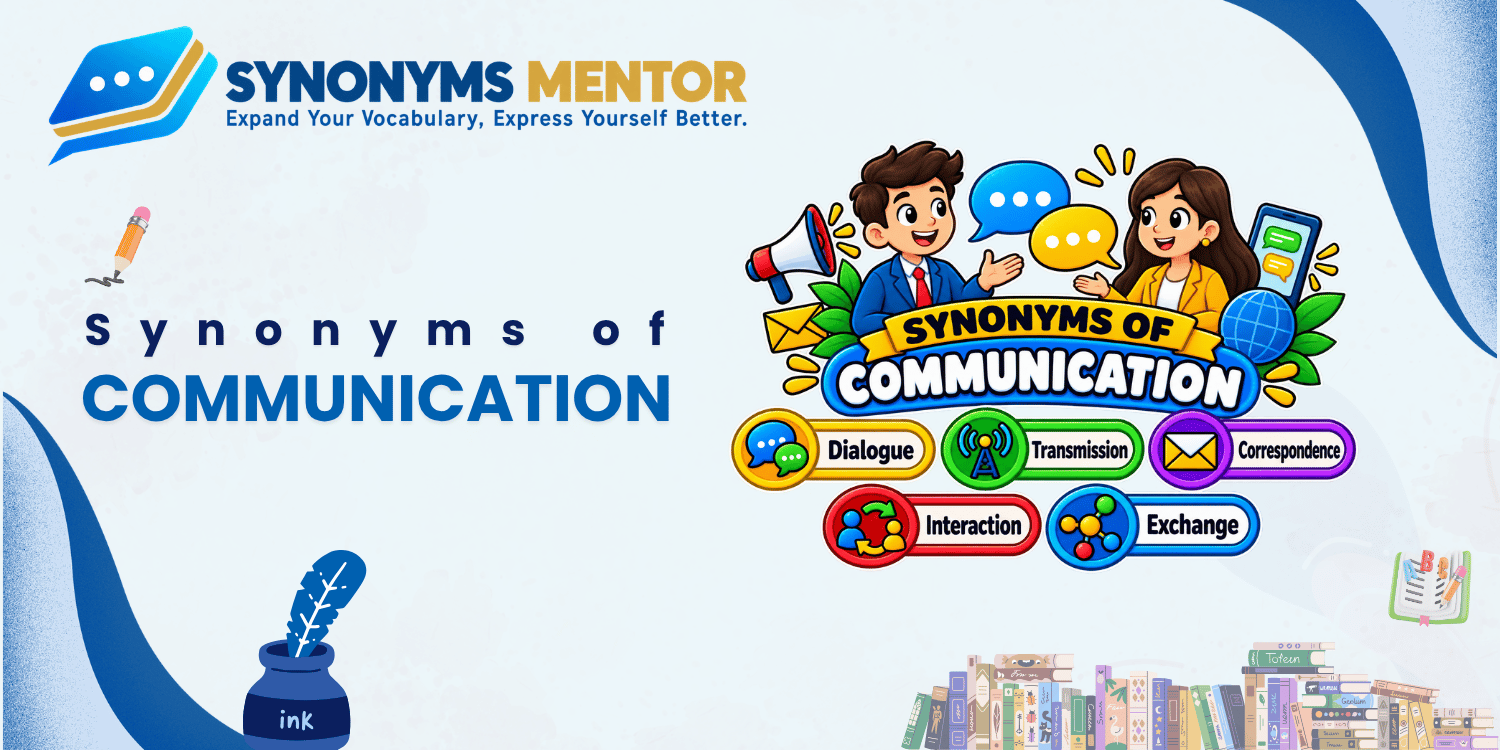
The best synonyms for communication include contact, conversation, correspondence, exchange, interaction, dialogue, message, transmission, and information sharing. The right choice depends on the meaning.
Use conversation for spoken interaction, correspondence for written communication, message for a specific piece of information, contact for maintaining communication, and transmission for sending information through a system or channel.
Synonyms of Communication at a Glance
| Word | Relationship | Meaning | Strength | Formality | Best Context |
|---|---|---|---|---|---|
| Contact | Near synonym | Communication or connection with another person or group | Similar | Neutral | Personal, professional |
| Conversation | Contextual alternative | Spoken exchange between people | Similar but narrower | Neutral | Everyday speech |
| Correspondence | Contextual alternative | Communication through letters, emails, or other writing | Similar but narrower | Formal/Neutral | Business, academic, written |
| Exchange | Near synonym | Two-way sharing of information, ideas, or feelings | Similar | Neutral | General, professional |
| Interaction | Near synonym | Reciprocal activity or communication between people | Similar but broader | Neutral | Social, professional |
| Dialogue | Near synonym | Communication through conversation, especially purposeful discussion | Similar but narrower | Neutral/Formal | Business, literature, diplomacy |
| Message | Contextual alternative | A particular piece of information communicated | Narrower | Neutral | Texts, emails, notices |
| Transmission | Contextual alternative | Sending information from one point to another | Narrower | Formal/Technical | Technology, science |
| Information sharing | Descriptive alternative | The act of making information available to others | Similar in some contexts | Neutral/Professional | Business, education |
| Dissemination | Contextual alternative | Wide distribution of information or knowledge | Narrower | Formal | Academic, institutional |
| Liaison | Contextual alternative | Communication or cooperation between people or organizations | Narrower | Formal | Business, organizations |
| Statement | Related/contextual | A spoken or written expression of information or position | Narrower | Neutral/Formal | Official communication |
These distinctions matter because dictionaries treat communication as a multi-sense noun. Oxford defines it as the activity or process of expressing ideas and feelings or giving information, while also recognizing communications as methods of sending information and a communication as a formal message.
What Does Communication Mean?
Communication is the process or activity of sharing information, ideas, thoughts, or feelings with another person or group.
For example:
Good communication is essential for a successful team.
Here, communication describes the general process of sharing information and understanding.
The word can also describe the means used to send information:
The storm disrupted communication between the two cities.
And in formal usage, a communication can mean a particular message, letter, or phone call:
We received an official communication from the company.
Oxford identifies all three of these major uses: communication as an activity, communications as methods of sending information, and a communication as a formal message.
The Best Synonyms of Communication
1. Contact
Contact is one of the closest alternatives when communication means maintaining contact or interacting with another person or organization.
We have regular communication with our suppliers.
We have regular contact with our suppliers.
The second sentence sounds completely natural.
However, contact emphasizes the connection or access between people, rather than the actual exchange of information.
Best contexts: business relationships, personal relationships, customer service, professional networking.
Natural collocations:
- maintain contact
- make contact
- stay in contact
- regular contact
- direct contact
- contact with customers
Collins lists contact as a synonym when communication means the exchange or connection between people.
2. Conversation
Conversation is a more specific form of communication involving people talking to one another.
We had good communication during the meeting.
We had a good conversation during the meeting.
The second sentence emphasizes the actual spoken exchange.
Best contexts: everyday speech, meetings, interviews, personal discussions.
Key difference: Communication can be written, spoken, visual, or nonverbal. A conversation is normally a spoken exchange.
So:
Email is a form of communication.
But:
Email is a conversation.
This would only make sense when referring to an ongoing email exchange.
3. Correspondence
Correspondence is a strong choice when communication takes place through writing, especially letters or formal emails.
The two companies maintained regular communication.
The two companies maintained regular correspondence.
The second version emphasizes written exchanges.
Best contexts: business, legal, academic, historical, and formal writing.
Key difference: Correspondence is narrower than communication because it normally implies written communication.
Common phrases include:
- business correspondence
- email correspondence
- written correspondence
- official correspondence
- correspondence between two parties
Collins specifically lists correspondence among alternatives for communication as contact or information exchange.
4. Exchange
Exchange works well when communication involves people sharing information, ideas, opinions, or feelings.
The meeting encouraged open communication.
The meeting encouraged an open exchange of ideas.
Here, exchange highlights the two-way nature of the communication.
Best contexts: ideas, information, opinions, views, experiences, and professional discussions.
Common collocations include:
- exchange of information
- exchange of ideas
- exchange of views
- exchange of opinions
- open exchange
Key difference: Exchange strongly suggests that something moves between two or more sides.
5. Interaction
Interaction refers to reciprocal activity between people, groups, or systems. Communication is often part of interaction, but the words are not identical.
Effective communication improves teamwork.
Effective interaction improves teamwork.
The second sentence can work, but it has a broader meaning. Interaction may involve communication plus other forms of behavior or response.
Best contexts: workplace relationships, education, social situations, technology, and human-computer interaction.
Key difference: Communication focuses on conveying information, while interaction emphasizes reciprocal activity.
6Dialogue
Dialogue refers to communication through conversation or discussion between two or more sides.
The two governments opened communication channels.
The two governments opened a dialogue.
In many contexts, dialogue implies a deliberate effort to discuss an issue, understand different viewpoints, or work toward resolving a problem.oblem.
Best contexts: diplomacy, politics, business, conflict resolution, literature, and formal discussion.
Example:
The company opened a dialogue with local residents.
This sounds more purposeful than simply saying:
The company communicated with local residents.
7. Message
Message is useful when communication means a specific piece of information that has been sent or received.
I received communication from the manager.
I received a message from the manager.
The second sentence is more natural in everyday English.
A message may be delivered by text, email, phone, letter, or another medium.
Best contexts: texts, emails, notifications, instructions, announcements, and individual pieces of information.
Key difference: Communication can describe an entire process; a message is usually one particular communication.
Cambridge and Collins both include message among alternatives when communication means something communicated.
8. Transmission
Transmission is appropriate when communication means sending information from one place, person, or system to another.
The communication of the signal was interrupted.
The transmission of the signal was interrupted.
The technical word transmission sounds more natural when discussing technology, radio, data, signals, or the transfer of knowledge.
Best contexts:
- data transmission
- radio transmission
- signal transmission
- transmission of information
- transmission of knowledge
Collins specifically uses transmission for the passing-on sense of communication.
9. Information Sharing
Information sharing is a clear professional alternative when communication specifically involves making information available to others.
Better communication between departments is needed.
Better information sharing between departments is needed.
The second sentence focuses more specifically on the distribution and exchange of information.
Best contexts: business, government, education, research, healthcare, and organizational communication.
It is a phrase rather than a single-word synonym, but it can be a more precise replacement in professional writing.
10. Dissemination
Dissemination means spreading information, knowledge, or ideas to a wider audience.
The communication of the research findings was important.
The dissemination of the research findings was important.
The second sentence sounds significantly more formal and emphasizes distribution.
Best contexts: academic writing, scientific research, government, education, and institutional communication.
Key difference: Dissemination usually implies spreading information outward, rather than a two-way conversation.
11. Liaison
Liaison can refer to communication and cooperation between people, departments, or organizations.
She serves as a point of communication between the two departments.
She serves as a liaison between the two departments.
The second sentence is more concise when describing someone’s coordinating role.
Best contexts: business, government, organizations, healthcare, and professional relationships.
Key difference: Liaison emphasizes the connection or coordinating relationship, not communication itself.
12. Statement
Statement can be a contextual alternative when communication refers to a formal expression of information, position, or opinion.
The company issued a communication about the changes.
The company issued a statement about the changes.
The second sentence is particularly natural when an organization officially announces its position.
Best contexts: official announcements, press releases, politics, business, and public relations.
Key difference: A statement is a particular piece of expressed information, while communication is the broader activity or process.
Which Word Should I Use?
The simplest way to choose is to identify what kind of communication you mean.
Choose “contact” when:
You mean maintaining a connection with another person or organization.
Please stay in contact with the client.
Choose “conversation” when:
You mean spoken communication between people.
We had a long conversation about the problem.
Choose “correspondence” when:
You mean written communication.
All correspondence should be sent by email.
Choose “exchange” when:
You want to emphasize two-way sharing.
There was a useful exchange of ideas.
Choose “interaction” when:
You mean reciprocal activity between people or systems.
The course encourages student interaction.
Choose “dialogue” when:
You mean purposeful discussion, especially between different sides.
The two groups began a dialogue.
Choose “message” when:
You mean one specific piece of information.
I left a message for the manager.
Choose “transmission” when:
You mean the movement of information through a technical or communication system.
The transmission of the data was interrupted.
Choose “dissemination” when:
You mean distributing information to a broad audience.
The dissemination of research findings is essential.
Choose “liaison” when:
You mean a connecting or coordinating relationship.
She acts as a liaison between the teams.
Communication by Context
For Workplace Communication
The most natural choices are usually:
- communication
- interaction
- dialogue
- correspondence
- exchange
- contact
- information sharing
Example:
Strong communication between departments can prevent misunderstandings.
Depending on the intended meaning, you could write:
Strong collaboration and communication between departments can prevent misunderstandings.
or:
Regular information sharing between departments can prevent misunderstandings.
The best replacement depends on whether you mean general communication or specifically the sharing of information.
For Written Communication
Use:
- correspondence
- message
- letter
- statement
- dispatch
- written exchange
Example:
The company maintained regular correspondence with its partners.
Correspondence is usually much more precise than simply replacing communication with conversation.
For Spoken Communication
Use:
- conversation
- dialogue
- talk
- discussion
- exchange
Example:
The manager had a conversation with the employee.
For Technical Communication
Use:
- transmission
- data transfer
- signal transmission
- telecommunications
- information transfer
Example:
The system supports secure data transmission.
Here, conversation or dialogue would obviously be inappropriate.
For Formal Communication
Depending on the situation, consider:
- correspondence
- statement
- announcement
- communiqué
- notification
- declaration
- dissemination
Example:
The government issued an official communication.
If the communication specifically announces a decision, statement or announcement may be more precise.
Communication vs. Conversation
Communication is the broader term.
Conversation is one type of communication, usually involving spoken interaction.
| Communication | Conversation |
|---|---|
| Broad concept | Narrower concept |
| Can be spoken or written | Usually spoken |
| Can be one-way or two-way | Usually interactive |
| Includes signals and nonverbal forms | Mainly verbal |
For example, a facial expression can communicate emotion, but it is not normally called a conversation.
Oxford explicitly includes nonverbal communication such as gestures and facial expressions within the broader concept of communication.
Communication vs. Interaction
These words overlap but emphasize different things.
Communication focuses on conveying information, ideas, or feelings.
Interaction focuses on reciprocal activity between people or systems.
Good communication improves customer service.
Customer interaction increased after the website redesign.
The first emphasizes information exchange; the second emphasizes how customers and the company interact.
Communication vs. Contact
Contact emphasizes having a connection or being in touch.
Communication emphasizes the exchange of information, ideas, or feelings.
We have had no communication with the supplier.
We have had no contact with the supplier.
Both are possible, but no contact can emphasize complete lack of connection, whereas no communication can specifically emphasize the absence of information exchange.
Communication vs. Message
A message is usually a specific instance of communication.
Email is an important form of communication.
I received an important message.
You would not normally replace communication with message when discussing communication as a general skill or process.
For example:
She has excellent communication skills.
Message skills would not have the same meaning.
Communication vs. Correspondence
Correspondence is communication through writing.
We maintain regular communication with our clients.
We maintain regular correspondence with our clients.
The second sentence specifically points to written exchanges.
It is therefore a good choice in formal business contexts when emails, letters, or documents are involved.
Common Collocations With Communication
Some of the most natural phrases include:
- effective communication
- clear communication
- good communication
- open communication
- direct communication
- regular communication
- verbal communication
- written communication
- nonverbal communication
- professional communication
- internal communication
- external communication
- communication skills
- communication channels
- communication system
- communication network
- communication technology
- communication between teams
- communication with customers
- communication with employees
Oxford also records common patterns such as communication between, communication with, and communication skills.
Common Mistakes When Choosing a Synonym
Using “conversation” for every type of communication
A conversation is only one form of communication. Written notices, gestures, data signals, and official statements are not necessarily conversations.
Using “message” for the entire communication process
A message is usually a particular piece of information. It is narrower than communication.
Using “interaction” when you specifically mean information sharing
Interaction can involve communication, but it has a broader meaning. Use information sharing when the exchange of information is the specific focus.
Using “transmission” in everyday conversation
Transmission is more technical and is especially natural for signals, data, broadcasts, and information transfer.
Using “correspondence” for spoken communication
Correspondence normally refers to written communication, particularly letters and formal exchanges.
Using “dissemination” for a private conversation
Dissemination suggests spreading information to a wider group. It is not a natural replacement for ordinary personal communication.
Related Words That Are Not Exact Synonyms
Some words are closely associated with communication but should not automatically be presented as synonyms.
Collaboration
Working together toward a shared objective. Communication may support collaboration, but they are not the same.
Feedback
A response to information, work, or performance. Feedback is a form of communication, not a general replacement for the word.
Expression
The act of conveying thoughts or feelings. It can be part of communication but has a different semantic focus.
Language
A system used for communication. Language is a means of communication, not a direct synonym.
Connection
A relationship or link between people, systems, or places. Communication may create or maintain a connection.
Information
Facts or knowledge that are communicated. Information is the content, whereas communication is the process or act of conveying it.
Keeping these distinctions clear prevents a vocabulary list from becoming a collection of merely related words.
Pronunciation of Communication
US IPA: /kəˌmjuːnəˈkeɪʃən/
UK IPA: /kəˌmjuːnɪˈkeɪʃən/
The main stress falls on -ca- in the final part of the word.
Cambridge and Oxford both provide pronunciations with the same general stress pattern.
Etymology of Communication
Communication entered English through Old French from Latin communicatio, related to communicare, meaning “to share.” The Latin root is connected with communis, meaning “common.”
That origin fits the modern concept: communication involves making information, ideas, or feelings available to others. Oxford traces the word to Late Middle English through Old French and Latin.
Frequently Asked Questions
What is the closest synonym for communication?
There is no single synonym that works in every context. Contact, exchange, and correspondence can be close alternatives depending on the intended meaning. For general information sharing, exchange is useful; for maintaining a relationship, contact is often better; for written communication, correspondence is more precise.
What is another word for communication in the workplace?
Depending on the context, useful alternatives include interaction, dialogue, correspondence, exchange, information sharing, and contact. For example, “communication between departments” could become “information sharing between departments” when the specific focus is the transfer of information.
What is a formal synonym for communication?
Formal alternatives include correspondence, dissemination, transmission, liaison, communiqué, and statement, but each has a narrower meaning. Correspondence refers to written exchanges, dissemination to distribution of information, and liaison to communication or coordination between people or organizations.
Is conversation a synonym for communication?
Conversation is a type of communication, but it is not a complete substitute in every context. Conversation normally involves spoken interaction, while communication can also be written, visual, nonverbal, digital, or technical.
Is interaction the same as communication?
Not exactly. Interaction refers to reciprocal activity between people, groups, or systems. Communication is specifically concerned with conveying or exchanging information, ideas, or feelings. The two overlap substantially in social and professional contexts.
What is a synonym for written communication?
Depending on the context, correspondence, written exchange, message, letter, email, statement, or documentation may work. Correspondence is especially useful for ongoing written communication between people or organizations.
What is a synonym for effective communication?
Depending on the intended meaning, alternatives include clear communication, effective information sharing, productive dialogue, open communication, strong communication, and successful interaction. These are contextual alternatives rather than exact synonyms.
What is the difference between communication and correspondence?
Communication is the broader concept of sharing information, ideas, or feelings. Correspondence specifically emphasizes written communication, especially letters, emails, or formal written exchanges. Therefore, correspondence is a narrower type of communication.
Conclusion
The best synonym for communication depends on the exact meaning you want to express. Contact emphasizes maintaining a connection, conversation focuses on spoken exchange, correspondence refers to written communication, exchange highlights two-way sharing, and dialogue suggests purposeful discussion. Message is best for a specific piece of information, while transmission works especially well for technical information transfer.

James Anderson is an English teacher and language researcher who creates easy synonym guides and vocabulary lessons. His goal is to help students and writers improve their language skills through simple and clear explanations.