Synonyms of Allusion: Better Alternatives With Examples
An allusion is an indirect reference to a person, event, place, literary work, or other subject. The word is especially common in literature, journalism, academic writing, and discussions of culture. Because an allusion is usually indirect, its closest alternatives are not interchangeable in every sentence.
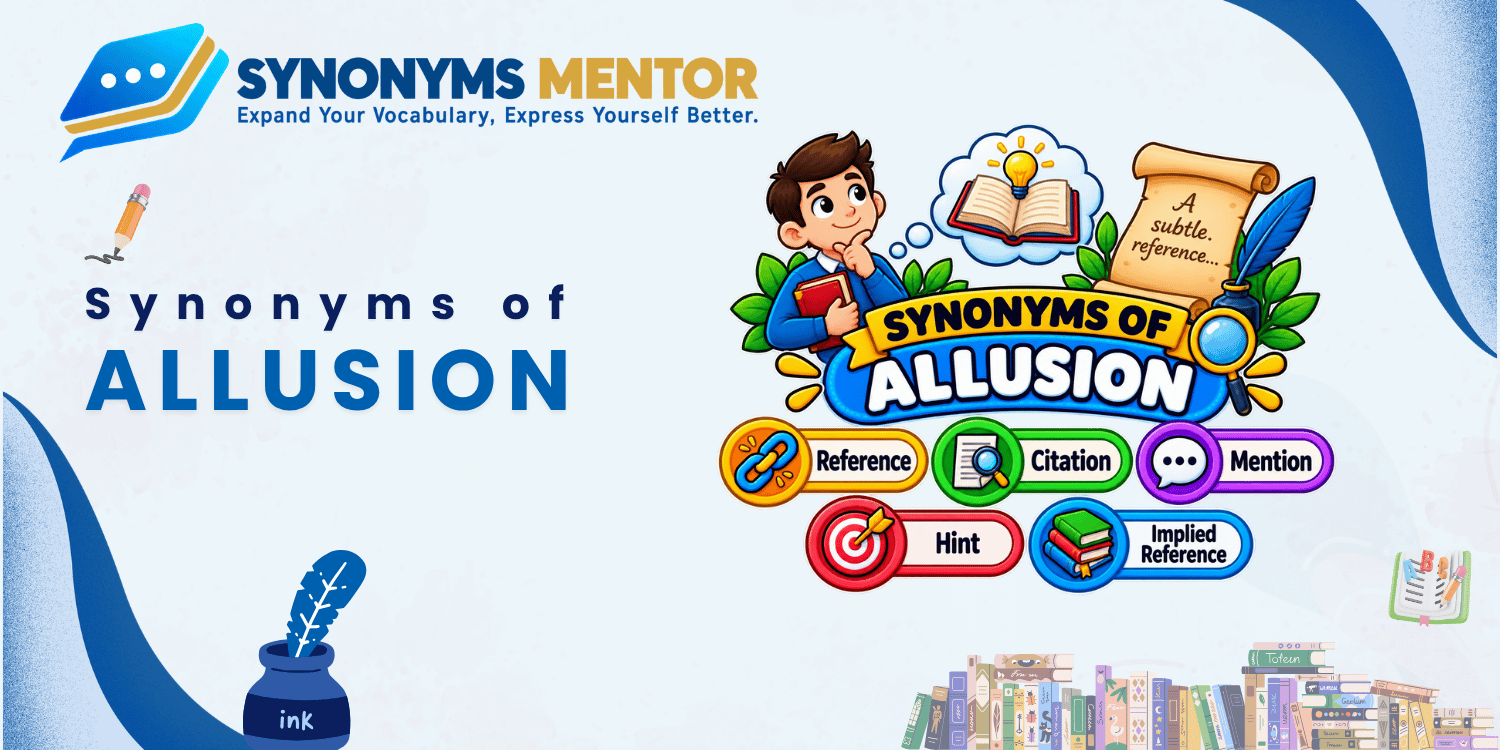
Reference is the broadest option, while hint, suggestion, and intimation emphasize indirect communication.
Words such as innuendo and insinuation are narrower and can carry a negative or suggestive tone. This guide explains the most useful synonyms of allusion, how they differ, and which one sounds most natural in different contexts.
Quick Answer: What Are the Best Synonyms of Allusion?
The closest synonyms of allusion include reference, mention, hint, suggestion, intimation, and indirect reference. However, they are not equally precise. Reference is the safest broad alternative, while hint emphasizes something communicated indirectly.
Mention is usually more direct and therefore weaker as a synonym. Intimation is formal, whereas innuendo and insinuation suggest a more specific or potentially negative kind of indirect meaning.
Synonyms of Allusion at a Glance
| Word | Relationship | Meaning | Strength | Formality | Best Context |
|---|---|---|---|---|---|
| Reference | Near synonym | A mention or indication of another person or subject | Similar | Neutral | General, academic, literary |
| Mention | Contextual alternative | A brief reference to something | Weaker | Neutral | Everyday and general writing |
| Hint | Near synonym | An indirect indication of something | Similar | Neutral | Conversation, advice, writing |
| Suggestion | Near synonym | An idea or meaning communicated indirectly | Similar | Neutral | General and professional writing |
| Intimation | Near synonym | A formal indication or indirect suggestion | Similar | Formal | Academic, literary, formal writing |
| Indirect reference | Direct paraphrase | A reference made without stating the subject explicitly | Very close | Neutral | Explanatory writing |
| Implication | Contextual alternative | A meaning that is suggested rather than directly stated | Similar in some contexts | Neutral/Formal | Analysis and argument |
| Innuendo | Narrow contextual alternative | An indirect remark that often carries a suggestive meaning | Stronger/narrower | Neutral | Sensitive or critical contexts |
| Insinuation | Narrow contextual alternative | An indirect suggestion, often unpleasant or damaging | Stronger/narrower | Neutral/Formal | Criticism and accusations |
| Quotation | Related, not general synonym | The exact words taken from another source | Different | Neutral/Formal | Literary and academic writing |
The core definition is important here: Cambridge describes allusion as something said or written that is intended to make someone think of a particular person or thing, while Oxford classifies the noun as formal and defines it as an indirect reference.
What Does Allusion Mean?
Allusion is a noun meaning an indirect reference to someone or something. Instead of explaining the subject directly, the writer or speaker briefly refers to it in a way that expects the audience to recognize the connection.
For example:
The novel’s title is an allusion to Shakespeare.
The title does not necessarily explain the Shakespearean connection. It simply evokes or points toward it.
Allusions are particularly common in literature and other forms of cultural communication because they allow writers to add meaning without lengthy explanations. The Academy of American Poets notes that literary allusions often depend on shared knowledge between the writer and reader.
The word is commonly used with to:
- an allusion to Shakespeare
- an allusion to Greek mythology
- an allusion to a historical event
- an allusion to his earlier remarks
Oxford also lists allusion to somebody/something as the standard construction.
The Best Synonyms of Allusion
1. Reference
Reference is usually the safest broad alternative to allusion.
A reference is an indication or mention of a person, subject, event, or source. Unlike allusion, however, reference does not have to be indirect.
Example:
The speech contains several references to American history.
You could use allusions here if the historical references are indirect or culturally suggestive:
The speech contains several allusions to American history.
When to choose “reference”
Choose reference when you want a neutral, broadly understood word and do not need to emphasize indirectness.
Best for: academic writing, general writing, literature, journalism, and professional communication.
2. Hint
A hint is an indirect indication that helps someone understand something without stating it openly.
Example:
Her comment was a hint that she wanted to leave.
A hint is often more conversational than allusion. It can also refer to information deliberately given to help someone discover an answer.
Best for: conversation, everyday writing, advice, and situations involving indirect communication.
Key difference: An allusion often points toward a recognizable person, event, work, or cultural subject. A hint is broader and may simply suggest what someone means.
3. Mention
Mention means referring to something briefly. It is related to allusion, but it is usually more direct.
Example:
The author mentions the historical event several times.
If the author only indirectly evokes the event, alludes to may be more precise:
The author alludes to the historical event several times.
Collins lists mention among the principal synonyms of allusion, but the two words differ in how direct the reference is.
Best for: straightforward references and everyday communication.
Important: Do not automatically replace every allusion with mention. An allusion often has a deliberate indirect or suggestive quality that mention lacks.
4. Suggestion
Suggestion can work as a synonym when an allusion communicates an idea indirectly.
Example:
His remarks contained a suggestion that the project might be canceled.
Here, suggestion focuses on the idea being indirectly communicated, whereas allusion focuses more on the indirect reference itself.
Best for: general, professional, and analytical writing.
Key difference: A suggestion does not necessarily refer to a particular person, work, event, or subject.
5. Intimation
Intimation is a formal word for an indirect indication or suggestion.
Example:
The letter contained an intimation that further changes were coming.
It can replace allusion in some formal contexts, particularly when the writer is emphasizing an indirect indication rather than a literary or cultural reference.
Best for: formal, literary, and academic writing.
Register: More formal and less common than reference, hint, or suggestion.
6. Indirect Reference
Indirect reference is the clearest descriptive alternative to allusion.
Example:
The poem contains an indirect reference to Greek mythology.
This phrase is particularly useful when explaining the meaning of allusion to students or readers who may not know the literary term.
Best for: educational writing, explanations, academic discussion, and general clarity.
Unlike some one-word alternatives, indirect reference preserves the central idea of the original word almost exactly.
7. Implication
Implication overlaps with allusion when the intended meaning is suggested rather than explicitly stated.
Example:
His comments carried an implication that the company had made a mistake.
The important distinction is that an implication is a meaning that can be inferred, whereas an allusion is an indirect reference to something.
Therefore, implication should generally be treated as a contextual alternative rather than a perfect synonym.
Best for: analysis, argument, academic writing, and discussions of implied meaning.
8. Innuendo
Innuendo is a much narrower alternative.
It refers to an indirect remark that suggests something, often something unpleasant, critical, embarrassing, or suggestive, without saying it openly.
Example:
The article contained several innuendos about the politician’s motives.
Because of this stronger connotation, innuendo should not normally replace allusion.
A literary reference to Greek mythology is an allusion, not an innuendo.
Best for: indirect criticism, suggestive remarks, or statements with an intentionally secondary meaning.
9. Insinuation
Insinuation is another narrow alternative. It generally refers to an indirect suggestion, especially one that implies something negative or damaging.
Example:
His comments were interpreted as an insinuation that the manager was dishonest.
The word therefore carries more negative force than allusion.
Choose “insinuation” when the indirect statement has an accusatory or unpleasant implication.
Which Word Should I Use?
The best choice depends on what you want to emphasize.
Choose “reference” when:
You need the broadest and safest alternative. The reference can be direct or indirect.
Choose “hint” when:
You want to emphasize that something is being communicated indirectly.
Choose “mention” when:
The reference is brief and relatively direct.
Choose “suggestion” when:
The important point is an indirectly communicated idea rather than a reference to a specific source.
Choose “intimation” when:
You need a formal word for an indirect indication.
Choose “indirect reference” when:
You want maximum clarity and want to preserve the core meaning of allusion.
Choose “innuendo” when:
The indirect meaning has a suggestive, critical, or potentially embarrassing character.
Choose “insinuation” when:
The indirect statement implies something negative or accusatory.
Allusion vs. Reference
Allusion and reference are closely related, but reference is broader.
A reference can be direct:
The essay makes a reference to the 1960s.
An allusion is typically indirect:
The poem makes an allusion to a famous historical event.
Collins lists reference as a synonym of allusion, while Cambridge’s thesaurus also places allusion among words related to reference.
Simple rule: Every allusion is a type of reference, but not every reference is an allusion.
Allusion vs. Hint
Both words involve indirect communication, but they are used differently.
| Word | Main idea |
|---|---|
| Allusion | Indirectly refers to a recognizable person, event, work, or subject |
| Hint | Indirectly gives information or indicates something |
Example:
The novel contains an allusion to Homer.
She gave me a hint about the answer.
The first sentence concerns a cultural or literary reference. The second concerns indirect information.
Allusion vs. Mention
Mention is generally more direct and neutral.
The article mentions the war.
This simply says that the war is referred to.
The article alludes to the war.
This suggests that the writer refers to it indirectly.
That difference in directness is why mention is often a useful contextual alternative but not a perfect replacement.
Allusion vs. Implication
These words can overlap, but they describe different relationships.
An allusion points toward something.
An implication is something that can be understood from what is said, even though it is not explicitly stated.
Example:
The speech contains an allusion to the previous administration.
His statement carried an implication that the previous administration had failed.
The first identifies an indirect reference. The second identifies an inferred meaning.
Allusion vs. Innuendo
These should not normally be treated as interchangeable.
An allusion can be completely neutral:
The poem contains an allusion to Greek mythology.
An innuendo usually carries an additional suggestive or critical meaning:
The comedian’s remark contained an innuendo about his rival.
So, innuendo is a narrower contextual alternative, not a general synonym for allusion.
Common Contexts for Allusion
Certain types of allusion occur especially often in writing.
Literary allusion
A reference to another literary work, author, character, or tradition.
The novel contains several literary allusions.
Historical allusion
A reference to a historical person, event, or period.
The politician made a historical allusion during the speech.
Biblical allusion
A reference to a person, story, phrase, or event from the Bible.
The poem contains several biblical allusions.
Classical allusion
A reference to Greek or Roman mythology, history, or literature.
The author’s classical allusions reward readers familiar with ancient mythology.
Collocations such as biblical allusion, historical allusion, and literary allusions are also recorded by Collins.
Common Collocations With Allusion
Some natural phrases include:
- make an allusion
- contain an allusion
- include an allusion
- an allusion to Shakespeare
- an allusion to history
- a literary allusion
- a historical allusion
- a biblical allusion
- a classical allusion
- a clear allusion
- an obscure allusion
- a frequent allusion
- a passing allusion
The most common preposition is to:
an allusion to the past
an allusion to Shakespeare
an allusion to a historical event
Oxford specifically identifies allusion to somebody/something as the standard construction.
Common Mistakes With Allusion Synonyms
Mistake 1: Treating “reference” as identical to “allusion”
Reference is broader. It does not always imply indirectness.
Mistake 2: Using “mention” for every allusion
A mention can be direct, while an allusion normally has an indirect quality.
Mistake 3: Calling every implication an allusion
An implication is an inferred meaning. It does not necessarily refer to an external person, event, text, or subject.
Mistake 4: Using “innuendo” as a literary synonym
An allusion can be neutral, but innuendo usually carries a suggestive or negative meaning. They should not be treated as interchangeable.
Mistake 5: Confusing allusion with quotation
A quotation reproduces someone else’s exact words. An allusion can refer to a source without quoting it.
Mistake 6: Confusing “allusion” with “illusion”
These words sound similar but have completely different meanings.
- allusion = an indirect reference
- illusion = a false or misleading appearance or perception
Allusion Pronunciation
US IPA: /əˈluːʒən/
UK IPA: /əˈluːʒən/
The pronunciation is essentially the same in standard American and British English. Cambridge and Oxford both give the pronunciation with the stress on the second syllable.
Etymology of Allusion
Allusion entered English in the 16th century through French or Late Latin allusio, from Latin alludere, meaning to play with or make an indirect reference. Oxford traces the word to alludere, formed from Latin elements associated with “towards” and “to play.”
The historical connection helps explain why allusion developed into a word for an indirect or suggestive reference.
Frequently Asked Questions
What is the closest synonym for allusion?
Reference is generally the closest broad synonym. However, indirect reference is even more precise because it preserves the central idea that an allusion refers to something without stating it directly.
What is another word for an indirect reference?
Allusion itself is the standard word. Other possibilities include reference, hint, suggestion, intimation, and indirect reference, depending on context.
Is “reference” the same as “allusion”?
Not exactly. A reference can be direct or indirect, while an allusion normally refers to something indirectly. Therefore, reference is broader than allusion.
Is “hint” a synonym for allusion?
Sometimes. Both can communicate something indirectly, but hint is broader and more conversational. Allusion is especially appropriate when the indirect reference points toward a recognizable person, event, work, or cultural subject.
What is the difference between allusion and implication?
An allusion is an indirect reference to something. An implication is a meaning that can be inferred from what someone says or writes. They overlap when an allusion communicates an implied meaning, but they are not identical.
Is “innuendo” a synonym for allusion?
Only in a narrow contextual sense. Innuendo describes an indirect remark with a suggestive, often unpleasant or critical meaning. Allusion is much broader and can be completely neutral.
What is the opposite of allusion?
There is no single perfect everyday antonym. In terms of communication style, direct statement, explicit reference, or direct reference can express the opposite idea: stating or identifying something openly rather than referring to it indirectly.
Conclusion
The best synonym for allusion depends on what you want to emphasize. Reference is the broadest and safest alternative, while indirect reference most closely captures the core meaning. Hint and suggestion work when indirect communication is the focus, and intimation suits formal writing.
Mention is usually more direct, while implication focuses on inferred meaning. Innuendo and insinuation are narrower choices because they can carry suggestive or negative connotations.

Sophia Martinez is an ESL educator who specializes in teaching vocabulary and word meanings. She writes beginner-friendly content that helps learners understand synonyms and improve their English fluency step by step.