Synonyms of Drag: 20+ Alternatives With Examples and Context
Finding the right synonym for drag can be surprisingly difficult because drag has several meanings. For example, you can drag a chair across the floor, drag yourself out of bed, or say that a meeting dragged on. Each use describes a different idea.
Therefore, the best synonym depends on the context. For physical movement, words such as pull, haul, draw, tow, and lug can work. However, when drag means moving slowly or taking too long, alternatives such as linger, lag, creep, or prolong may be more appropriate.
This guide separates genuine synonyms from near-synonyms and contextual alternatives. As a result, you can choose the word that sounds natural rather than simply picking another word from a thesaurus.
Quick Answer
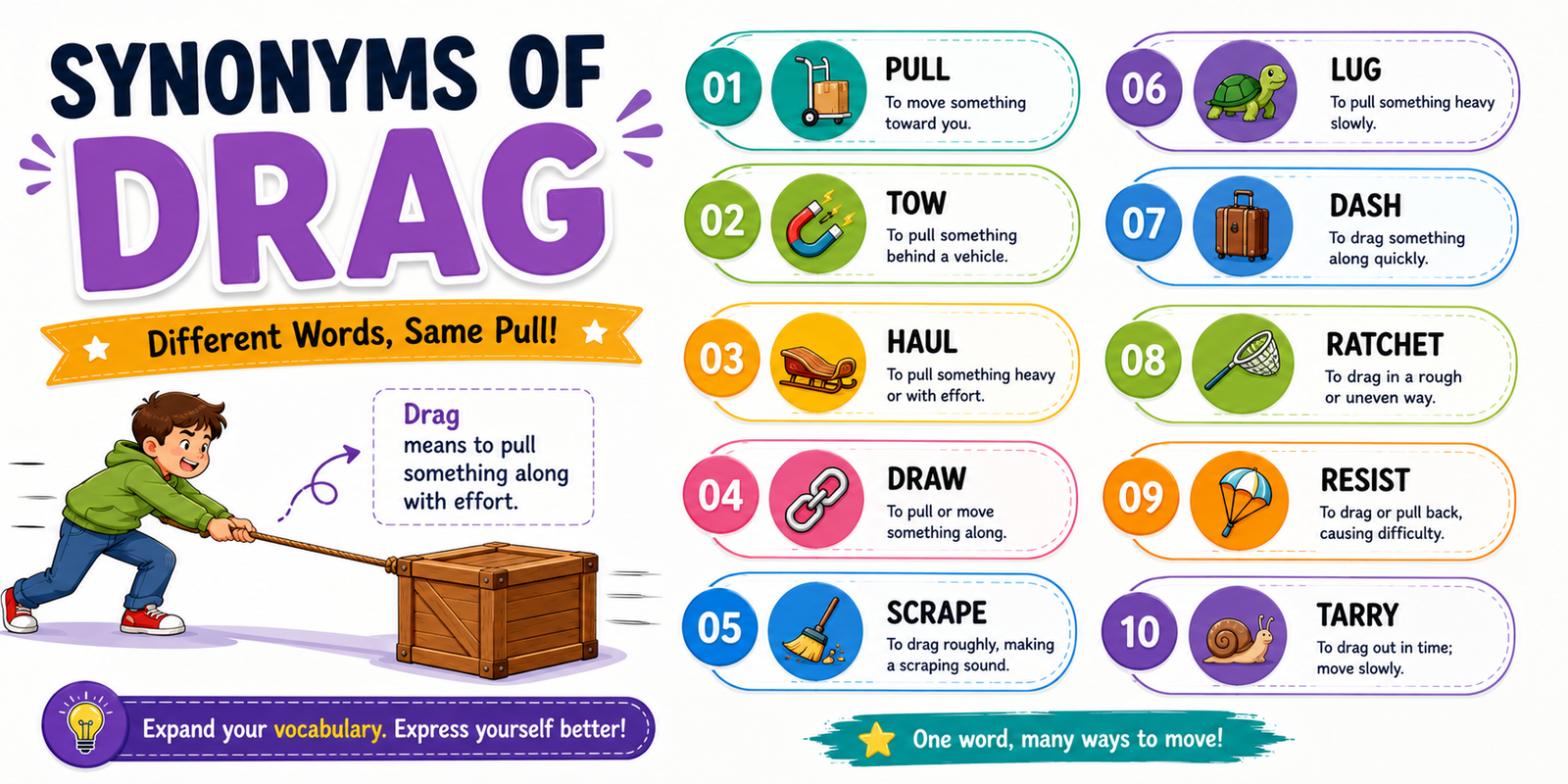
The closest synonyms of drag include pull, draw, haul, tow, tug, lug, trail, and pull along when drag means moving something with force. However, when drag means continuing slowly or for too long, better alternatives include linger, lag, creep, crawl, prolong, and delay. The correct choice depends on what drag means in your sentence.
Core Synonyms of Drag
| Word | Relationship | Meaning | Strength | Formality | Best Context |
|---|---|---|---|---|---|
| pull | Direct synonym | Move something toward or along by force | Similar | Neutral | General physical movement |
| draw | Near synonym | Pull something in a particular direction | Similar | Neutral/Formal | Objects, vehicles, curtains |
| haul | Near synonym | Pull or transport something heavy | Stronger | Neutral | Heavy objects |
| tow | Contextual alternative | Pull a vehicle or object behind another | Specific | Neutral | Cars, trailers, boats |
| tug | Near synonym | Pull with a short or forceful movement | More specific | Neutral | Ropes, handles, objects |
| lug | Near synonym | Carry or pull something heavy with effort | Similar | Informal | Heavy bags or equipment |
| trail | Near synonym | Follow or be pulled along behind | Different emphasis | Neutral | Feet, clothing, objects |
| draw along | Contextual alternative | Pull something along | Similar | Neutral/Formal | Literary or formal writing |
| pull along | Contextual alternative | Move something by pulling | Similar | Neutral | General movement |
| drag away | Contextual alternative | Pull something or someone away | Similar | Neutral | Removing something |
| linger | Contextual alternative | Remain or continue longer than expected | Different meaning | Neutral | Time, events, feelings |
| lag | Near synonym | Fall behind or progress slowly | Different emphasis | Neutral | Progress, people, systems |
| creep | Contextual alternative | Move very slowly | Different emphasis | Neutral | Time, traffic, movement |
| crawl | Contextual alternative | Move extremely slowly | Stronger slowness | Neutral | Progress, traffic, time |
| prolong | Contextual alternative | Make something last longer | Different grammar | Formal | Discussions, events, problems |
| delay | Near synonym | Make something happen later | Different meaning | Neutral/Formal | Plans, projects, processes |
| slow down | Near synonym | Reduce speed or progress | Similar in some contexts | Neutral | Movement and progress |
| dawdle | Contextual alternative | Move or act slowly because of lack of urgency | More specific | Neutral | People, tasks |
| stall | Contextual alternative | Stop or delay progress | Different emphasis | Neutral | Projects, negotiations |
| linger on | Contextual alternative | Continue for longer than expected | Similar in time contexts | Neutral | Memories, discussions, effects |
The table shows why a simple synonym list is not enough. Pull may replace drag in many physical contexts. Prolong, however, is better when someone intentionally makes an event last longer.
What Does “Drag” Mean?
Drag is primarily a verb meaning to move something by pulling it along a surface, often with effort or difficulty. Cambridge gives examples involving pulling objects along a surface, while Collins also lists meanings involving computer interfaces, slow-moving events, and things that hinder progress.
For example:
She dragged the suitcase across the floor.
Here, drag describes physical movement.
However, the word has other important meanings:
- Physical movement: He dragged the box across the room.
- Forced movement: They dragged him away from the door.
- Computer use: Drag the image into the folder.
- Slow progress: The project dragged for months.
- Long duration: The meeting dragged on.
- Something that slows progress: High costs became a drag on growth.
Consequently, the synonym should change with the meaning.
1. Pull — The Closest General Synonym
Pull is usually the safest alternative when drag means moving something by applying force.
Example:
She dragged the chair across the room.
Natural alternative:
She pulled the chair across the room.
Both sentences work. However, drag emphasizes that the chair is being moved along a surface, often with friction or difficulty. Collins specifically distinguishes drag from broader forms of pulling.
Best for: everyday English and general physical movement.
2. Haul — Use It for Heavy Objects
Haul suggests pulling or transporting something heavy, often with sustained effort.
The workers dragged the equipment across the field.
More natural when weight is important:
The workers hauled the equipment across the field.
Therefore, haul is stronger and more effort-focused than ordinary pull.
Best for: boats, equipment, furniture, heavy loads, and difficult transportation.
3. Draw — A More Formal or Literary Alternative
Draw can mean to pull something in a particular direction. It overlaps with drag, although it often sounds more formal or context-specific.
The horse dragged the cart.
Depending on the intended meaning:
The horse drew the cart.
However, draw does not always preserve the sense of something scraping or being pulled along a surface. Collins notes that draw, drag, haul, and pull overlap, but each emphasizes a slightly different type of movement.
Best for: formal writing, vehicles, curtains, and literary contexts.
4. Tow — Specifically for Vehicles and Trailers
Tow means pulling a vehicle, trailer, boat, or similar object behind another vehicle.
The truck dragged the broken car.
Better when the relationship between two vehicles matters:
The truck towed the broken car.
Therefore, tow is not a general synonym for drag. It is a contextual alternative.
Best for: cars, trailers, boats, and other vehicles.
5. Tug — A Short, Forceful Pull
Tug emphasizes a quick or forceful pull.
He dragged the rope toward himself.
If the movement consists of a short forceful action:
He tugged the rope toward himself.
The two words overlap, but tug usually describes the action of pulling sharply, rather than moving something continuously across a surface.
6. Lug — Heavy and Difficult Movement
Lug is commonly used when someone moves something heavy or awkward with effort.
She dragged her heavy suitcase upstairs.
A more informal alternative could be:
She lugged her heavy suitcase upstairs.
Lug often conveys inconvenience or physical effort. Therefore, it is useful in conversational English, but it is less neutral than pull.
7. Trail — When Something Follows Behind
Trail can overlap with drag when something extends or moves behind another object.
His coat dragged along the ground.
Another possibility:
His coat trailed along the ground.
However, trail does not necessarily imply forceful pulling. Instead, it focuses on something following behind or extending backward.
Best for: clothing, ropes, objects, smoke, and things following behind.
Synonyms for “Drag” When Something Moves Slowly
The meaning changes when drag describes time, progress, or an event.
For example:
The meeting dragged on for three hours.
Here, drag does not mean physically pulling something. Instead, it means the event continued slowly and seemed excessively long. Collins and Cambridge both recognize this use.
Better alternatives include:
- linger
- lag
- creep
- crawl
- prolong
- delay
- dawdle
- stall
- slow down
Nevertheless, these words are not interchangeable in every sentence.
Linger — Continue Longer Than Expected
Linger works when something remains or continues instead of ending quickly.
The discussion dragged on.
Possible alternative:
The discussion lingered.
However, linger can sound less negative. It may describe something remaining for a long time without necessarily suggesting that it is boring.
Best for: memories, feelings, smells, effects, conversations, and situations that remain.
Lag — Fall Behind
Lag means to remain behind or progress more slowly than something else.
The project dragged behind schedule.
A natural alternative:
The project lagged behind schedule.
Therefore, lag is especially useful when the idea of falling behind is important.
Best for: projects, technology, economic growth, people, and performance.
Creep — Move Very Slowly
Creep can describe extremely slow movement.
The traffic dragged through the city.
Depending on the context:
The traffic crept through the city.
Likewise:
Time seemed to drag.
can become:
Time seemed to creep by.
The meaning is similar, but creep adds an image of very slow movement.
Crawl — Extremely Slow Progress
Crawl is stronger than creep when progress is painfully slow.
The negotiations dragged on.
A more vivid alternative:
The negotiations crawled along.
However, crawl is more expressive. Therefore, it works especially well in descriptive writing.
Prolong — Make Something Last Longer
Prolong is useful when someone or something causes an event or situation to continue.
They dragged the meeting out.
More formal:
They prolonged the meeting.
This is an important distinction. Prolong usually takes an object:
They prolonged the discussion.
By contrast, drag on is commonly intransitive:
The discussion dragged on.
So, although the meanings overlap, the grammatical patterns differ.
Which Word Should I Use?
The easiest way to choose a synonym is to identify what kind of “drag” you mean.
Choose “pull” when:
You mean ordinary physical movement.
Pull the box toward the door.
Choose “haul” when:
The object is heavy and moving it requires significant effort.
They hauled the equipment across the field.
Choose “tow” when:
One vehicle or object pulls another.
The truck towed the trailer.
Choose “tug” when:
The action is short, sharp, or forceful.
She tugged the handle.
Choose “trail” when:
Something follows behind or extends along the ground.
The scarf trailed behind her.
Choose “lag” when:
Something falls behind or progresses slowly.
The project lagged behind schedule.
Choose “linger” when:
Something remains longer than expected.
The smell lingered in the room.
Choose “prolong” when:
Someone makes an event or situation last longer.
They prolonged the discussion.
Choose “crawl” when:
Progress is extremely slow.
The negotiations crawled forward.
Drag vs Pull
Drag and pull are close synonyms, but they are not identical.
| Drag | Pull |
|---|---|
| Often suggests movement along a surface | Broader meaning |
| Often implies friction or difficulty | Can involve easy movement |
| Can emphasize effort | Can involve varying effort |
| Common with objects on the ground | Works in many physical contexts |
For example:
He pulled the suitcase.
This does not necessarily tell us that the suitcase was scraping along the floor.
By contrast:
He dragged the suitcase across the floor.
The second sentence gives a much clearer image of the suitcase being moved along the surface.
Therefore, pull is the broader word, while drag is more specific in many physical contexts.
Drag vs Haul
Both words can describe difficult physical movement. However, haul places more emphasis on weight, effort, or transportation.
She dragged the heavy box across the room.
She hauled the heavy box across the room.
The second sentence makes the physical effort more prominent.
Therefore, choose haul when the object is especially heavy or difficult to transport.
Drag vs Tow
These words overlap only in certain situations.
Tow normally involves pulling a vehicle or object behind another vehicle or moving force.
The truck towed the car.
You would not normally replace tow with drag when describing ordinary vehicle recovery.
Therefore, tow is best treated as a context-specific alternative, not a universal synonym.
Drag vs Prolong
These words overlap when discussing something that lasts too long.
They dragged the meeting out.
They prolonged the meeting.
Both suggest that the meeting continued longer than necessary. However, prolong is more formal and directly means to make something last longer.
Meanwhile, drag on often suggests that something feels boring, tedious, or unnecessarily long.
Useful Collocations With “Drag”
Learning collocations can help you choose synonyms more naturally.
object + Drag
- drag a chair
- drag a box
- drag a suitcase
- drag a table
- drag a file
- drag an image
person + Drag
- drag someone away
- drag someone into something
- drag someone along
time/event + Drag
- drag on
- drag out a meeting
- drag out a discussion
- drag on for hours
- drag on for years
progress + Drag
- drag down growth
- drag down performance
- act as a drag on progress
Consequently, the surrounding words can often tell you which synonym is appropriate.
Common Mistakes With Synonyms of Drag
Mistake 1: Treating every synonym as interchangeable
Pull, tow, and haul overlap with drag, but they have different uses.
Better: Check the object and the type of movement before choosing a replacement.
Mistake 2: Using “prolong” for physical movement
You cannot normally replace:
She dragged the chair across the floor.
with:
She prolonged the chair across the floor.
Prolong relates to duration, not physical pulling.
Mistake 3: Using “tow” for every heavy object
A heavy suitcase can be dragged or hauled, but tow normally implies pulling a vehicle or similar object behind something else.
Mistake 4: Confusing “lag” with “drag”
Lag usually means falling behind or progressing slowly.
The website lagged behind its competitors.
Drag can mean that something is slowing progress.
High costs dragged down profits.
The meanings overlap, but the sentence structure differs.
Mistake 5: Ignoring register
Lug is more informal than pull, while prolong is more formal than drag out.
Therefore, word choice should match the tone of your writing.
Antonyms of Drag
The best antonym depends on the meaning.
physical movement, possible opposites include:
- lift
- carry
- raise
slow progress, possible opposites include:
- accelerate
- hasten
- speed up
- advance
prolonging something, possible opposites include:
- shorten
- end
- finish
- conclude
In other words, there is no single antonym that works for every meaning of drag.
Pronunciation
Drag
- US: /dræɡ/
- UK: /dræɡ/
The pronunciation is essentially the same in standard American and British English.
FAQ
What is the closest synonym for “drag”?
Pull is usually the closest general synonym when drag means moving something by force. However, drag often adds the idea of moving an object along a surface with effort or friction. Therefore, pull is broader, while drag can be more specific.
What is another word for “drag” something heavy?
Haul is often a good alternative when the object is heavy or difficult to move. Lug can also work, especially in informal English. However, pull remains the broadest everyday option.
What is a synonym for “drag on”?
Depending on context, alternatives include linger, continue, last, prolong, and go on. If the event is unpleasantly long, prolong or linger may work. If progress is extremely slow, crawl can be more expressive.
What is a formal synonym for “drag out”?
Prolong is usually the strongest formal alternative.
They dragged out the negotiations.
Can become:
They prolonged the negotiations.
However, the tone changes slightly because drag out more strongly suggests unnecessary or tedious extension.
Is “haul” the same as “drag”?
Not exactly. Both can describe moving something with effort. However, haul emphasizes transporting or pulling something heavy, whereas drag often emphasizes pulling something along a surface. Therefore, they are near-synonyms rather than perfect substitutes.
Is “pull” a synonym for “drag”?
Yes, in many physical contexts. However, pull has a broader meaning. For example, you can pull something toward yourself without dragging it along a surface. Drag more strongly suggests movement along a surface.
What is the synonym of “drag” in computing?
In computing, drag means moving an on-screen object by holding and moving it with a mouse or similar input device. In this context, words such as move or reposition may describe the result, but they do not always preserve the specific user-interface action of dragging.
Conclusion
The best synonym for drag depends on its meaning. For physical movement, pull is the closest general alternative, while haul, lug, tow, tug, and draw fit more specific situations. On the other hand, when drag describes slow progress or excessive duration, lag, linger, creep, crawl, prolong, and delay become more useful.

David Wilson is a content strategist and SEO expert who focuses on creating structured vocabulary content. He combines keyword research with simple explanations to make learning English both effective and search-friendly.