Synonyms for Thankfully: 15 Better Alternatives With Examples
If you are looking for synonyms for thankfully, the best alternative depends on what you mean by the word. In everyday English, thankfully commonly expresses happiness or relief that something good happened or something bad was avoided.
For example, “Thankfully, nobody was hurt” is close in meaning to “Fortunately, nobody was hurt.” However, thankfully can also mean “in a thankful or grateful way,” as in “She accepted the gift thankfully.”
Because of this, not every word that appears in a thesaurus is a true substitute. Fortunately and luckily are strong alternatives when thankfully means “fortunately,” whereas gratefully and appreciatively are more appropriate when the meaning involves gratitude.
This guide separates those meanings so you can choose the most natural word for your sentence.
Quick Answer: What Are the Best Synonyms for “Thankfully”?
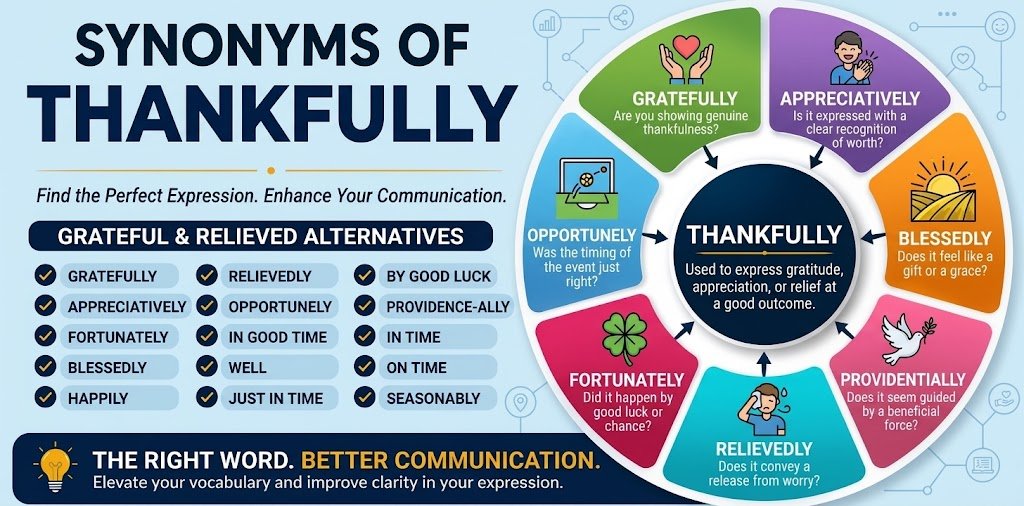
The closest synonyms for thankfully are fortunately, luckily, gratefully, mercifully, happily, and appreciatively, but they do not work in exactly the same contexts.
- Fortunately — best general alternative when something good happened or something bad was avoided.
- Luckily — similar to fortunately, but usually more conversational.
- Gratefully — best when expressing genuine gratitude.
- Mercifully — emphasizes relief that something unpleasant was avoided or ended.
- Happily — can express a positive outcome, although it is broader than thankfully.
- Appreciatively — focuses on showing appreciation rather than simply being relieved.
Oxford and Cambridge both identify the “fortunately” sense of thankfully, while Oxford also records its “pleased or grateful” sense.
Core Synonym Resource
| Word or phrase | Relationship | Main meaning | Best context | Formality |
|---|---|---|---|---|
| Fortunately | Direct synonym in one sense | Happily because of a favorable outcome | General, professional, academic | Neutral |
| Luckily | Direct/near synonym | Because of good luck | Conversational, everyday writing | Neutral/informal |
| Gratefully | Direct synonym in gratitude sense | With thanks or gratitude | Receiving help, gifts, support | Neutral |
| Mercifully | Near synonym | Thankfully because something unpleasant was avoided | Relief from danger, pain, difficulty | Neutral/formal |
| Happily | Near synonym | In a fortunate or pleasing way | Positive outcomes | Neutral |
| Appreciatively | Contextual alternative | In a way that shows appreciation | Responding to kindness or help | Neutral/formal |
| Thank goodness | Contextual alternative | An expression of relief | Informal speech and writing | Informal |
| Thank God | Contextual alternative | Strong expression of relief | Personal or religious contexts | Informal |
| Thank heavens | Contextual alternative | Strong expression of relief | Conversational/literary | Informal |
| By good fortune | Contextual alternative | As a result of good luck | Formal or descriptive writing | Neutral/formal |
| By luck | Contextual alternative | As a result of luck | Casual contexts | Informal |
| With gratitude | Contextual alternative | In a grateful manner | Formal writing | Formal |
| With appreciation | Contextual alternative | In a way showing appreciation | Professional communication | Formal |
| Relievedly | Related/rare alternative | In a relieved manner | Specialized prose | Formal/less common |
| Blessedly | Near synonym | Fortunately or in a relieving way | Literary or expressive writing | Literary |
Important: These alternatives are not interchangeable in every sentence. In particular, fortunately/luckily and gratefully/appreciatively belong to different semantic uses of thankfully.
What Does “Thankfully” Mean?
Thankfully is an adverb. It has two important modern uses.
1. “Thankfully” meaning “fortunately”
This use expresses happiness or relief because a favorable situation occurred or an undesirable outcome was avoided:
Thankfully, nobody was injured.
Here, thankfully means approximately fortunately.
Oxford defines this sense as showing that you are pleased something good happened or something bad was avoided. Cambridge similarly describes thankfully as showing that you are happy or grateful about something.
2. “Thankfully” meaning “in a grateful way”
The word can also describe an action performed with gratitude:
She accepted the help thankfully.
Here, replacing thankfully with fortunately would change the meaning. The intended idea is gratitude.
Merriam-Webster likewise records both “in a thankful manner” and the sense of something occurring “as makes one thankful.”
The Best Synonyms for “Thankfully”
1. Fortunately
Meaning: Happily because circumstances turned out well.
Best use: This is usually the safest replacement when thankfully means “fortunately.”
Thankfully, the package arrived before the deadline.
Fortunately, the package arrived before the deadline.
The two sentences have essentially the same meaning.
Register: Neutral and widely appropriate.
Best for: Professional writing, essays, articles, reports, and everyday English.
If you need one general-purpose synonym for thankfully, fortunately is usually the strongest choice.
2. Luckily
Meaning: As a result of good luck.
Thankfully, we found a taxi before the rain started.
Luckily, we found a taxi before the rain started.
The difference is mainly tone. Luckily is often more conversational and directly emphasizes luck.
Choose “luckily” when: the favorable result seems accidental or dependent on good fortune.
3. Gratefully
Meaning: In a thankful or appreciative manner.
She accepted the assistance thankfully.
She accepted the assistance gratefully.
Here, gratefully is much more precise than fortunately because the sentence is about the person’s emotional response.
Choose “gratefully” when: you mean that someone is showing gratitude.
4. Mercifully
Meaning: In a way that brings relief because something unpleasant was avoided, reduced, or ended.
Thankfully, the storm passed quickly.
Mercifully, the storm passed quickly.
The second sentence adds a stronger sense of relief. Therefore, mercifully is not a neutral substitute for every use of thankfully.
Choose “mercifully” when: the situation involved something unpleasant, difficult, or potentially serious.
5. Happily
Meaning: In a happy, pleasing, or fortunate way.
Thankfully, the problem was resolved quickly.
Happily, the problem was resolved quickly.
However, happily is broader than thankfully. It can describe something simply being pleasing rather than something causing relief or gratitude.
Choose “happily” when: you want to emphasize a positive outcome rather than gratitude specifically.
6. Appreciatively
Meaning: In a way that shows appreciation.
He nodded thankfully.
He nodded appreciatively.
This works particularly well when someone responds to kindness, assistance, praise, or generosity.
Choose “appreciatively” when: the focus is on showing appreciation.
Contextual Alternatives to “Thankfully”
Some expressions can replace thankfully in particular situations but should not be treated as universal synonyms.
“Thank goodness”
This is a common informal expression of relief.
Thank goodness, we arrived before the store closed.
It is stronger and more conversational than fortunately.
Best for: speech, informal messages, personal writing.
“Thank God”
This can express strong relief:
Thank God, everyone got home safely.
However, it has religious wording and may not suit every audience or context.
For neutral professional writing, fortunately is usually a better choice.
“Thank heavens”
This is another expressive way to show relief:
Thank heavens, the missing documents were found.
It can sound conversational, dramatic, or slightly old-fashioned depending on context.
“By good fortune”
This explicitly emphasizes good luck.
By good fortune, the team found an available venue.
It is less natural than fortunately in ordinary conversation, but it can work in formal or narrative writing.
“With gratitude”
When thankfully means “in a grateful manner,” this phrase can work well:
She accepted the award with gratitude.
This is particularly useful in formal writing.
“With appreciation”
This is another formal alternative:
He accepted the assistance with appreciation.
It emphasizes appreciation rather than relief.
It is especially suitable when discussing professional relationships, recognition, support, or service.
Which Word Should You Use?
The easiest way to choose is to identify the intended meaning first.
Choose “fortunately” when:
You mean a favorable outcome or the avoidance of something bad.
Thankfully, no one was injured.
→ Fortunately, no one was injured.
Choose “luckily” when:
You want to emphasize good luck, especially in conversational English.
Thankfully, I found my keys before leaving.
→ Luckily, I found my keys before leaving.
Choose “gratefully” when:
You mean with gratitude.
She accepted the gift thankfully.
→ She accepted the gift gratefully.
Choose “mercifully” when:
You want to emphasize relief from something unpleasant.
Thankfully, the noise stopped.
→ Mercifully, the noise stopped.
Choose “appreciatively” when:
You mean showing appreciation.
He smiled thankfully.
→ He smiled appreciatively.
Thankfully vs. Fortunately
These two words are often interchangeable when thankfully means that a positive outcome occurred.
| Thankfully | Fortunately |
|---|---|
| Often expresses relief or gratitude | Primarily emphasizes a favorable outcome |
| Can have a personal/emotional tone | Usually more neutral |
| Common in conversational writing | Very versatile in formal writing |
| Has a separate “gratefully” sense | Does not normally mean “gratefully” |
Compare:
Thankfully, the children were safe.
Fortunately, the children were safe.
Both work naturally.
However:
She accepted the gift thankfully.
does not normally mean the same as:
She accepted the gift fortunately.
The second sentence changes the intended meaning.
Thankfully vs. Luckily
Thankfully and luckily overlap when discussing a favorable outcome.
Thankfully, we arrived on time.
Luckily, we arrived on time.
However, luckily explicitly highlights luck, while thankfully can express a broader feeling of relief or gratitude.
Therefore:
- Use luckily when good fortune is central.
- Use thankfully when relief or appreciation is central.
Thankfully vs. Gratefully
This distinction is particularly important for vocabulary learners.
Thankfully can mean “in a thankful way,” while gratefully directly expresses gratitude.
She accepted the invitation gratefully.
This means she accepted it with gratitude.
By contrast:
Thankfully, she accepted the invitation.
can be interpreted differently depending on context and placement.
If your intended meaning is specifically “with gratitude,” choose gratefully.
If your intended meaning is “fortunately,” choose fortunately.
Natural Examples of “Thankfully” and Its Alternatives
Relief
Thankfully, the rain stopped before the event began.
Alternative:
Fortunately, the rain stopped before the event began.
Good luck
Thankfully, I remembered to save a backup.
Alternative:
Luckily, I remembered to save a backup.
Gratitude
She thanked her mentor thankfully.
A more natural alternative in many contexts is:
She thanked her mentor gratefully.
Professional writing
Fortunately, the issue was resolved before publication.
This is generally more neutral than:
Thankfully, the issue was resolved before publication.
Strong relief
Mercifully, the delay was brief.
This conveys more relief than the neutral:
Thankfully, the delay was brief.
Common Mistakes When Choosing a Synonym for “Thankfully”
Mistake 1: Treating “fortunately” and “gratefully” as identical
They are not.
Fortunately concerns a favorable situation.
Gratefully concerns gratitude.
Mistake 2: Using “luckily” in every formal sentence
Luckily is perfectly normal English, but fortunately may sound more neutral in formal or academic writing.
For example:
Fortunately, the experiment produced reliable results.
is generally more formal than:
Luckily, the experiment produced reliable results.
Mistake 3: Assuming every thesaurus entry is interchangeable
Large thesaurus lists can contain words with different meanings, registers, or contexts. Merriam-Webster’s thesaurus, for example, lists fortunately and luckily prominently but also includes many broader related words.
A synonym list is therefore a starting point—not a substitute for understanding context.
Mistake 4: Using “thankfully” when you actually mean “gratefully”
Consider:
He accepted the award gratefully.
The sentence focuses on his gratitude.
If you write:
He accepted the award fortunately.
the meaning is wrong.
When gratitude is the intended idea, use gratefully, appreciatively, or with gratitude.
Mistake 5: Overusing “thankfully”
In longer writing, repeating the same transition or sentence adverb can make the prose feel monotonous.
Instead, choose the word that expresses the precise relationship:
- fortunately → favorable outcome
- luckily → good luck
- gratefully → gratitude
- mercifully → relief
- appreciatively → appreciation
This improves both vocabulary precision and readability.
Transition Words and Yoast SEO: How “Thankfully” Fits
If you are using Yoast SEO, thankfully can function as a transition-style adverb when it connects an outcome with the writer’s attitude toward that outcome. However, it should not be inserted simply to increase a readability score.
A better approach is to use genuine logical transitions according to the relationship between ideas:
- However → contrast
- Therefore → result
- For example → illustration
- In addition → addition
- Meanwhile → time or simultaneous development
- Fortunately → favorable circumstance
- Consequently → result
- In contrast → comparison
- Finally → sequence
For example:
The deadline was extremely close. Fortunately, the team had already completed most of the work.
Here, fortunately naturally signals that the second statement describes a favorable circumstance.
Do not replace every occurrence of thankfully with a transition word merely because an SEO plugin recommends more transitions. Natural language and logical relationships should come first.
Is “Thankfully” Formal?
Thankfully is standard English and is appropriate in many contexts. However, the choice between thankfully and alternatives depends on the intended tone.
For neutral or formal writing, fortunately is often a straightforward alternative when the intended meaning is “fortunately.” For a gratitude-focused meaning, gratefully or with gratitude may be more precise.
Collins notes that the use of thankfully in the sense of “fortunately” was once criticized but is now accepted in informal contexts.
Pronunciation of “Thankfully”
The common pronunciation is approximately:
US: /ˈθæŋkfəli/
UK: /ˈθæŋkfəli/
Oxford and Cambridge both provide pronunciation information for the word.
The word is formed from thankful + -ly, and Oxford traces its word origin to Old English.
Antonyms of “Thankfully”
Because thankfully has two major senses, its opposites depend on context.
When it means fortunately, possible contrasting ideas include:
- unfortunately
- regrettably
- sadly
- disastrously
Example:
Fortunately, nobody was injured.
versus:
Unfortunately, several people were injured.
When it means gratefully, its opposite would involve a lack of gratitude rather than simply bad luck. Words such as ungratefully or thanklessly may work depending on the sentence.
FAQ: Synonyms for Thankfully
What is the closest synonym for “thankfully”?
Fortunately is usually the closest general synonym when thankfully means that something good happened or something bad was avoided. Gratefully is closer when thankfully means “in a thankful manner.” The correct choice therefore depends on the sense being used.
What is a formal synonym for “thankfully”?
Fortunately is generally a strong neutral-to-formal alternative when thankfully means “fortunately.” When expressing gratitude, with gratitude or gratefully may be more appropriate.
Is “luckily” the same as “thankfully”?
Not always. Luckily emphasizes good luck, whereas thankfully can express relief, happiness, or gratitude. They are often interchangeable when describing a favorable outcome, but they are not identical in every context.
Is “gratefully” a synonym for “thankfully”?
Yes, but only for the gratitude-related sense. If thankfully means “fortunately,” then gratefully is not an appropriate replacement.
What is another word for “thankfully” in professional writing?
Fortunately is usually the safest choice when you mean “fortunately.” For gratitude, consider gratefully, appreciatively, or with appreciation, depending on the sentence.
Can I use “thank goodness” instead of “thankfully”?
Sometimes. Thank goodness is an informal expression of relief, so it works well in conversation and casual writing. It is generally less suitable for formal or academic prose.
What is the difference between “thankfully” and “fortunately”?
Both can describe a favorable outcome. However, thankfully can also communicate the speaker’s relief or gratitude, while fortunately focuses more directly on the favorable circumstances.
Conclusion
The best synonyms for thankfully depend on what you are trying to express. If you mean “fortunately,” choose fortunately or luckily. If you mean “in a grateful manner,” choose gratefully or appreciatively. When the situation involves strong relief, mercifully may be more expressive, while phrases such as thank goodness are better suited to informal contexts.

James Anderson is an English teacher and language researcher who creates easy synonym guides and vocabulary lessons. His goal is to help students and writers improve their language skills through simple and clear explanations.