Synonyms of Forest: 15+ Words for Different Contexts
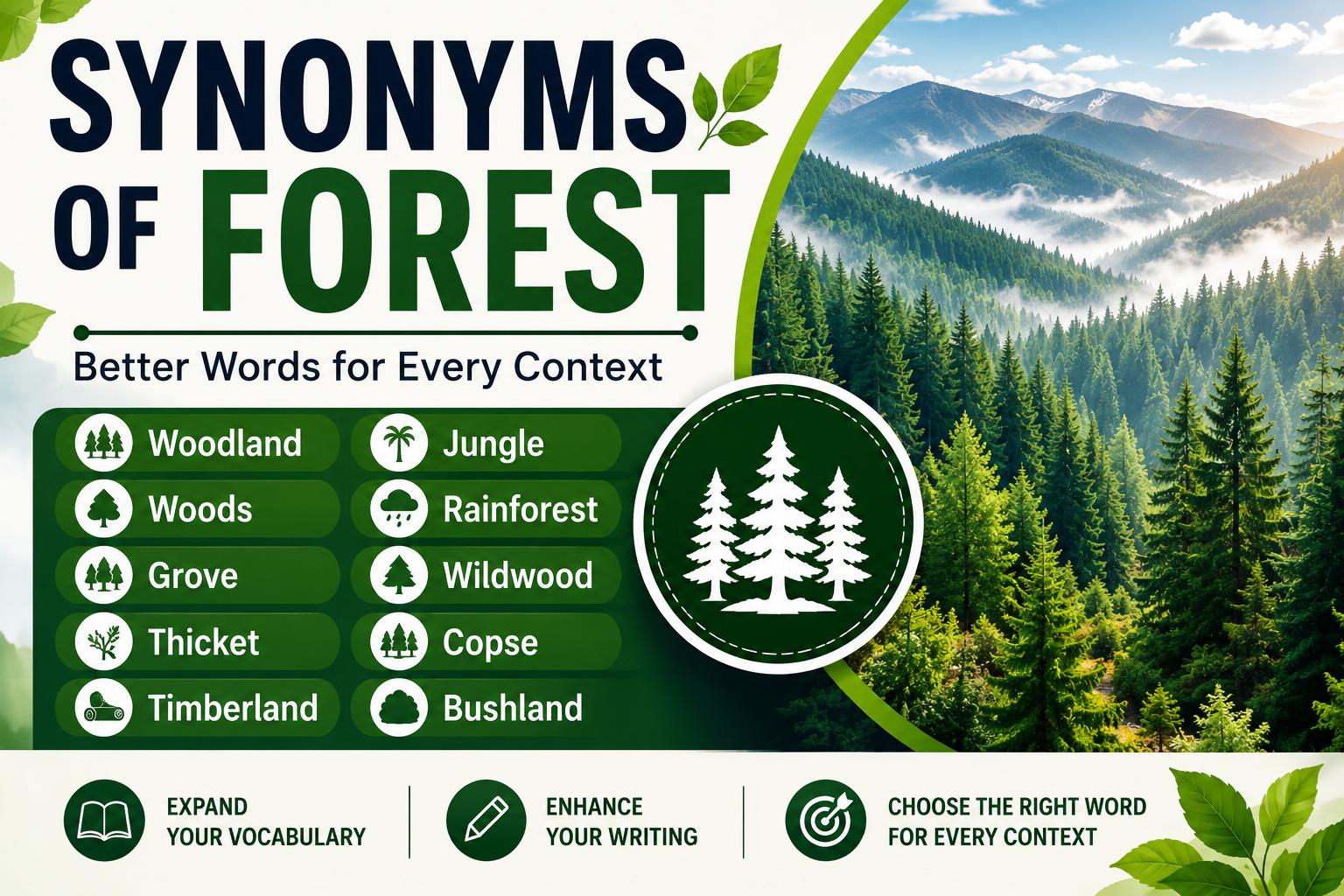
If you need another word for forest, the closest everyday alternatives are woods, woodland, and wood. However, these words are not always interchangeable. A grove usually means a small group of trees, a copse is a small wooded area, and a thicket emphasizes dense growth of shrubs or small trees. Other terms, such as rainforest, plantation, timberland, and forestland, describe particular kinds of wooded areas rather than serving as exact replacements for forest.
This guide separates direct synonyms from near synonyms and contextual alternatives so you can choose the word that actually fits your sentence.
Quick Answer
The closest synonyms of forest are woods, woodland, and wood. Depending on context, you can also use forestland, timberland, grove, copse, thicket, wildwood, and bushland. However, some alternatives describe a specific size, density, purpose, or type of forest rather than a forest in general.
What Does “Forest” Mean?
Forest is primarily a noun meaning a large area covered by trees and other vegetation, often including undergrowth. Merriam-Webster defines it as a dense growth of trees and underbrush covering a large tract.
Examples:
- We walked through the forest before sunset.
- The mountain is covered by dense forest.
- Several species live deep in the forest.
Forest can also be used attributively, as in forest fire, forest ecosystem, and forest management.
The word also has extended uses. English speakers can describe something as a forest of skyscrapers or a forest of microphones when many similar objects appear together in large numbers.
The Closest Synonyms of Forest
Not every word associated with trees is an exact synonym. The table below shows how the most useful alternatives differ.
| Word | Relationship | Formality | Best Context |
|---|---|---|---|
| Woods | Direct / very close | Neutral | Everyday English |
| Wood | Near synonym | Neutral | British English and literary contexts |
| Woodland | Near synonym | Neutral–formal | Land covered with trees |
| Forestland | Near synonym | Formal | Land-use and environmental contexts |
| Timberland | Contextual alternative | Neutral–formal | Land associated with timber |
| Grove | Contextual alternative | Neutral | Small group of trees |
| Copse | Contextual alternative | Literary/neutral | Small area of trees |
| Thicket | Contextual alternative | Neutral | Dense shrubs or small trees |
| Wildwood | Literary alternative | Literary | Untamed or natural woodland |
| Bushland | Contextual alternative | Regional | Areas dominated by bush and trees |
| Coppice | Contextual alternative | Specialized | Managed trees repeatedly cut for regrowth |
| Plantation | Contextual alternative | Neutral–formal | Deliberately planted trees |
| Rainforest | Specific type | Neutral | Tropical or other rainforests |
| Covert | Literary/contextual | Literary | A sheltered wooded area |
| Spinney | Contextual alternative | Regional/literary | Small wooded area, especially British English |
Collins lists wood, woods, woodland, bushland, plantation, rainforest, thicket, copse, and coppice among words associated with forest, while also distinguishing their more specific senses.
1. Woods
Woods is one of the most natural alternatives to forest, especially in everyday English.
Meaning:
A wooded area, often smaller or less formal-sounding than forest.
Example:
We spent the afternoon walking through the woods.
Best used when:
You are talking conversationally about a wooded area.
Forest vs. woods:
Forest often suggests a larger tract, while woods can sound more local, familiar, or informal. The distinction is not absolute, however; dictionaries treat woods as a synonym or near synonym of forest.
2. Woodland
Woodland refers to land that is substantially covered with trees.
Example:
The village is surrounded by beautiful woodland.
It is especially useful when you are emphasizing the land or habitat rather than simply naming a forest.
Merriam-Webster lists forest, wood(s), forestland, and timberland among related words for woodland.
3. Wood
Wood can refer to a wooded area and is particularly common in British English.
Example:
They followed a narrow path through the wood.
Be careful with context: wood also commonly means the material obtained from trees.
Compare:
- We walked through the wood. → wooded area
- The table is made of wood. → material
So wood can be a useful synonym for forest, but context determines the meaning.
4. Forestland
Forestland emphasizes land that is covered by or designated for forest.
Example:
The government is working to protect endangered forestland.
This word is more useful in environmental, geographical, conservation, and land-management writing than in casual conversation.
5. Timberland
Timberland refers to land covered with trees that are especially relevant to timber production.
Example:
The company manages thousands of acres of timberland.
It should not automatically replace forest. A natural forest can be described as timberland in some contexts, but timberland brings an additional association with commercially valuable timber.
6. Grove
A grove is generally a small group or cluster of trees, so it is not a full synonym for a large forest.
Example:
We rested beneath a grove of oak trees.
Use grove when the size or arrangement of the trees matters.
Merriam-Webster defines grove as a small group of trees.
7. Copse
A copse is a small group or area of trees, often smaller than what people normally imagine when they hear forest.
Example:
A small copse stood at the edge of the field.
It is useful in descriptive and literary writing, particularly when you want to distinguish a small wooded patch from a large forest.
8. Thicket
A thicket emphasizes dense, tangled vegetation, particularly shrubs and small trees.
Example:
The fox disappeared into a dense thicket.
A thicket is therefore not simply a smaller forest. Its defining idea is dense growth.
Collins describes thicket as a dense growth of small trees or shrubs.
9. Wildwood
Wildwood is a literary term for a natural or untamed wooded area.
Example:
The travelers disappeared into the ancient wildwood.
It has a more poetic tone than forest or woods, making it particularly suitable for fiction, fantasy, poetry, and descriptive writing.
10. Bushland
Bushland describes land dominated by bush, shrubs, and trees. It is especially associated with regional varieties of English, including Australian usage.
Example:
Kangaroos moved quietly through the surrounding bushland.
Because it has regional and ecological associations, it is not a universal replacement for forest.
11. Coppice
A coppice is a group or area of trees that are managed by periodically cutting them back so they can regrow.
Example:
The path runs alongside an old coppice.
This is a specialized term, so use it when the management or growth pattern of the trees is relevant.
12. Plantation
A plantation can refer to an area where trees have been deliberately planted, often for commercial purposes.
Example:
The surrounding plantation contains thousands of eucalyptus trees.
A plantation is not simply another word for a natural forest. The word highlights intentional planting and management.
13. Rainforest
A rainforest is a specific type of forest characterized by very high rainfall and particular ecological conditions.
Example:
Thousands of species live in the tropical rainforest.
It is therefore a type of forest, not a universal synonym.
14. Covert
Covert is a literary or somewhat specialized word for a sheltered wooded area, traditionally associated with cover for game.
Example:
The deer vanished into the covert.
It is uncommon in ordinary conversation, so forest, woodland, or woods will usually sound more natural.
15. Spinney
Spinney is a regional, especially British, term for a small wooded area.
Example:
A narrow path led through the old spinney.
It can add local or literary flavor, but it is much less common than woods or woodland.
Closest Synonyms vs. Contextual Alternatives
The most important distinction is that not every word associated with forest can replace it freely.
Closest replacements
Use these when you need a broadly similar meaning:
- woods
- wood
- woodland
- forestland
Words for smaller wooded areas
Use these when the area is smaller:
- grove
- copse
- spinney
Words emphasizing dense vegetation
Use:
- thicket
- brushwood
- bushland
These focus more on dense vegetation than on the broad concept of a forest.
Words describing specific forest types or uses
Use:
- rainforest — a particular ecological type
- plantation — deliberately planted trees
- timberland — land associated with timber
- coppice — managed tree growth
This distinction matters because replacing forest with one of these words can unintentionally change the meaning.
Which Word Should I Use?
Choose the word based on what you want to communicate.
Use “woods” when:
You want a natural, everyday alternative.
We spent the morning exploring the woods.
Use “woodland” when:
You want to emphasize land covered with trees.
The development could damage nearby woodland.
Use “grove” when:
You mean a relatively small group of trees.
They planted an olive grove.
Use “copse” when:
You want to describe a small wooded patch, especially in descriptive writing.
A copse bordered the meadow.
Use “thicket” when:
The vegetation is dense and difficult to move through.
The bird disappeared into the thicket.
Use “wildwood” when:
You want a poetic or literary tone.
Legends spoke of creatures living in the wildwood.
Use “plantation” when:
The trees have been deliberately planted or cultivated.
The region has extensive tea and tree plantations.
Forest vs. Woods vs. Woodland
These three words are often confused because they overlap considerably.
| Word | Typical emphasis | Example |
| Forest | A large wooded area | The forest stretches for miles. |
| Woods | A wooded area, often conversational | We walked through the woods. |
| Woodland | Land covered with trees | The project threatens local woodland. |
The boundaries are not rigid. In ordinary English, woods and forest can often refer to the same place. The choice may depend more on scale, regional preference, style, and context than on a strict rule. Merriam-Webster lists woodland and wood(s) among the principal synonyms of forest.
Forest vs. Grove
A forest generally refers to a large tract of wooded land, whereas a grove is a smaller group of trees.
Compare:
They explored a vast forest.
They rested beneath a small grove.
Calling a large forest a grove can make it sound much smaller than intended.
Forest vs. Thicket
A forest is defined broadly by its extensive tree cover. A thicket emphasizes dense, tangled growth, often involving shrubs or smaller trees.
Compare:
The hikers crossed the forest.
The hikers struggled through a dense thicket.
The second sentence tells the reader more about the density and difficulty of the vegetation.
Forest vs. Plantation
A forest can develop naturally or be managed, while a plantation specifically suggests trees that have been deliberately planted and cultivated.
Compare:
The region contains a large natural forest.
The region contains a commercial tree plantation.
Using plantation instead of forest can therefore introduce an important change in meaning.
Natural Collocations With “Forest”
Some common phrases with forest include:
- dense forest
- tropical forest
- rainforest
- ancient forest
- temperate forest
- forest ecosystem
- forest habitat
- forest floor
- forest fire
- forest cover
- forest management
- forest conservation
- forest wildlife
- forest resources
The best synonym depends on the phrase.
For example:
- forest ecosystem → natural and standard
- woodland ecosystem → also natural, with a slightly different emphasis
- forest floor → much more natural than woodland floor
- forest management → standard in environmental and forestry contexts
- woods management → possible in some contexts but much less conventional
This is why synonym selection should be based on collocation and meaning, not simply on whether two words appear in a thesaurus.
Common Mistakes With Forest Synonyms
Mistake 1: Treating every related word as an exact synonym
Words such as rainforest, plantation, grove, and thicket describe specific kinds or sizes of wooded areas.
Better approach:
Use them only when their additional meaning fits.
Mistake 2: Using “grove” for a huge forest
A grove normally suggests a small group of trees.
Better:
A small grove surrounded the farmhouse.
Mistake 3: Using “thicket” simply to mean forest
Thicket emphasizes dense, tangled growth.
Better:
Use thicket when the vegetation itself is dense or difficult to pass through.
Mistake 4: Assuming “timberland” means every forest
Timberland adds an association with timber production or commercially useful trees.
Better:
Use forestland when you simply mean land covered by forest.
Mistake 5: Overusing obscure alternatives
Words such as spinney, covert, and wildwood can be useful, but they are not always natural replacements in modern everyday English.
For most general writing, forest, woods, woodland, and wood are safer choices.
Synonyms of Forest for Different Writing Situations
Everyday English
- woods
- forest
- wood
Academic or professional writing
- forest
- woodland
- forestland
- timberland
Creative writing
- wildwood
- copse
- grove
- covert
- woodland
Environmental writing
- forest
- woodland
- forestland
- rainforest
- bushland
Describing dense vegetation
- thicket
- brushwood
- bushland
Antonyms of Forest
There is no single perfect antonym for forest, but depending on context, useful contrasts include:
- open land
- grassland
- clearing
- meadow
- desert
- barren land
A clearing is particularly useful when contrasting a forested area with an open space within or beside it.
After hours in the forest, they reached a sunny clearing.
FAQ About Synonyms of Forest
What is another word for forest?
The closest common alternatives are woods, wood, and woodland. The best choice depends on context and regional usage.
What is the closest synonym for forest?
Woods and woodland are among the closest alternatives. Wood can also function as a synonym, especially in British English.
What is a small forest called?
A small wooded area may be called a grove, copse, spinney, or wood, depending on its characteristics and regional usage.
Is “woods” the same as “forest”?
Often, yes. Both can describe areas covered with trees, although forest commonly suggests a larger tract while woods can sound more informal or local. The distinction is not absolute.
What is a formal synonym for forest?
Woodland and forestland can work well in formal writing. However, forest itself is completely appropriate in academic, professional, and scientific contexts.
What is a poetic word for forest?
Wildwood is a strongly literary choice. Woodland, copse, and covert can also create a more descriptive or literary tone.
Is “jungle” a synonym for forest?
Not exactly. A jungle usually refers to dense tropical vegetation and is a more specific term. A rainforest may contain jungle-like vegetation, but the two words are not interchangeable in every context.
What is the opposite of forest?
There is no universal one-word opposite. Depending on the context, clearing, grassland, meadow, open land, or barren land may provide a useful contrast.
Conclusion
The best synonyms of forest are not simply a long list of interchangeable words. Woods, wood, and woodland are the closest general alternatives, while grove, copse, thicket, wildwood, plantation, timberland, and rainforest add specific meanings.

Olivia Brown is a vocabulary expert and content writer who focuses on synonyms, antonyms, and word usage. She helps learners understand English words in a simple and practical way, making communication clearer and more effective