Positive Attitude Synonyms: Better Words & Phrases for Context
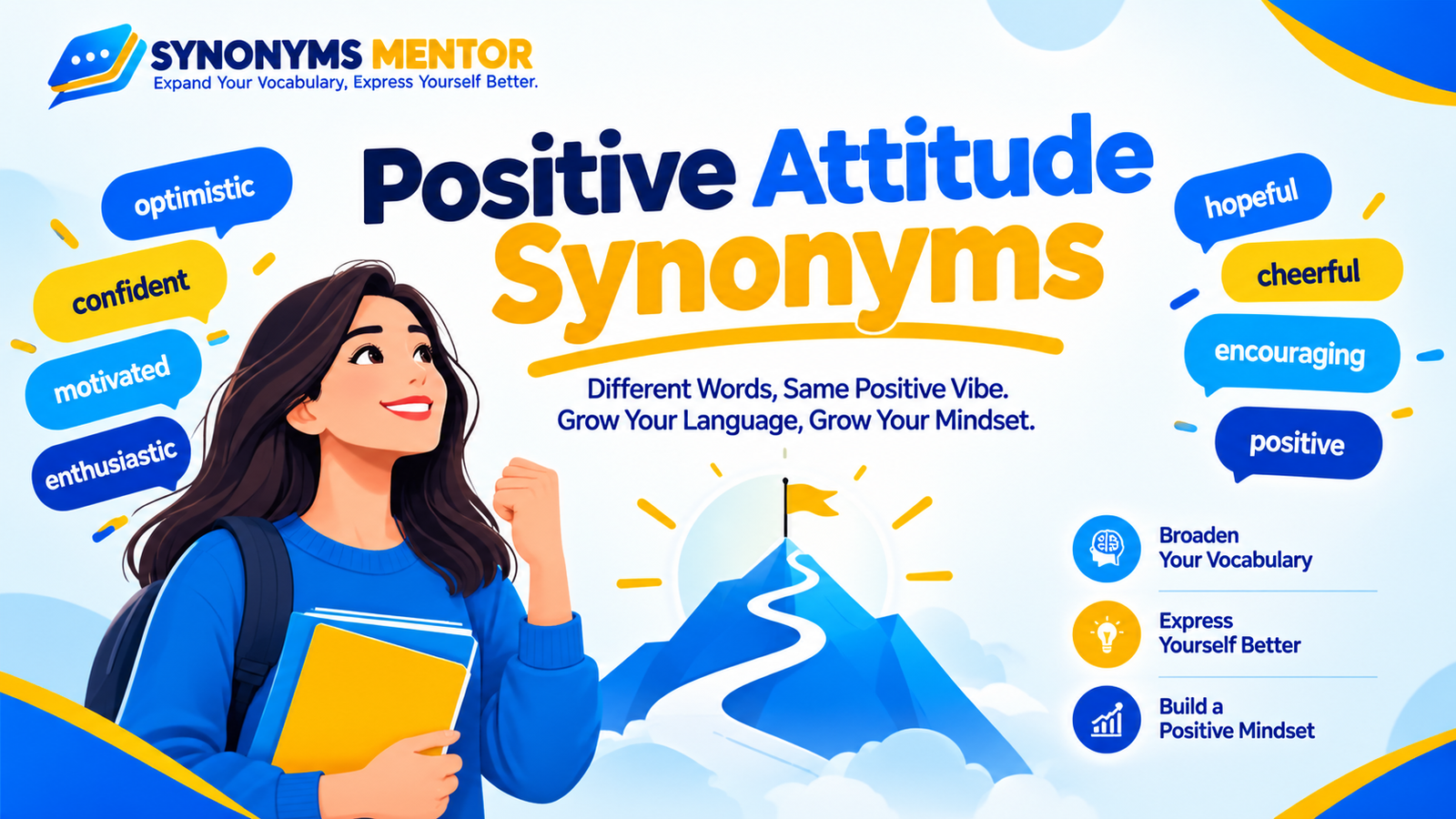
Looking for a better way to say positive attitude? The best alternative depends on what kind of positivity you want to express. Optimism emphasizes hope for the future, positivity describes a generally positive mental outlook, while upbeat attitude suggests cheerful energy.
Other expressions, such as constructive outlook or can-do attitude, add a stronger sense of action and problem-solving.
That distinction matters because not every positive-sounding word is a true synonym. Happiness, for example, describes an emotional state, while positive attitude describes a way of thinking and feeling that can influence behavior.
This guide focuses on natural, useful alternatives and explains when to use each one.
Quick Answer: What Are the Best Synonyms for Positive Attitude?
The closest alternatives to positive attitude include optimism, positivity, positive outlook, upbeat attitude, hopeful mindset, constructive outlook, and cheerful disposition. However, they are not interchangeable in every sentence.
Use optimism for confidence about favorable future outcomes, positivity for a general positive outlook, and constructive outlook when the emphasis is on responding productively to problems.
Core Positive Attitude Synonyms
| Word or phrase | Relationship | Main meaning | Best context | Formality |
|---|---|---|---|---|
| Optimism | Direct/near synonym | Expectation that things can turn out well | Future, challenges, life | Neutral |
| Positivity | Direct synonym | General tendency toward positive thinking | General attitude | Neutral |
| Positive outlook | Direct synonym | A favorable way of viewing situations | Life, work, future | Neutral |
| Upbeat attitude | Near synonym | Cheerful, energetic outlook | People, teams, everyday speech | Neutral |
| Hopeful mindset | Near synonym | Belief that a favorable outcome is possible | Challenges, future | Neutral |
| Constructive outlook | Contextual alternative | Focus on useful solutions and improvement | Work, problems, feedback | Professional |
| Cheerful disposition | Contextual alternative | Naturally happy and pleasant manner | Personality | Neutral/formal |
| Can-do attitude | Contextual alternative | Readiness to tackle difficulties | Work, projects, challenges | Informal/professional |
| Positive mindset | Near synonym | Habit of approaching situations positively | Personal development, education | Neutral |
| Encouraging attitude | Contextual alternative | Tendency to support or motivate others | Teams, teaching, relationships | Neutral |
| Confident outlook | Near synonym | Positive view based partly on self-belief | Work, performance, future | Neutral |
| Enthusiastic approach | Related/contextual | Energy and eagerness toward an activity | Work, projects, learning | Neutral |
| Resilient outlook | Related/contextual | Positive response despite setbacks | Adversity, work, education | Professional |
| Bright outlook | Near synonym | Hopeful, favorable view of life or circumstances | Life, future | Neutral |
| Good spirits | Contextual alternative | Cheerful emotional state | Casual conversation | Informal |
These distinctions matter because synonym resources often list broad associations alongside closer equivalents. For example, thesaurus-style results may include hopefulness, optimism, confidence, and cheerfulness, but those words emphasize different aspects of the broader idea.
What Does “Positive Attitude” Mean?
A positive attitude is a generally favorable, constructive, or hopeful way of thinking and feeling about a person, situation, activity, or future outcome.
The phrase is broader than simply being happy. Someone can have a positive attitude while facing a difficult situation because they remain hopeful, constructive, confident, or willing to look for solutions.
For example:
She maintained a positive attitude despite the difficult project.
This does not necessarily mean she was happy about the project. It means she approached the situation in a favorable or constructive way.
The American Psychological Association also uses positive attitude in a more specific psychological context involving feelings of acceptance and approval, illustrating why context matters when interpreting the phrase.
The Most Useful Synonyms Explained
1. Optimism
Meaning: A tendency to expect or anticipate favorable outcomes.
How it differs: Optimism is especially concerned with expectations about the future, whereas positive attitude can describe a broader approach to present situations.
Best contexts: Future plans, difficult circumstances, business, education, life.
Example:
Her optimism helped her remain confident about the project’s future.
Choose “optimism” when you want to emphasize hope that things will turn out well.
2. Positivity
Meaning: A generally positive way of thinking, responding, or behaving.
How it differs: This is one of the closest noun alternatives to positive attitude, but it can sound broader and more contemporary.
Best contexts: General conversation, personal development, workplace culture.
Example:
His positivity helped create a welcoming environment for the new team members.
Choose “positivity” when you mean a general quality of being positive.
3. Positive Outlook
Meaning: A favorable way of viewing circumstances or the future.
How it differs: Outlook focuses strongly on someone’s perspective, particularly how they view life or future possibilities.
Example:
She has a positive outlook on her career.
Choose “positive outlook” when you are describing someone’s general perspective on life, work, or the future.
4. Upbeat Attitude
Meaning: A cheerful, energetic, and positive approach.
How it differs: Upbeat adds an element of energy and cheerfulness that is not necessarily present in every positive attitude.
Example:
His upbeat attitude kept the team motivated during a demanding week.
Choose “upbeat attitude” when positivity is visible through someone’s lively manner.
5. Hopeful Mindset
Meaning: A way of thinking characterized by hope for a favorable result.
How it differs: Hopeful is narrower than positive. Someone may be positive about solving a problem without specifically expecting a particular outcome.
Example:
She approached the situation with a hopeful mindset.
Choose “hopeful mindset” when the emphasis is on possibility and future improvement.
6. Constructive Outlook
Meaning: A perspective focused on useful responses, solutions, or improvement.
How it differs: This expression adds a practical dimension. It is not simply about feeling positive; it suggests responding productively.
Example:
His constructive outlook helped the team turn criticism into practical improvements.
Choose “constructive outlook” for professional, academic, or problem-solving contexts.
7. Cheerful Disposition
Meaning: A naturally pleasant, happy, and cheerful temperament.
How it differs: Cheerful disposition describes personality more specifically than positive attitude.
Example:
Her cheerful disposition made her easy to work with.
Choose “cheerful disposition” when you are describing someone’s general personality rather than their approach to a particular problem.
8. Can-Do Attitude
Meaning: A confident willingness to attempt difficult tasks and find ways to accomplish them.
How it differs: This expression is more action-oriented than positive attitude.
Example:
His can-do attitude helped the team complete the project on schedule.
Choose “can-do attitude” when you want to emphasize willingness to act rather than simply maintaining positive thoughts.
Which Word Should You Use?
The easiest way to choose the right alternative is to identify what kind of positivity you mean.
Choose “optimism” when:
You expect a favorable future outcome.
Her optimism about the new business was impressive.
Choose “positivity” when:
You mean general positive thinking or behavior.
His positivity was noticeable throughout the meeting.
Choose “positive outlook” when:
You are describing someone’s overall perspective.
She has a positive outlook on life.
Choose “upbeat attitude” when:
The person is cheerful and energetic.
He brought an upbeat attitude to the team.
Choose “constructive outlook” when:
The person focuses on solutions and improvement.
She responded to the criticism with a constructive outlook.
Choose “can-do attitude” when:
The person is ready to take action and tackle challenges.
His can-do attitude made him a valuable member of the project team.
Choose “cheerful disposition” when:
You are describing someone’s personality.
Her cheerful disposition made conversations easy.
Positive Attitude Synonyms by Context
For Work and Professional Writing
The best choices are usually:
- constructive outlook
- solutions-focused approach
- can-do attitude
- positive outlook
- optimistic approach
- proactive attitude
- resilient outlook
Be careful with simply replacing positive attitude with enthusiasm. Enthusiasm means strong interest or eagerness, not necessarily optimism or constructive thinking.
For professional writing, a specific behavior is often stronger than a vague personality claim. For example:
Vague:
I have a positive attitude.
More specific:
I approach problems constructively and focus on practical solutions.
The second sentence tells the reader what the person actually does.
For Students and Education
Useful alternatives include:
- positive mindset
- hopeful outlook
- optimism
- growth-oriented mindset
- enthusiastic approach
- constructive attitude
Example:
Her positive mindset helped her remain engaged when the subject became difficult.
Here, positive mindset sounds more natural than highly formal alternatives.
For Personality
Use:
- cheerful disposition
- upbeat personality
- good spirits
- bright outlook
- positive outlook
- sunny disposition
Example:
He has an upbeat personality and enjoys working with others.
These expressions describe a person’s general manner rather than their response to one specific situation.
For Difficult Situations
Use:
- optimism
- resilience
- hopeful mindset
- constructive attitude
- can-do attitude
- determination
However, resilience and determination are not exact synonyms for positive attitude. They describe related qualities that become especially relevant when someone faces difficulty.
Positive Attitude vs. Optimism
| Feature | Positive attitude | Optimism |
|---|---|---|
| Core idea | Favorable way of thinking or responding | Expectation of favorable outcomes |
| Focus | Present situations and behavior | Future possibilities |
| Can involve action? | Yes | Sometimes |
| Example | “He approached the problem positively.” | “She is optimistic about the result.” |
Bottom line: Optimism is one important form of a positive attitude, but the two expressions are not identical.
Positive Attitude vs. Positivity
These are very close.
Positive attitude usually describes the way someone thinks, feels, or approaches something.
Positivity describes the broader quality or tendency of being positive.
Compare:
She has a positive attitude toward learning.
Her positivity encouraged the rest of the class.
Both are natural, but the second emphasizes the quality itself rather than the person’s attitude toward a particular subject.
Positive Attitude vs. Cheerfulness
Cheerfulness is mainly about being happy, bright, or pleasant in manner.
A person can be cheerful without being especially optimistic about the future.
For example:
He was cheerful during lunch.
This tells us about his mood or manner.
By contrast:
He maintained a positive attitude toward the difficult assignment.
This tells us how he approached a particular situation.
Positive Attitude vs. Confidence
Confidence means belief in one’s abilities, qualities, or judgment.
It can contribute to a positive attitude, but it is not synonymous with it.
She approached the presentation with confidence.
This emphasizes belief in her ability.
She approached the presentation with a positive attitude.
This emphasizes her favorable approach to the situation.
Common Mistakes When Choosing a Synonym
1. Treating “happy” as a perfect synonym
Happy describes an emotional state. A positive attitude is broader.
He was happy after receiving the news.
does not mean exactly the same thing as:
He maintained a positive attitude despite the news.
2. Using “enthusiasm” when you mean optimism
Enthusiasm means strong interest or eagerness.
Someone can be enthusiastic about a project without believing that everything will go well.
3. Using “confidence” when you mean positivity
Confidence is specifically related to self-belief or certainty. It does not necessarily imply a generally positive outlook.
4. Calling every positive emotion a synonym
Words such as joy, excitement, euphoria, delight, and happiness are related to positive emotional states, but they are not direct synonyms for positive attitude.
5. Using “can-do attitude” in every context
Can-do attitude is useful when willingness to act or tackle challenges is important. It can sound too informal or action-focused in contexts where you simply mean a favorable outlook.
Related Words That Are Not Exact Synonyms
Some words belong to the same semantic field but should not be presented as direct replacements:
- Happiness — a state of feeling happy
- Joy — intense or great happiness
- Enthusiasm — strong interest or eagerness
- Confidence — belief in one’s ability or judgment
- Resilience — ability to recover or adapt after difficulty
- Determination — firmness of purpose
- Motivation — reason or drive for acting
- Kindness — consideration toward others
- Friendliness — a warm or amicable manner
These words can describe aspects of a person who has a positive attitude, but they do not mean exactly the same thing.
Antonyms of Positive Attitude
The clearest opposites include:
- negative attitude
- pessimistic outlook
- defeatist attitude
- cynical outlook
- negative mindset
- gloomy outlook
- hopeless outlook
Again, context matters. Pessimism specifically concerns expectations about unfavorable outcomes, while a negative attitude can describe a broader unfavorable approach.
Frequently Asked Questions
What is the best synonym for positive attitude?
There is no single best synonym for every context. Positivity is one of the closest general alternatives, while optimism works well when the focus is on expecting good outcomes. For practical problem-solving, constructive outlook is more precise.
What is another word for a positive attitude at work?
Good professional alternatives include constructive outlook, positive outlook, solutions-focused approach, can-do attitude, and proactive attitude. Choose based on the behavior you want to emphasize rather than simply replacing the phrase mechanically.
What is a formal synonym for positive attitude?
Positive outlook, constructive outlook, and optimistic approach generally work well in formal writing. The best choice depends on whether you mean general positivity, practical problem-solving, or hope about future outcomes.
Is optimism the same as a positive attitude?
Not exactly. Optimism is a tendency to expect favorable outcomes, especially in the future. A positive attitude is broader and can include optimism, constructive thinking, confidence, encouragement, or a favorable approach to a situation.
Is “positive mindset” a synonym for “positive attitude”?
They are very close, but not identical. Positive mindset emphasizes a person’s habitual way of thinking, while positive attitude can refer to their approach toward a particular person, activity, or situation.
What is a good synonym for positive attitude on a resume?
Choose a phrase that describes an observable professional quality instead of relying on a vague label. Depending on the role, solutions-focused, constructive, proactive, adaptable, resilient, or collaborative may communicate something more specific. Career-oriented search results similarly emphasize concrete behavioral language over unsupported claims of positivity.
What is the difference between a positive attitude and a cheerful personality?
A positive attitude describes someone’s approach to situations, while a cheerful personality describes a person’s generally happy and pleasant manner. Someone can have a positive attitude during a difficult situation without appearing cheerful.
Conclusion
The best positive attitude synonyms are not interchangeable word-for-word. Optimism highlights hope for the future, positivity describes a general positive tendency, positive outlook emphasizes perspective, upbeat attitude adds cheerful energy, and constructive outlook emphasizes productive responses.
For the strongest vocabulary choice, start with the context rather than the thesaurus. Ask what you actually mean: hope, cheerfulness, confidence, action, resilience, or constructive thinking. Then choose the word that expresses that specific idea.

David Wilson is a content strategist and SEO expert who focuses on creating structured vocabulary content. He combines keyword research with simple explanations to make learning English both effective and search-friendly.