Synonyms for Starving: 15 Better Words With Examples
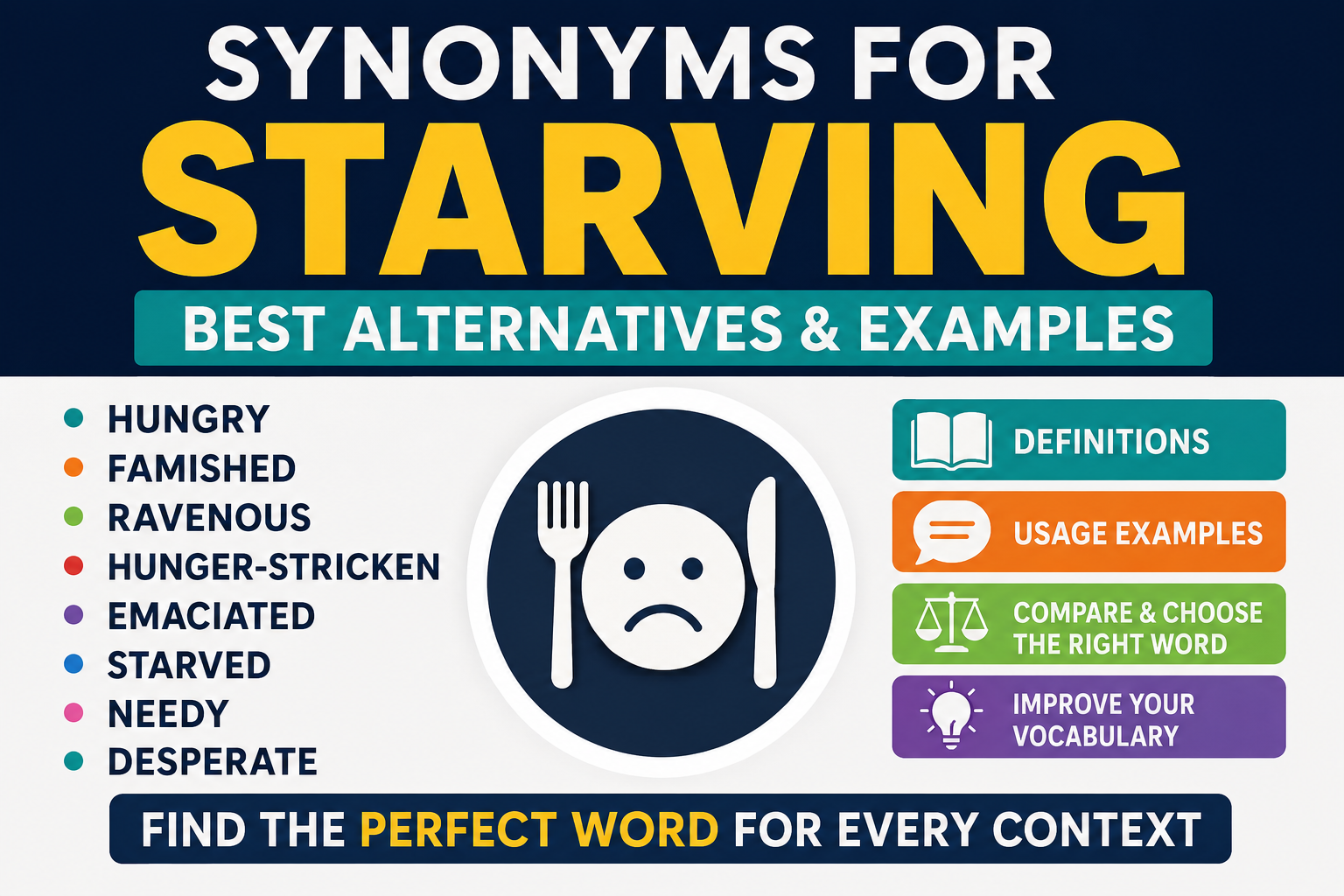
If you need a different way to say starving, the best choice depends on what you mean. For ordinary hunger, hungry is the most natural alternative. For stronger hunger, famished or ravenous works better. In informal conversation, expressions such as starved or I could eat a horse can add emphasis, while peckish usually describes a mild desire for food. If you mean literal deprivation of food rather than simply feeling hungry, words such as undernourished or malnourished describe a different situation.
Quick Answer: What Are the Best Synonyms for Starving?
The closest everyday synonyms for starving are hungry, famished, ravenous, and starved. However, they are not interchangeable in every situation. Hungry is neutral and general, famished and ravenous emphasize intense hunger, and starved is especially common in informal American English. For literal lack of food, starving can describe a much more serious condition than simply being hungry.
Best Synonyms for Starving at a Glance
| Word or phrase | Relationship | Meaning | Intensity | Register | Best context |
|---|---|---|---|---|---|
| Hungry | Direct synonym | Wanting or needing food | Moderate | Neutral | Everyday use |
| Famished | Direct/near synonym | Extremely hungry | Very strong | Informal/neutral | Everyday emphasis |
| Ravenous | Direct/near synonym | Extremely hungry | Very strong | Neutral | Strong hunger |
| Starved | Direct synonym in informal use | Very hungry | Strong | Informal | Especially common in US English |
| Very hungry | Phrase-level equivalent | Experiencing strong hunger | Strong | Neutral | Clear, simple writing |
| Peckish | Contextual alternative | Slightly hungry | Mild | Informal, chiefly UK | Small desire for food |
| Hangry | Contextual alternative | Hungry and irritable | Strong | Informal | Casual conversation |
| I could eat a horse | Idiomatic alternative | Extremely hungry | Very strong | Humorous/informal | Casual speech |
| Voracious | Contextual alternative | Having a very strong appetite | Strong | Neutral/formal | Eating habits |
| Wolfish | Contextual alternative | Extremely hungry or having a strong appetite | Strong | Literary/less common | Descriptive writing |
| Malnourished | Related, not exact synonym | Lacking adequate nutrition | — | Medical/formal | Health and nutrition contexts |
| Undernourished | Related, not exact synonym | Not receiving enough nourishment | — | Formal | Health and nutrition contexts |
| Empty | Contextual alternative | Having an empty-feeling stomach | Mild–moderate | Informal | Describing how you feel |
| Hungry for food | Phrase-level alternative | Wanting food | Moderate | Neutral | Clear explanatory writing |
| In need of food | Contextual alternative | Requiring nourishment | Variable | Formal | Literal situations |
The first four are the strongest everyday replacements. Major dictionaries consistently identify hungry, famished, ravenous, and starved as closely related to starving.
What Does “Starving” Mean?
Starving has two important food-related senses.
In ordinary informal conversation, starving means very hungry:
I’m starving. Let’s get something to eat.
Cambridge identifies this as an informal meaning of starving. It also distinguishes a more literal sense: being in serious need of food, potentially to the point of dying because there is not enough food.
This distinction matters because “I’m starving” is often casual exaggeration, while “starving families” can describe genuine food deprivation.
That is why not every synonym is appropriate in every sentence.
1. Hungry
Hungry is the safest and most general synonym for starving.
It simply means that you want or need food. Unlike starving, it does not automatically suggest extreme hunger.
Example:
I’m hungry, so I’ll make something to eat.
Choose “hungry” when:
- You want a neutral expression.
- The degree of hunger is not especially important.
- You are writing in a formal or straightforward style.
Strength: Moderate
2. Famished
Famished means extremely hungry and is stronger than ordinary hungry.
It is especially natural in everyday speech:
We were famished after the long journey.
Cambridge lists famished alongside starving and ravenous as a word describing strong hunger.
Choose “famished” when:
You want to emphasize that someone is very hungry without using the dramatic literal sense that starving can sometimes carry.
Strength: Very strong
3. Ravenous
Ravenous means extremely hungry or having an intense desire for food.
After the hike, everyone was ravenous.
It is a particularly useful alternative when you want a stronger, more vivid word than hungry. Cambridge and Collins both include ravenous among the principal synonyms of starving.
Choose “ravenous” when:
- You want to emphasize intense hunger.
- You are describing someone who wants a substantial meal.
- You want a vivid but widely understood adjective.
Strength: Very strong
4. Starved
Starved can function as an informal synonym for very hungry, particularly in American English.
I skipped breakfast, so I’m absolutely starved.
Cambridge labels this use as mainly US and informal.
However, starved also has a literal meaning connected with being deprived of food, so context matters.
Choose “starved” when:
The sentence is conversational and you mean very hungry.
Strength: Strong
5. Very Hungry
Sometimes the clearest synonym is simply the phrase very hungry.
We were very hungry after the long trip.
This is less vivid than famished or ravenous, but it is extremely clear and works well in educational and general writing.
Choose “very hungry” when:
You want maximum clarity rather than stylistic variety.
Strength: Strong
6. Peckish
Peckish means slightly hungry and is chiefly associated with British English.
I’m feeling a little peckish, so I’ll have a snack.
It is actually weaker than starving, making it useful when you want to describe hunger without implying urgency or intensity. Cambridge identifies peckish as a UK term.
Choose “peckish” when:
Someone wants a small amount of food rather than describing extreme hunger.
Strength: Mild
7. Hangry
Hangry is an informal blend of hungry and angry, describing a state in which hunger causes someone to become irritable or bad-tempered.
I need lunch before I get hangry.
The term is not a direct synonym for starving, since it adds an emotional element to the meaning. For that reason, hangry is better classified as a contextual alternative rather than a true synonym.
Choose “hangry” when:
The person’s hunger is affecting their mood or behavior.
Register: Very informal
8. “I Could Eat a Horse”
I could eat a horse is a humorous idiom meaning I am extremely hungry.
After the tournament, I could eat a horse.
Cambridge includes this expression among informal and humorous ways of expressing extreme hunger.
Choose this expression when:
You are writing dialogue or casual speech and want a playful exaggeration.
It should generally be avoided in formal or academic writing.
9. Voracious
Voracious can describe someone with an extremely strong appetite.
The children had a voracious appetite after their day outside.
It is related to starving but is not a direct replacement in every sentence. It often describes appetite or eating behavior, rather than simply someone’s current physical feeling of hunger.
Choose “voracious” when:
You are describing a strong appetite or a tendency to consume food eagerly.
Relationship: Contextual alternative
10. Wolfish
Wolfish can describe an intense or almost animal-like appetite.
He gave the meal a wolfish look.
This is much less common than hungry, famished, or ravenous, and it has a more literary or vivid quality.
Choose “wolfish” when:
You deliberately want descriptive or literary language.
Relationship: Contextual alternative
11. Empty
Empty can describe the sensation of an empty stomach:
My stomach feels empty.
It is not a direct synonym for starving, but it can work when the focus is on the physical sensation associated with hunger.
Choose “empty” when:
You are describing how hunger feels rather than simply naming the condition.
Relationship: Contextual alternative
12. Malnourished
Malnourished should not normally be used as a synonym for starving.
It refers to inadequate nutrition and can involve deficiencies or an insufficient intake of nutrients. Someone can be malnourished without currently saying they feel hungry.
For example:
The organization provided nutritional support to malnourished children.
This is a more serious and specific term than casual starving.
Relationship: Related word, not a direct synonym.
13. Undernourished
Undernourished is another related term describing insufficient nourishment.
The rescue team cared for several undernourished animals.
Like malnourished, it should not replace starving when you simply mean “very hungry.”
Relationship: Related word, not a direct synonym.
Which Word Should I Use?
The easiest way to choose is to consider how strong the hunger is and what exactly you are describing.
Choose “hungry” when:
You mean that someone wants food in a normal, neutral sense.
I’m hungry. Let’s eat.
Choose “famished” when:
You want to emphasize very strong hunger.
I’m famished after that long walk.
Choose “ravenous” when:
You want a vivid, strong word for intense hunger.
We were ravenous by the time dinner arrived.
Choose “starved” when:
You are speaking informally, especially in American English.
I’m absolutely starved.
Choose “peckish” when:
The hunger is mild, especially in British English.
I’m a little peckish.
Choose “hangry” when:
Hunger is making someone irritable.
I’m getting hangry; let’s take a break for food.
Choose “voracious” when:
You are describing someone’s appetite rather than simply saying they feel hungry.
He has a voracious appetite.
Starving vs. Hungry
Starving and hungry overlap, but they are not identical in intensity.
| Feature | Hungry | Starving |
|---|---|---|
| Basic meaning | Wanting food | Very hungry or lacking food |
| Intensity | General | Usually stronger |
| Register | Neutral | Informal when meaning “very hungry” |
| Literal deprivation | No | Yes, in another sense |
| Everyday use | Very common | Very common as an exaggeration |
Hungry is the broader and more neutral word. Starving usually creates a stronger impression of hunger when used conversationally. Cambridge specifically distinguishes the informal “very hungry” sense from the literal sense involving severe lack of food.
Starving vs. Famished
Both can describe very strong hunger.
Famished is generally a straightforward adjective meaning extremely hungry:
I was famished after the journey.
Starving can mean the same thing informally, but it can also describe genuine deprivation of food:
The community was starving because food supplies had run out.
So famished is often a useful choice when you mean intense hunger without invoking the literal deprivation sense.
Starving vs. Ravenous
Both express strong hunger, but ravenous is especially vivid.
I’m starving.
is a common casual statement.
I’m ravenous.
puts more emphasis on intense appetite or hunger.
For everyday conversation, either can work. For descriptive writing, ravenous can create a stronger image.
Natural Collocations With “Starving”
The meaning of starving becomes clearer when you look at the nouns and contexts it commonly modifies.
Starving + people
Aid was sent to starving families.
Here, starving can have a literal meaning involving severe lack of food.
Starving + animals
The abandoned animals were starving.
Again, this can describe genuine food deprivation.
“I’m starving”
I’m starving. Is dinner ready?
Here, the expression is informal and usually means “I’m very hungry.” Cambridge and Collins both document this everyday sense.
“Starving for” something
The verb starve can also be used figuratively with for:
The plants were starved for sunlight.
The audience was starved for new ideas.
This is a different construction and should not be confused with simply using starving to mean hungry. The verb starve can describe deprivation of something other than food.
Common Mistakes With Synonyms for Starving
1. Treating every related word as an exact synonym
Words such as malnourished, undernourished, voracious, and hangry are related to hunger but add different meanings.
2. Using “peckish” for extreme hunger
Peckish normally suggests mild hunger, so it is almost the opposite of the intensity conveyed by starving.
3. Using “voracious” to mean simply hungry
A person can have a voracious appetite, but voracious does not always describe the temporary feeling of hunger.
4. Using “malnourished” as a casual synonym
Being malnourished concerns inadequate nutrition. It is not simply another way to say “I haven’t eaten recently.”
5. Forgetting that “starving” has two important senses
“I’m starving” is usually an informal expression meaning “I’m very hungry,” while “starving families” can refer to people experiencing serious food deprivation.
Pronunciation of “Starving”
US: /ˈstɑːr.vɪŋ/
UK: /ˈstɑː.vɪŋ/
Cambridge lists these pronunciations for the adjective starving.
Related Words for Hunger
These words are useful for building a broader vocabulary around starving, but they do not all function as direct synonyms:
- hunger — the feeling or condition of needing food
- starvation — severe deprivation of food
- appetite — the desire to eat
- famished — extremely hungry
- ravenous — extremely hungry
- peckish — slightly hungry
- hangry — hungry and irritable
- voracious — having an extremely strong appetite
- malnourished — inadequately nourished
- undernourished — insufficiently nourished
The distinction between these terms is more useful than simply memorizing a long synonym list.
Antonyms of Starving
The appropriate opposite depends on the sense of starving.
For the everyday meaning very hungry, useful opposites include:
- full
- satisfied
- satiated
- sated
For example:
I was starving before dinner, but I felt completely satisfied afterward.
Cambridge and Merriam-Webster both list terms such as stuffed, full, satisfied, and satiated among opposites associated with hunger.
FAQ: Synonyms for Starving
What is the best synonym for starving?
The best general synonym is hungry, but it is weaker. For strong hunger, famished and ravenous are usually better choices. Starved is also common as an informal alternative, particularly in American English.
What is a stronger word than hungry?
Famished and ravenous are strong alternatives to hungry. They emphasize a much greater degree of hunger than the neutral word hungry.
Is “famished” the same as “starving”?
They can mean essentially the same thing when starving is used informally to mean “very hungry.” However, starving also has a literal sense involving severe lack of food, while famished generally emphasizes the person’s extreme hunger.
Is “ravenous” stronger than “hungry”?
Yes. Ravenous normally describes very strong hunger, whereas hungry can describe anything from a normal desire for food to a more noticeable need to eat.
What is a casual way to say “starving”?
In casual speech, you can say I’m starving, I’m absolutely famished, I’m ravenous, or I could eat a horse. The last expression is humorous and highly informal.
Is “peckish” the opposite of “starving”?
Not exactly, but the words express very different levels of hunger. Peckish usually means slightly hungry, whereas starving can mean extremely hungry in informal conversation.
Is “malnourished” a synonym for starving?
No. Malnourished describes inadequate nutrition and is more specific than simply being hungry. It should not normally be substituted for starving in an everyday sentence.
Conclusion
The best synonym for starving depends on the intended meaning and intensity. Use hungry for a neutral expression, famished or ravenous for intense hunger, starved for an informal alternative, and peckish for mild hunger. Words such as malnourished and undernourished are related to food deprivation but should not be treated as ordinary synonyms.

James Anderson is an English teacher and language researcher who creates easy synonym guides and vocabulary lessons. His goal is to help students and writers improve their language skills through simple and clear explanations.