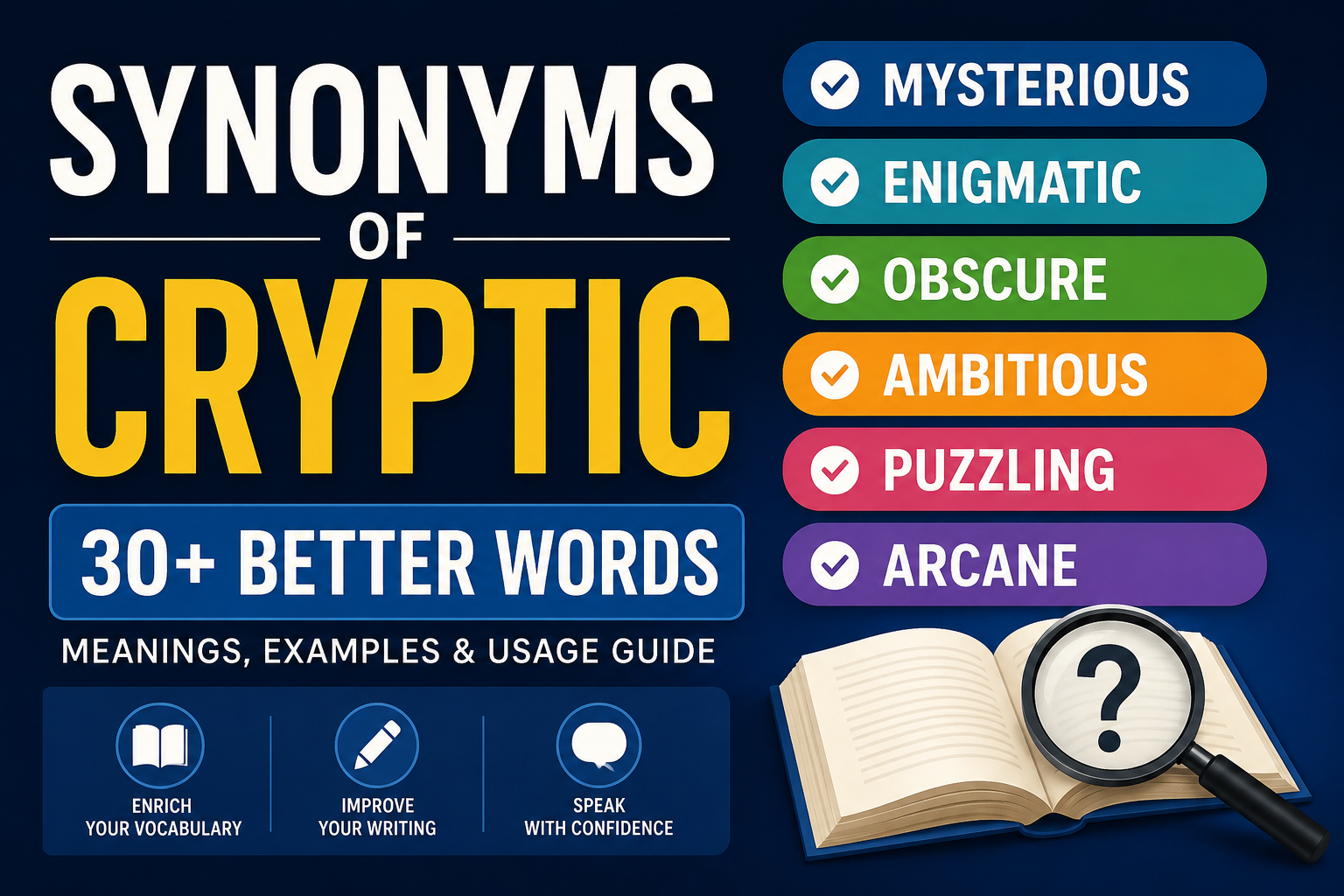
Synonyms of Cryptic: Meaning, Alternatives, and Examples
The best synonyms of cryptic include enigmatic, mysterious, puzzling, obscure, ambiguous, perplexing, inscrutable, and arcane, but they are not interchangeable in every sentence. Cryptic usually describes something whose meaning is hidden, deliberately concealed, or difficult to understand.
The most suitable alternative depends on why the meaning is difficult: it may be puzzling, unclear, open to multiple interpretations, or simply known only to specialists.
Choosing the right synonym therefore matters. A cryptic message may conceal its meaning, while an ambiguous statement may have several possible interpretations. An enigmatic smile is puzzling or mysterious, whereas an arcane text is difficult because it involves specialized or obscure knowledge.
This guide separates close synonyms from contextual alternatives so you can choose the word that actually fits your meaning.
Quick Answer
The closest synonyms of cryptic are enigmatic, mysterious, obscure, puzzling, and inscrutable. Enigmatic emphasizes something puzzling or mysterious; mysterious stresses unexplained qualities; obscure suggests hidden or unclear meaning; puzzling focuses on difficulty understanding something; and ambiguous is better when a statement has more than one possible interpretation.
What Does “Cryptic” Mean?
Cryptic is an adjective meaning mysterious, hidden in meaning, or difficult to understand.
For example:
- She sent me a cryptic message.
- His cryptic remark left everyone wondering what he meant.
- The report contained several cryptic references to the incident.
The central idea is not simply that something is unclear. Cryptic often suggests that the meaning is concealed rather than openly expressed. Merriam-Webster specifically distinguishes cryptic from related words by noting its implication of a purposely concealed meaning.
Cambridge similarly defines cryptic as mysterious and difficult to understand.
Part of Speech
Cryptic is an adjective.
Common patterns include:
- cryptic message
- cryptic remark
- cryptic clue
- cryptic response
- cryptic warning
- cryptic statement
- cryptic explanation
Oxford also records the specialized use of cryptic for crossword clues involving a particular kind of word puzzle.
Pronunciation
Cryptic
- US IPA: /ˈkrɪp.tɪk/
- UK IPA: /ˈkrɪp.tɪk/
The pronunciation is essentially the same in standard American and British English.
Etymology of “Cryptic”
Cryptic ultimately relates to Greek kryptós, meaning “hidden” or “secret,” through later Latin and Greek forms. This history fits the modern sense: something cryptic conceals or obscures its meaning. Merriam-Webster dates the first known English use of cryptic to 1620.
Core Synonyms of Cryptic
Not every word listed in a thesaurus is an equally good replacement. The table below distinguishes the closest choices from words that work mainly in particular contexts.
| Word | Relationship | Strength | Formality | Best Context |
|---|---|---|---|---|
| Enigmatic | Near synonym | Strong | Neutral–formal | People, expressions, events, messages |
| Mysterious | Near synonym | Strong | Neutral | Unknown or unexplained things |
| Obscure | Near synonym | Strong | Neutral–formal | Meaning, writing, references |
| Puzzling | Near synonym | Moderate | Neutral | Statements, events, behavior |
| Inscrutable | Near synonym | Very strong | Formal | People, motives, expressions |
| Ambiguous | Contextual alternative | Moderate | Neutral–formal | Language with multiple interpretations |
| Perplexing | Contextual alternative | Strong | Neutral–formal | Problems, situations, explanations |
| Vague | Contextual alternative | Moderate | Neutral | Imprecise or poorly expressed ideas |
| Arcane | Contextual alternative | Strong | Formal | Specialized or obscure knowledge |
| Esoteric | Contextual alternative | Strong | Formal | Specialized knowledge understood by few |
Merriam-Webster identifies ambiguous, dark, enigmatic, equivocal, obscure, and vague among the principal words related to cryptic, while Cambridge lists alternatives including puzzling, perplexing, mysterious, obscure, and ambiguous.
Closest Synonyms for Cryptic
1. Enigmatic
Meaning: Mysterious or difficult to understand.
How it differs: Enigmatic emphasizes the puzzling or mystifying quality of something. It does not necessarily imply that someone deliberately concealed the meaning.
Best used for: People, expressions, events, remarks, writing, and situations.
Example:
Her enigmatic smile made it impossible to tell what she was thinking.
This is one of the closest alternatives to cryptic. Merriam-Webster distinguishes the two by explaining that enigmatic stresses a puzzling, mystifying quality, while cryptic more strongly suggests concealed meaning.
2. Mysterious
Meaning: Difficult to explain, understand, or identify.
How it differs: Mysterious is broader and more common than cryptic. Something can be mysterious without containing a hidden message or deliberate concealment.
Best used for: Events, people, circumstances, sounds, objects, and unexplained behavior.
Example:
A mysterious package arrived at the office without a return address.
3. Obscure
Meaning: Not clear, easily understood, or readily known.
How it differs: Obscure can suggest that meaning is hidden by poor expression, lack of information, or limited knowledge. It does not necessarily imply deliberate concealment.
Best used for: Writing, references, meanings, facts, and literary passages.
Example:
The article makes an obscure reference to a little-known historical event.
Merriam-Webster specifically contrasts obscure with cryptic, explaining that obscure can imply veiled meaning through inadequate expression or withheld knowledge, whereas cryptic more strongly suggests purposeful concealment.
4. Puzzling
Meaning: Causing confusion because something is difficult to understand or explain.
How it differs: Puzzling focuses on the effect on the reader or listener rather than on hidden meaning.
Best used for: Statements, behavior, problems, decisions, and events.
Example:
His sudden decision to resign was puzzling to his colleagues.
5. Inscrutable
Meaning: Impossible or extremely difficult to understand or interpret.
How it differs: Inscrutable is stronger and more formal. It often describes a person’s motives, expression, or character when these cannot be understood.
Example:
The manager remained inscrutable throughout the negotiations.
Context-Specific Alternatives
For a Cryptic Message or Remark
Use:
- enigmatic — puzzling and mysterious
- ambiguous — capable of more than one interpretation
- obscure — difficult to understand
- vague — insufficiently precise
- puzzling — difficult to make sense of
He gave a cryptic answer.
Possible alternatives:
He gave an enigmatic answer.
He gave an ambiguous answer.
He gave a vague answer.
The nuance changes with each word.
For a Cryptic Person or Expression
Use:
- enigmatic
- inscrutable
- mysterious
- unreadable
She gave him a cryptic look.
Enigmatic or mysterious may sound more natural when the emphasis is on uncertainty about what the expression means.
For Specialized or Difficult Knowledge
Use:
- arcane
- esoteric
- obscure
The book contains cryptic references to medieval philosophy.
If the difficulty comes from specialized knowledge rather than deliberately hidden meaning, arcane or esoteric may be more accurate.
For Difficult Problems or Situations
Use:
- perplexing
- puzzling
- baffling
- mystifying
The cause of the error remains cryptic.
In ordinary prose, puzzling, perplexing, or mysterious may be more natural depending on the intended nuance.
Cryptic vs. Enigmatic
These two words overlap considerably.
Cryptic is preferable when something seems to conceal its meaning, especially a message, clue, remark, or statement.
Enigmatic is preferable when something is puzzling or mysterious, particularly a person, expression, event, or phenomenon.
Compare:
He sent a cryptic message about the meeting.
The wording seems intentionally concealed.
Her enigmatic expression revealed nothing.
The expression is mysterious and difficult to interpret.
This distinction is consistent with Merriam-Webster’s synonym guidance.
Cryptic vs. Mysterious
Mysterious is broader.
A mysterious disappearance is unexplained.
A cryptic message has meaning that is difficult to decipher or appears concealed.
So:
- mysterious → unexplained or strange
- cryptic → hidden, coded, or difficult to interpret
The disappearance was mysterious.
The suspect left a cryptic note.
Cryptic vs. Obscure
Obscure generally means difficult to understand, see, know, or recognize.
Cryptic is more suggestive of hidden meaning.
The author’s argument was obscure.
The argument was difficult to understand.
The author left a cryptic clue.
The clue appears to conceal its intended meaning.
Merriam-Webster treats these words as close synonyms but identifies this difference in emphasis.
Cryptic vs. Ambiguous
This distinction is especially important.
Ambiguous means that language can reasonably have more than one interpretation.
Cryptic means that the intended meaning is hidden or difficult to decipher.
The instructions were ambiguous.
There are multiple possible interpretations.
The instructions were cryptic.
The intended meaning was difficult to uncover.
A sentence can be both ambiguous and cryptic, but the words emphasize different problems.
Cryptic vs. Vague
Vague means lacking precision or clear boundaries.
Cryptic suggests concealed or difficult-to-decipher meaning.
His explanation was vague.
He did not provide enough specific information.
His explanation was cryptic.
He expressed himself in a way that was difficult to decipher.
Calling something cryptic therefore does not simply mean that it lacks detail.
Synonym Strength and Nuance
There is no scientifically fixed “strength scale” for synonyms, but this editorial comparison can help with word choice:
| Word | Approximate Effect | Main Nuance |
| Vague | Moderate | Not sufficiently precise |
| Puzzling | Moderate | Causes confusion |
| Ambiguous | Moderate | Allows multiple interpretations |
| Mysterious | Strong | Difficult to explain or understand |
| Obscure | Strong | Meaning is unclear or hidden |
| Cryptic | Strong | Meaning appears concealed |
| Enigmatic | Strong | Puzzling or mystifying |
| Perplexing | Strong | Creates considerable confusion |
| Inscrutable | Very strong | Extremely difficult to interpret |
These are practical writing distinctions, not objective numerical rankings.
Natural Collocations with “Cryptic”
Some common combinations are especially useful:
- cryptic message
- cryptic remark
- cryptic clue
- cryptic warning
- cryptic response
- cryptic statement
- cryptic comment
- cryptic smile
- cryptic expression
- cryptic reference
- cryptic instructions
- cryptic answer
- cryptic language
Oxford specifically records collocations including cryptic clue, cryptic comment, and cryptic crossword, illustrating how naturally the adjective combines with language and puzzle-related nouns.
Which Word Should I Use?
Choose the word according to the reason something is difficult to understand:
How to Choose the Right Word
Choose cryptic when the meaning seems deliberately hidden or concealed, while enigmatic is better for something puzzling, mysterious, or difficult to interpret. Mysterious works when something is unexplained, strange, or unknown, whereas obscure describes meaning that is unclear, hidden, or not readily understood. For statements with two or more possible interpretations, ambiguous is the more precise choice, while vague applies when a speaker or writer fails to provide sufficient detail or precision. Use puzzling for something that causes confusion or raises questions, and inscrutable when a person, expression, or motive is extremely difficult to understand. Finally, arcane is appropriate for information known or understood mainly by specialists.
Common Mistakes
Mistake 1: Treating “cryptic” as exactly the same as “ambiguous”
They overlap, but ambiguity specifically concerns multiple possible interpretations. Cryptic language may instead have one intended meaning that is simply difficult to uncover.
Mistake 2: Using “vague” for every cryptic statement
A vague statement lacks precision. A cryptic statement may be quite precise but deliberately difficult to decipher.
Mistake 3: Calling every mysterious event “cryptic”
A strange event can be mysterious without being cryptic. Cryptic works particularly well when there is language, symbolism, a clue, or another concealed meaning to interpret.
Mistake 4: Using “arcane” as a universal synonym
Arcane usually refers to knowledge or information that is obscure or understood by relatively few people. It is not a general replacement for cryptic.
Mistake 5: Assuming “enigmatic” means deliberately secret
Enigmatic emphasizes mystery or puzzlement. It does not necessarily imply that someone intentionally concealed information.
Real-World Examples
Workplace
The director sent a cryptic email about changes to the project.
Here, cryptic works because the email appears to contain a meaning that is not openly stated.
Academic Writing
The author’s reference to the earlier study is somewhat obscure.
Obscure is appropriate because the reference is difficult to understand or identify.
Everyday Conversation
His answer was so cryptic that I had no idea what he meant.
Cryptic naturally describes an answer that seems deliberately indirect or concealed.
Describing a Person
She remained enigmatic throughout the interview.
Enigmatic is more natural than cryptic when describing someone’s overall character or manner.
Multiple Interpretations
The wording of the policy is ambiguous.
Ambiguous is the precise choice when the wording permits more than one interpretation.
Antonyms of Cryptic
Depending on context, useful opposites include:
- clear
- explicit
- straightforward
- plain
- obvious
- unambiguous
- transparent
- understandable
The best antonym depends on what cryptic means in the sentence.
a cryptic explanation → a clear explanation
a cryptic message → an explicit message
a cryptic instruction → a straightforward instruction
a cryptic statement → an unambiguous statement
FAQ
What is another word for cryptic?
Common alternatives include enigmatic, mysterious, obscure, puzzling, inscrutable, and perplexing. The best choice depends on whether you mean hidden, mysterious, unclear, or confusing.
What is the closest synonym for cryptic?
Enigmatic is one of the closest general alternatives because both words can describe something mysterious and difficult to interpret. Cryptic, however, more strongly suggests concealed meaning.
What is a formal synonym for cryptic?
Inscrutable, enigmatic, obscure, arcane, and esoteric can sound more formal depending on context. They are not interchangeable, so choose according to the intended meaning.
What is the difference between cryptic and ambiguous?
Cryptic suggests hidden or difficult-to-decipher meaning, whereas ambiguous specifically describes language that allows more than one interpretation.
What is the difference between cryptic and mysterious?
Mysterious is broader and can describe anything unexplained or strange. Cryptic more often concerns concealed meaning, especially in messages, remarks, clues, or expressions.
What is the difference between cryptic and vague?
Vague means insufficiently precise or clearly expressed. Cryptic suggests that meaning is hidden or difficult to decipher.
What is the strongest synonym for cryptic?
There is no universally strongest synonym. Inscrutable can be stronger when something is exceptionally difficult to interpret, while enigmatic emphasizes mystery and arcane emphasizes specialized or obscure knowledge.
Is “cryptic” positive or negative?
Usually, cryptic is neutral to mildly negative when describing communication because it suggests unnecessary difficulty or concealment. In contexts such as puzzles, however, being cryptic can be intentional and desirable.
Conclusion
The best synonym for cryptic depends on the precise reason something is difficult to understand. Use enigmatic for something puzzling or mysterious, mysterious for something unexplained, obscure for unclear or hidden meaning, ambiguous for multiple interpretations, vague for insufficient precision, and inscrutable for something exceptionally difficult to interpret.

Our editorial team is dedicated to making English vocabulary easier to understand and use correctly. We research and review synonyms, antonyms, definitions, word usage, and example sentences to ensure our content is clear, accurate, practical, and useful for students, writers, professionals, and English learners.