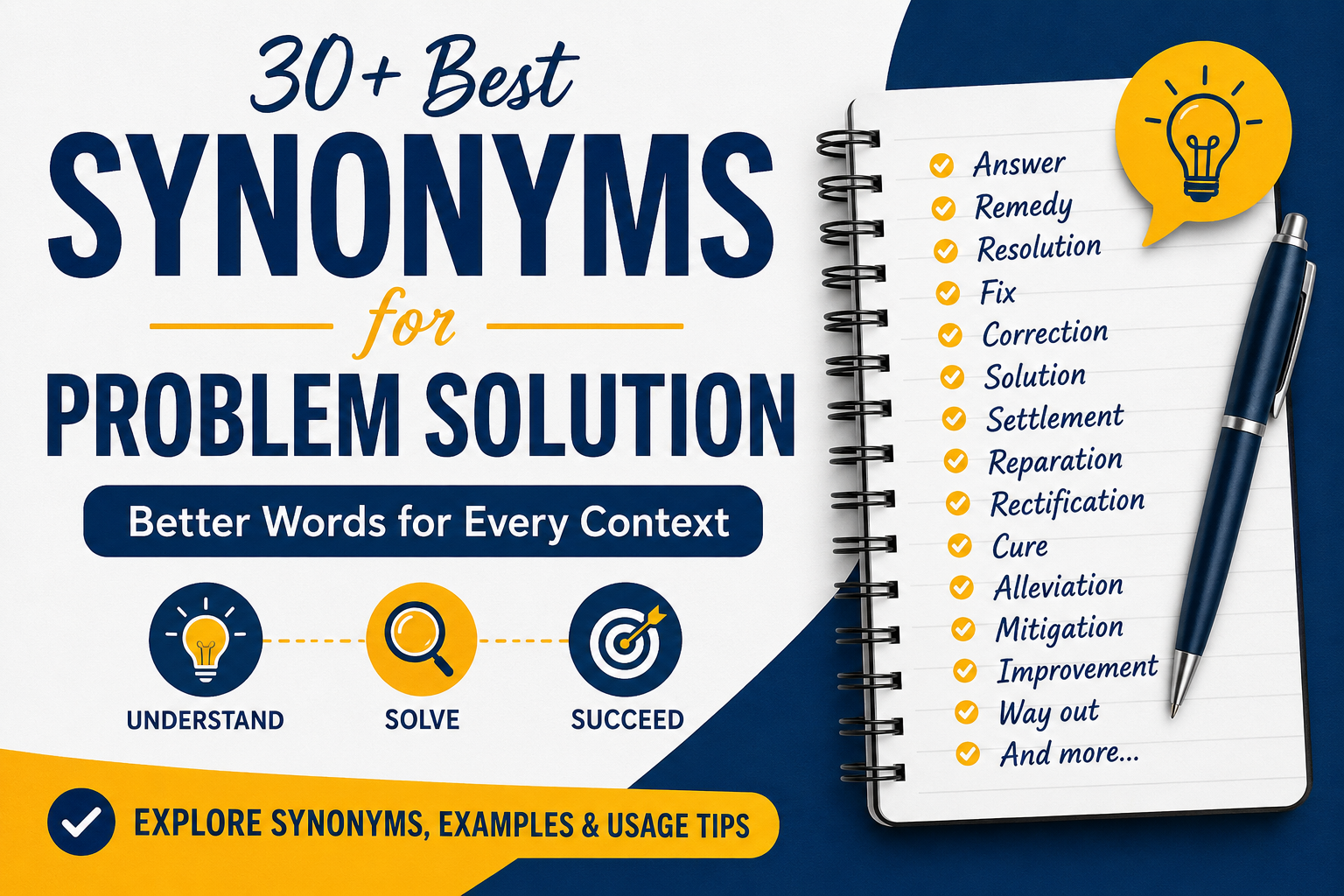
Problem-Solution Synonyms: Better Alternatives for Every Context
When you repeatedly use solution or problem-solving, the best replacement depends on exactly what you mean. Answer, resolution, remedy, fix, way out, workaround, approach, strategy, and corrective measure can all relate to solving a problem, but they are not interchangeable in every sentence.
This guide separates genuine synonyms from near synonyms and contextual alternatives, so you can choose the word that fits your meaning, tone, and situation.
Quick Answer
The closest synonyms for solution include answer, resolution, remedy, and fix. Answer works especially well for questions and problems with a definite result; resolution emphasizes settling an issue; remedy suggests correcting a problem; and fix is more informal.
Workaround, strategy, approach, and corrective measure are useful alternatives when you mean a particular method of dealing with a problem rather than the final solution.
What Does “Problem Solution” Mean?
Problem solution generally refers to an answer, method, action, or result that deals with a problem or difficult situation.
The noun solution is commonly used for a way of solving a problem or dealing with a difficult situation. Oxford also uses solution for answers to mathematical problems and puzzles, so the word has both general and specialized uses.
The word problem refers broadly to something difficult to deal with or understand.
So, depending on your sentence, you may be looking for:
- a direct synonym for solution
- a word describing the process of solving
- a word describing a method or plan
- a word describing a corrective action
- an expression for avoiding or managing a problem
That distinction matters because not every word associated with problem-solving is a true synonym of solution.
Best Problem-Solution Synonyms
| Word | Relationship | Strength | Formality | Best Context |
|---|---|---|---|---|
| Answer | Direct/near synonym | Strong | Neutral | Questions, puzzles, academic problems |
| Resolution | Near synonym | Strong | Formal/neutral | Disputes, conflicts, complex issues |
| Remedy | Near synonym | Strong | Formal | Correcting a problem or deficiency |
| Fix | Contextual alternative | Strong | Casual/neutral | Repairs, technical problems, everyday speech |
| Way out | Contextual alternative | Moderate | Casual/neutral | Difficult situations |
| Workaround | Contextual alternative | Moderate | Professional/technical | Bypassing a problem |
| Approach | Contextual alternative | Moderate | Neutral/formal | Methods of dealing with a problem |
| Strategy | Contextual alternative | Moderate | Neutral/formal | Planned problem-solving |
| Corrective measure | Contextual alternative | Strong | Formal | Business, policy, technical contexts |
| Countermeasure | Contextual alternative | Strong | Formal/technical | Responding to a threat or problem |
| Intervention | Contextual alternative | Moderate–strong | Formal | Active action intended to change a situation |
| Course of action | Contextual alternative | Moderate | Neutral/formal | Decisions and practical responses |
1. Answer
Answer is one of the closest alternatives to solution, particularly when a problem has a definite answer.
Use it for:
- questions
- puzzles
- mathematical problems
- straightforward practical problems
Example:
The answer to the technical problem was surprisingly simple.
However, answer is not always interchangeable with solution. A complicated social or political problem may have several possible solutions, while calling one of them an answer can sound less natural.
2. Resolution
Resolution emphasizes bringing a problem, disagreement, dispute, or conflict to an end.
It is especially natural in formal and professional English. Cambridge defines resolve as solving or ending a problem or difficulty, including disputes and differences.
Example:
Both sides are working toward a peaceful resolution to the dispute.
Best choice when: the problem involves conflict, disagreement, negotiation, or an issue that needs to be settled.
3. Remedy
Remedy means a way of dealing with or correcting a problem. It often suggests that something is wrong and needs to be improved or repaired.
Example:
The company introduced several remedies for the recurring quality problems.
It is particularly useful in:
- formal writing
- business
- law
- policy
- discussions of deficiencies
Remedy can also refer to medical treatment, so context determines its meaning.
4. Fix
Fix is a natural, everyday alternative to solution, especially when something needs repairing or correcting.
Example:
We need a quick fix for the software problem.
It is common in:
- conversation
- technology
- customer support
- informal workplace communication
Compared with solution, fix is generally more conversational and can sometimes imply a simple or immediate correction.
5. Way Out
Way out describes a method of escaping or getting through a difficult situation.
Example:
We need to find a way out of this financial crisis.
It is less formal than solution and works particularly well when the emphasis is on escaping a difficult situation.
6. Workaround
A workaround is not necessarily a complete solution. It is a method of bypassing a problem so that you can continue working.
Example:
The developers found a workaround while they investigated the underlying bug.
This distinction is important:
Solution: solves the problem.
Workaround: allows you to operate despite the problem.
Therefore, workaround should not be presented as a universal synonym for solution.
7. Approach
Approach refers to a way or method of dealing with a problem.
Example:
We need a different approach to the staffing problem.
An approach may eventually lead to a solution, but it is not necessarily the solution itself.
8. Strategy
Strategy emphasizes a planned method for dealing with a problem or achieving an objective.
Example:
The team developed a long-term strategy for reducing customer complaints.
Use strategy when planning and deliberate action are more important than the final answer.
9. Corrective Measure
Corrective measure is a formal expression for an action taken to correct an identified problem.
Example:
The company introduced corrective measures after the audit revealed several weaknesses.
This phrase works especially well in:
- business reports
- compliance documents
- technical writing
- quality management
- policy discussions
10. Countermeasure
A countermeasure is an action taken in response to a threat, risk, weakness, or undesirable situation.
Example:
The security team introduced new countermeasures against cyberattacks.
It is more specialized than solution and should be used when the response is specifically intended to counter a threat or adverse condition.
11. Intervention
An intervention is an action taken deliberately to influence or change a situation.
Example:
Early intervention prevented the disagreement from becoming more serious.
It is common in professional, governmental, educational, and technical contexts.
12. Course of Action
A course of action describes a particular option or set of actions chosen to address a problem.
Example:
The committee considered several possible courses of action.
Unlike solution, it does not necessarily imply that the chosen action will completely solve the problem.
Closest Synonyms vs Contextual Alternatives
A common mistake in synonym articles is to treat every related word as interchangeable. That is not how native English works.
Closest alternatives
These can replace solution in a meaningful number of contexts:
- answer
- resolution
- remedy
- fix
Contextual alternatives
These are useful when the meaning shifts slightly:
- way out
- workaround
- approach
- strategy
- corrective measure
- countermeasure
- intervention
- course of action
Related problem-solving words
These describe the process or ability of solving problems rather than the solution itself:
- problem-solving
- troubleshooting
- analysis
- diagnosis
- critical thinking
- brainstorming
- reasoning
Oxford defines problem-solving as the act of finding ways of dealing with problems and gives natural collocations such as problem-solving skills, approach, and technique.
Synonyms for “Problem-Solving”
If your intended meaning is problem-solving rather than solution, use words carefully.
Troubleshooting
Best for identifying and correcting technical or operational problems.
The IT department specializes in troubleshooting network failures.
Issue Resolution
A professional expression commonly used for handling and resolving workplace, customer, or technical issues.
The support team is responsible for issue resolution.
Problem Resolution
A formal phrase emphasizing the process of bringing a problem to a satisfactory end.
Effective problem resolution requires identifying the root cause.
Solution-Finding
Emphasizes the process of searching for solutions.
The workshop focused on creative solution-finding.
Analytical Thinking
This is related, not a direct synonym. It describes the mental process used to understand and evaluate problems.
Analytical thinking helped the team identify the source of the failure.
Which Word Should You Use?
Use answer when:
The problem has a definite or discoverable answer.
What is the answer to this equation?
Use resolution when:
You want to emphasize settling a dispute, conflict, or difficult issue.
The negotiations eventually produced a resolution.
Use remedy when:
You want to emphasize correcting something that is wrong.
The policy was introduced as a remedy for the problem.
Use fix when:
The language is conversational or the problem involves repair.
I think I’ve found a fix for the bug.
Use workaround when:
You are bypassing a problem rather than permanently eliminating its cause.
We have a workaround until the update is released.
Use approach when:
You mean a method of dealing with the problem.
We need a more practical approach.
Use strategy when:
The response involves planning and coordinated action.
The company developed a strategy to reduce costs.
Use corrective measure when:
You are writing formally about actions taken to correct a deficiency.
Management implemented corrective measures after the inspection.
Problem-Solution Synonyms by Context
Everyday English
Natural choices include:
- fix
- answer
- way out
- solution
We need to find a way out of this situation.
Professional Writing
Prefer:
- solution
- resolution
- remedy
- approach
- strategy
- corrective measure
The organization adopted a long-term strategy to address the issue.
Academic Writing
Useful choices include:
- solution
- answer
- approach
- method
- strategy
- resolution
Several approaches have been proposed to address the problem.
Avoid replacing solution with an unnecessarily complicated word merely to sound academic.
Technical Writing
Useful terms include:
- solution
- fix
- workaround
- remedy
- corrective measure
- troubleshooting
The latest software update provides a permanent fix for the error.
Business Communication
Strong choices include:
- solution
- resolution
- strategy
- approach
- course of action
- corrective measure
The management team agreed on a course of action.
Natural Collocations
Some expressions sound much more natural than others.
Common with “solution”
- find a solution
- provide a solution
- offer a solution
- develop a solution
- propose a solution
- implement a solution
- practical solution
- effective solution
- long-term solution
- permanent solution
- innovative solution
- simple solution
- viable solution
Oxford specifically records patterns such as propose, offer, provide, develop, seek, and look for a solution.
Common with “problem”
- solve a problem
- address a problem
- tackle a problem
- deal with a problem
- fix a problem
- resolve a problem
- identify a problem
- understand the problem
For example:
The team identified the problem before proposing a solution.
Common Mistakes
Mistake 1: Treating “strategy” as an exact synonym
A strategy is a plan for dealing with a problem, not necessarily the final solution.
Better:
We developed a strategy to address the problem.
Mistake 2: Using “workaround” to mean permanent solution
A workaround may only bypass the underlying problem.
Better:
The workaround keeps the system running until a permanent solution is available.
Mistake 3: Using “resolution” for every problem
Resolution is particularly natural for conflicts, disputes, disagreements, and issues that need to be settled.
Better:
The two parties reached a resolution.
For a broken printer, fix or solution is generally more natural.
Mistake 4: Assuming “remedy” always sounds better
Remedy has a formal, corrective flavor. It can sound unnatural in casual contexts.
We need a remedy for the problem.
is grammatical, but
We need a fix for the problem.
may sound more natural in everyday conversation.
Mistake 5: Using “answer” for every practical problem
Answer works especially well for questions, puzzles, and problems with a definite answer. For complex social or organizational problems, solution is often more natural.
Solution vs Resolution vs Remedy vs Fix
| Word | Key Idea | Typical Use |
| Solution | A way of solving a problem | General-purpose |
| Resolution | Bringing an issue or conflict to an end | Disputes, conflicts, formal issues |
| Remedy | Correcting or relieving a problem | Deficiencies, harm, legal/business contexts |
| Fix | Repairing or correcting something | Everyday and technical contexts |
These distinctions are supported by established dictionary usage: Cambridge treats resolution in the context of solving or ending difficulties, while remedy refers to a way of dealing with a problem or correcting something wrong.
Antonyms and Opposing Concepts
The most useful opposites depend on what aspect of solution you mean.
For a solved situation, relevant opposing concepts include:
- problem
- difficulty
- obstacle
- complication
- deadlock
- impasse
- failure
For problem-solving actions, opposing concepts can include:
- inaction
- neglect
- avoidance
- obstruction
- exacerbation
These are not all strict grammatical antonyms, but they help define the semantic boundaries of problem-solving vocabulary.
FAQ
What is another word for “solution”?
The closest alternatives include answer, resolution, remedy, and fix. The best choice depends on context. Answer suits questions and problems with definite results, while resolution is especially useful for conflicts and disputes.
What is the most formal synonym for “solution”?
Resolution, remedy, and corrective measure can sound more formal than solution, but they are not interchangeable in every context. Corrective measure is particularly suitable for formal business, technical, and policy writing.
What is a professional way to say “solution”?
You can use resolution, remedy, approach, strategy, corrective measure, or course of action, depending on the intended meaning.
Is “fix” a synonym for “solution”?
Yes, in many contexts, especially when something is being repaired or corrected. However, fix is generally more informal than solution and may imply a quick or practical correction.
Is “workaround” the same as “solution”?
No. A workaround bypasses a problem or allows something to function despite it. A solution generally addresses the problem itself.
What is another word for problem-solving?
Depending on context, alternatives include troubleshooting, issue resolution, problem resolution, and solution-finding. Words such as analysis and critical thinking are related concepts rather than direct synonyms.
What is the difference between a solution and a remedy?
A solution is a general way of solving a problem. A remedy emphasizes correcting, relieving, or improving something that is wrong. Remedy can therefore carry a stronger corrective sense.
What is the difference between a solution and a resolution?
A solution is a way of solving a problem. A resolution often emphasizes the successful settling or ending of a problem, disagreement, or conflict.
Conclusion
The best problem-solution synonym depends on what you actually want to express. Use solution as the broad, neutral choice; answer for questions and problems with definite results; resolution for disputes and issues that need to be settled; remedy for correcting a problem; and fix for everyday or technical repairs.

James Anderson is an English teacher and language researcher who creates easy synonym guides and vocabulary lessons. His goal is to help students and writers improve their language skills through simple and clear explanations.